
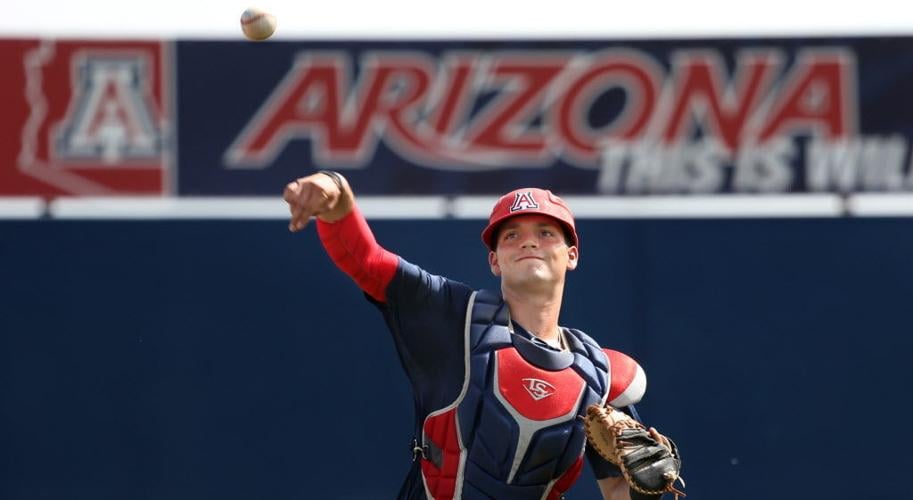
When the subject turns to freshman catcher Cesar Salazar, Arizona’s pitchers pay him the highest compliment:
He doesn’t seem like a freshman.
“The mind he has for baseball just comes naturally for him,” senior right-hander Nathan Bannister said. “I don’t know where he got it. We’re thankful that he has it.”
“If I had no knowledge of him being a freshman,” said sophomore lefty Cameron Ming, “I would think he’s a junior (or) senior. He’s got such a mature approach back there. I feel extremely confident throwing to him.”
In his first season as a Wildcat, Salazar has emerged as an indispensable defender, a tough out at the plate and a building block for the program. The Sahuaro High School graduate has started 21 of 28 games, has handled the pitching staff with aplomb and is batting .309 entering Arizona’s weekend series against Washington State.
People are also reading…
When he was a high school sophomore, Salazar practiced with Sahuaro grad Pat McCoy, who pitched for the Detroit Tigers in 2015. After their session, McCoy approached Sahuaro coach Mark Chandler.
“Wow,” McCoy told Chandler. “This kid could catch for me right now.”
UA coach Jay Johnson describes Salazar, 20, as “mature beyond his years” and says he has adjusted to the speed of college baseball as well as “any freshman catcher I’ve ever seen.”
Salazar arrived on campus that way. He grew up fast because he had no other choice. Life threw him a Clayton Kershaw curveball. The left-handed batter didn’t flinch.
Coming to America
Before we get to the series of events that nearly drove him away, here’s how Salazar got here:
At the age of 12, Salazar, a pudgy shortstop from Hermosillo, Mexico, began playing for Luis Valenzuela. Valenzuela ran a club team called the Nogales Roadrunners. He looked for players who fit a certain profile — good kids, responsible students, family-oriented — and Salazar satisfied those requirements. The Roadrunners would play in tournaments in Arizona and around the U.S.
In 2010, Valenzuela and his family moved to Tucson so his son, Luis III, could attend Salpointe Catholic. (Luis Valenzuela III is now an infielder for Vernon College in Wichita Falls, Texas.) Valenzuela continued to coach the Roadrunners. They were preparing for an upcoming tournament in Fort Myers, Florida, when they met some members of another travel team, the Tucson Cowboys. They included Vinnie Tarantola, who happened to play first base. The Roadrunners needed a first baseman. So they invited him to play in Fort Myers.
Tarantola became friends with Salazar and his teammate, Javier Medina. Salazar and Medina told Tarantola that they dreamed of moving to America to pursue baseball and a better education. Tarantola told his father, Anthony, who asked Valenzuela how that dream could become a reality.
A plan was formulated: Anthony Tarantola would become the legal guardian to Salazar and Medina. They would stay at the Tarantolas’ home, enroll at Sahuaro in January 2013 and play baseball with Vinnie and a new set of teammates.
“I was shocked,” Salazar said. “Me and my dad talked a lot about it. My mom didn’t want me to at the beginning. Then they met the (Tarantola) family. They’re a really good family, really good people. And it happened, thank God. It was the best thing that could have happened to me.”
If they were going to live in Anthony Tarantola’s house, Salazar and Medina had to live by his rules. They had to carry themselves with honor, integrity and respect. And they had to perform well in school.
“If you don’t get B’s,” Tarantola told them, “I don’t care if you’re Albert Pujols, you’re not playing.”
Salazar and Medina held up their end of the bargain. Circumstances beyond their control kept them off the field.
“An unfortunate situation”
Tarantola believed he had taken all the proper steps to ensure that Salazar and Medina would be able to play baseball for Sahuaro. The Arizona Interscholastic Association had a different interpretation.
The AIA ruled that Salazar and Medina were ineligible as sophomores in 2013. Given that they were transfer students — international ones at that — this wasn’t a huge surprise.
But then the AIA ruled they couldn’t play as juniors either. Frustration mounted. Salazar began to question his decision to come to America.
“There were times I was like, ‘What am I doing here? I’m here, and I’m not even playing,’ ” Salazar said. “I hung in there. My dad helped me a lot. Anthony, Vinnie and the family helped me a lot. I made the right choice about staying.”
Heading into their senior year, the situation seemed to be resolved. Salazar and Medina played in the first 18 games for Sahuaro. Salazar batted .613. Medina had a 4-0 record.
Then another ruling came down, from the AIA and the Tucson Unified School District. Salazar and Medina again were deemed ineligible. Chandler literally had to pull them off the field during warmups for a game against Sabino.
“It was one of my most difficult moments as a head coach,” Chandler said. “I had to tell them they were done. They were very emotional. But they handled themselves with dignity and grace. They finished their business at school. They looked at the bigger picture.
“It was one of those situations where adversity was going to make you stronger.”
Chandler still doesn’t fully understand why Salazar and Medina couldn’t play. Neither does Tarantola, although he has some ideas. He accused the AIA of making arbitrary rulings in response to parents’ complaints and said TUSD “has no backbone whatsoever.”
“It was their time to play; they should have played,” Tarantola said. “It’s an unfortunate situation that comes down to nothing more than jealousy and playing time.”
Current AIA bylaws state that foreign-exchange students can be eligible for one year of competition. Salazar and Medina were considered international students. Per bylaw 15.15.2, “An international student is eligible only for non-varsity level competition, which may include only 9th through 11th grade, and is not at any time of enrollment eligible for varsity level competition.”
Chandler and Tarantola contend that rules were changed during their battle with the AIA. David Hines, assistant executive director of the AIA, acknowledged that more restrictions were implemented in the past four to five years but couldn’t say precisely when.
Although disappointed and angry, Salazar tried not to think about the particulars of his plight. Asked this week to reflect on the ordeal, Salazar viewed it in a positive light.
“I think I grew up as a human being a lot due to that experience,” he said. “I became more mature. That helped me get tougher, too.
“That’s one of the biggest (reasons) I’m here. I overcame that adversity. Me and Javier overcame that adversity. It worked for us. We turned that bad thing into a really good thing.”
Salazar and Medina still had something to look forward to: Both had committed to the UA. Medina ended up being drafted by the Colorado Rockies in the third round; he’s now part of their minor-league system. Salazar considered turning pro but decided that college would better prepare him for baseball and whatever comes after it. As Valenzuela, who remains close to Salazar, put it, becoming a student-athlete at Arizona has allowed Salazar to “enjoy all those things he didn’t get to enjoy in high school.”
Putting in the work
After gaining clearance from the NCAA last summer — a lengthy but ultimately successful process — Salazar finally is playing for his school and with his classmates. His parents, Cesar and Patricia, make the four-hour drive from Hermosillo to attend Arizona’s weekend home games. Valenzuela is a constant presence as well.
It was Valenzuela who urged Salazar to change positions. Although he had quick feet and hands, Salazar didn’t possess the size or athleticism to become a major-league shortstop. If Salazar wanted to play in the big leagues, Valenzuela advised, he’d have to move to catcher.
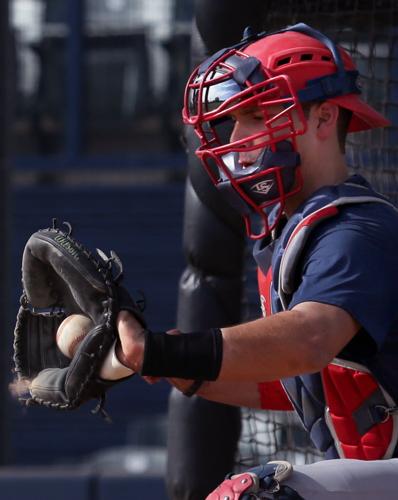
Catching proved challenging at first. But the more he succeeded, the more comfortable Salazar felt. He looks like a natural now, displaying a lightning release, soft hands and a superb ability to block balls in the dirt. (Arizona has 22 combined wild pitches and passed balls, second-fewest in the Pac-12.)
Salazar doesn’t consider himself to be a naturally gifted baseball player. He attributes his success to the work ethic he began honing at age 15, when he had a heart-to-heart with his dad and started to approach the game more seriously. The self-described “fat kid” got in better shape. No one would outwork him.
Tarantola had a batting cage in his backyard and said Salazar would spend countless hours in it sharpening his skills. He was dating a “very nice girl” back home during his senior year, according to Valenzuela. But when the coach asked Salazar about her, he told him they had broken up. Valenzuela wondered why.
“Coach, my mind doesn’t have the space right now for a girlfriend,” Salazar told him. “That is going to stall my development. I want to keep working toward my goals. I don’t want any distractions.”
Valenzuela and Salazar’s father had to explain to Cesar the value in taking the occasional day off to let his body rest and recover.
“He doesn’t believe in days off,” Valenzuela said. “He thought by having a day off he was losing ground.”
Salazar’s favorite player is Buster Posey, the superstar catcher for the San Francisco Giants. Salazar admires Posey’s work ethic, his humility, his clean-cut look and the gentlemanly way he carries himself on the field.
Posey is 6 feet 1 inch tall and 215 pounds. Salazar is listed at 5-9, 190. That’s undersized by big-league standards. Or, just another obstacle to surmount.
“I don’t try to think too much about that,” Salazar said. “Just work my butt off and overcome adversity. That’s basically what my whole life has been based off.”