

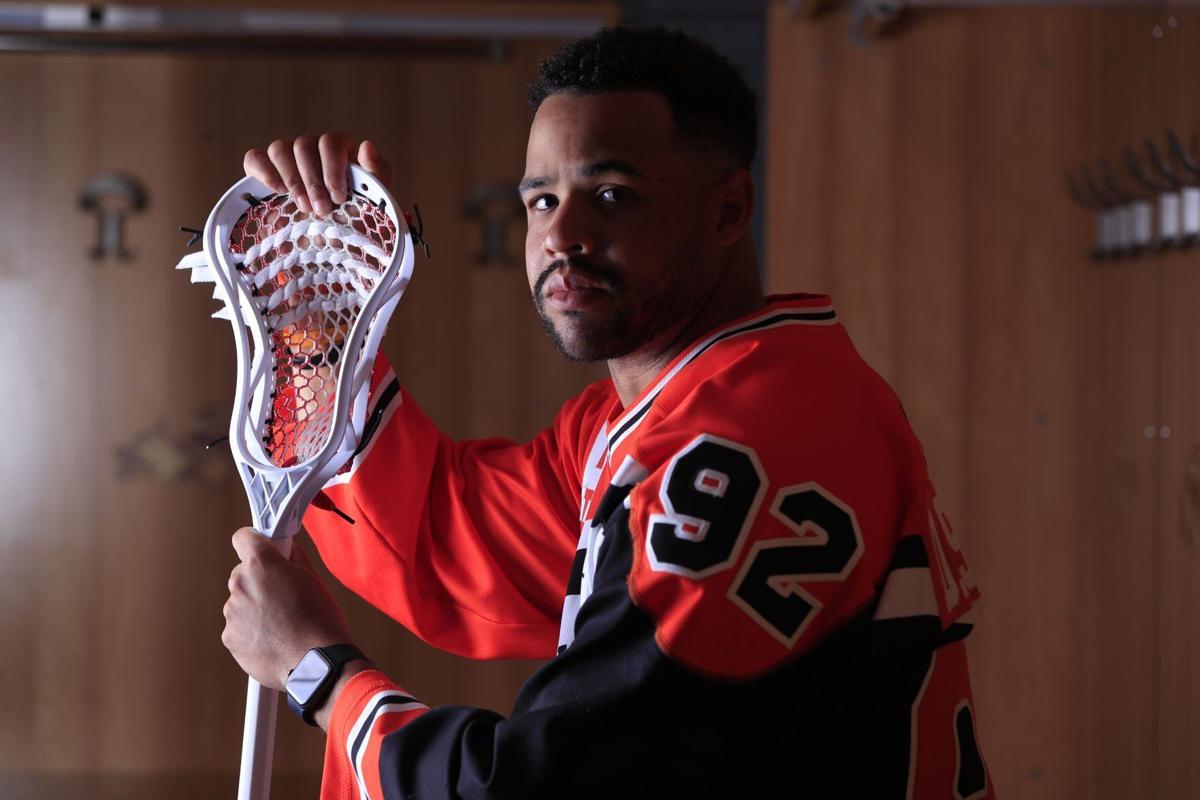
Dhane Smith just learned he’s the first black MVP in the history of the National Lacrosse League.
He won the award in 2016.
“It’s really something that’s kind of eye-opening now that you mention it,” Smith said during a recent interview with The Buffalo News. “I didn’t really think about it; I was just excited to win MVP. It definitely means a lot if that’s the case.”
The league, at the time, didn’t acknowledge the historical context of Smith’s accolade. Nor did his team, the Buffalo Bandits, nor did any media coverage, and so Smith, honored after authoring the greatest offensive season in league history, didn’t appreciate the full significance of the moment. He’s long viewed the award as an individual achievement tinged by disappointment after the Bandits reached the NLL Final, only to be swept by Saskatchewan in the best-of-3 series.
People are also reading…
Katie Lavin, the league's recently hired vice president of marketing, wrote in an email that the award “focuses on his contribution as a player and a teammate." Similarly, the league did not acknowledge at the time of their awards the ethnic backgrounds of the three indigenous players who have been named MVP.
But Smith’s honor represents far more than he ever imagined. It can serve as a beacon to recruit diverse players to the sport and help tell the broad story of black history and culture, according to Akilah Carter-Francique, an associate professor of African American studies at San Jose State University and the first black female executive director of the Institute for the Study of Sport, Society and Social Change.
“It’s important for black boys and black girls to see themselves represented in places that do not have representation, or have historically low representation, because certain spaces are often viewed as ‘acceptable’ sports for black people,” Carter-Francique said, citing basketball, football and track.
“So when we think of golf, when we think of swimming, when we think of NASCAR, you don’t see (many black athletes), so having a Tiger Woods is important. Having a Simone Manuel or Cullen Jones is important to get young black kids involved. Having a Bubba Wallace is important to have that visual representation and to have young people sort of see themselves in these other spaces.”
A classy gesture
Smith said he wasn’t sure he’d even win the MVP award, despite setting single-season league records with 72 goals and 137 points. But he prepared a brief speech, just in case, tapping out some thoughts on his phone before the awards ceremony in suburban Toronto.
After collecting the trophy, a large golden loving cup presented by Bandits legend John Tavares, a three-time MVP considered the “Wayne Gretzky” of box lacrosse, Smith concluded his remarks by reading the entire Bandits roster aloud and inviting each teammate in attendance to join him on stage.
“For him to recognize his teammates when he won an individual award says a lot about Dhane’s character,” said Tavares, now the Bandits coach who was inducted into the NLL Hall of Fame that same night. “Dhane puts the team first. I thought that was really classy on his part.”
But that’s the partial story, the external view.
For Smith, that phalanx of teammates also provided a shield.
“I was very nervous; I’m a shy person,” Smith said. “I remember thanking a lot of people. I remember thanking my coaches and making jokes about everything to kind of make it easier for myself, so people would kind of laugh.”
Smith, 28, has never much enjoyed being the center of attention. He was the only black player on his lacrosse and hockey teams as a kid growing up in Kitchener, Ontario, he said, and though his white teammates never made him feel any different, opponents and spectators were sure to remind him.
Smith tried to ignore the slurs and racial epithets, the trash talk that crossed the line, the taunts about monkeys and bananas that he and his younger brother endured. That was just a normal part of life. Sure, he could tell his coach. But it was always his word against another kid’s, at least until the one time an official overheard.
The teenage bigot was kicked out of the game, suspended from school and forced to write an apology letter, which Smith never accepted as genuine.
“You could tell that it was more his parents apologizing than he was,” Smith said, “and I remember going home and being like, ‘Mom, I don’t feel comfortable with this. I don’t think what he did was right. I don’t think he means this apology at all.’
“I felt like he just tried to do it to get out of it.”
Smith’s mom saved that letter in a scrapbook, alongside newspaper clippings and awards from throughout his athletic career.
He never understood why.
‘I Belong Here’
Smith couldn’t sleep, his mind fixated on the endless news coverage of Black Lives Matter protests in the aftermath of the killing of George Floyd in Minneapolis and an ongoing conversation with his parents.
“We were just texting back and forth about how it was hard growing up playing sports,” Smith said, which led to his mom sending him a photo of the letter.
“It means a lot to me now, seeing it.”
Smith wasn’t comfortable sharing the image or having his mom participate in this story. He didn’t even want to talk, at least not at first, declining an initial interview request.
But he’d made it clear he had something to say.
Two weeks ago, after being encouraged by his parents, Smith shared in a series of nine tweets a glimpse into his lifelong experience with racism, addressing not just the flagrant hatred he’s endured, but the stereotypes and ignorant comments he still hears to this day, like how he must be good at basketball or that he’s the “whitest black guy.”
“In some sense, he’s sort of suffering a little PTSD,” Carter-Francique said, “because I think he’s coming to understand, ‘I experienced overt and covert racism by teammates, by coaches, by families going on these different road trips.’ And when you’re the only one on the team and you speak up, you’re seen as angry or you’re disagreeable, and how do you deal with that as a young person?”
Smith took several days to craft those tweets.
“It was pretty sad for me to write,” he said, “just knowing I was young when a lot of this happened.”
He opened the missive with a photo of himself sitting on a weight bench, holding a makeshift cardboard sign inspired by the protests he'd seen on the news.
On it, he had scrawled “I Belong Here” in black marker.
Sometimes you gotta be comfortable being uncomfortable so here I am telling a bit of my story...Growing up BLACK is amazing but has NOT been easy. ✌🏾 1/9#BlackLivesMatter pic.twitter.com/qGmLOMgVG6
— Dhane Smith (@dhanesmith92) June 12, 2020
Several more days passed before he worked up the nerve to post it online.
“I felt like I had to share my story,” Smith said. “I know there’s probably tons of black kids out there that deal with the same kind of issues that I did, and for them to see that I went through the same things and I’m playing at the highest level, I’m hoping that helps them.”
‘The first and only’
Smith had yet to appreciate the magnitude of his achievements.
“He is the first and only black player to win the NLL MVP award,” Lavin wrote in an email.
Additionally, three indigenous players have been named MVP since the league’s inception in 1987: Jeff Shattler of the Calgary Roughnecks in 2011, Cody Jamieson of the Rochester Knighthawks in 2014 and Lyle Thompson of the Georgia Swarm in 2017.
Thompson was the target of derogatory remarks about his heritage during a game between his Georgia Swarm and the Philadelphia Wings in January 2019, which led to Philadelphia firing its public address announcer for shouting, “Let’s snip the ponytail right here!”
Lyle told the Buffalo News last year that he heard a couple of fans near the Georgia bench screaming for the Wings to “scalp” him and cut off his braid.
Indigenous players make up about 20% of NLL rosters, according to Sports Illustrated. There are far fewer black players.
Tavares said he’s proud of Smith’s decision to speak up about a sensitive and personal topic.
“I feel like I’m very similar to Dhane in personality,” Tavares said. “In the lacrosse world, that’s my home. This is what I am. This is what I was born to do. And outside of the lacrosse world, I’m just not as secure as a person. I’m not as confident. And I think maybe Dhane and I kind of share the same characteristics.
“That’s what made it extra special, to see him put himself out there on social media, telling people how he felt growing up and how he feels being a black lacrosse player.”
‘Color blind’
Smith estimates there are 10 to 15 black players among the NLL’s 13 teams, a figure the league said it couldn’t confirm, citing a lack of player-reported ethnic backgrounds.
The Canadian Lacrosse Association similarly said it was unable to provide such information because it does not ask Team Canada players to identify racial or ethnic backgrounds. A spokesperson noted that two teams comprised of indigenous athletes compete at the world championships, the Iroquois men’s national team and Haudenosaunee women’s national team.
U.S. Lacrosse reports that five of the 27 male athletes at its Fall Classic were black, and that of 23 players on the 2019 men’s indoor championship team, one was black and two were indigenous. At the youth level, of the 405,999 members who submitted their race as of February, 1.9% were black (7,887) and 0.54% were indigenous (2,193).
Lacrosse is among the least diverse sports in the college ranks, where 18% of NCAA Division I men’s lacrosse athletes were people of color and just 2.8% were black as of 2018, according to the NCAA's annual report.
Locally, Buffalo Public Schools fields one combined varsity lacrosse team, which represents City Honors and plays at Riverside. This year, it would have had a roster of 20 players. One is indigenous. One is black. Black students make up 46% of the city's public schools enrollment, according to state figures.
“To not acknowledge race sort of speaks to this notion of ‘color blind racism,’ if you will. ‘I don’t see color,’ ” Carter-Francique said. “That was a way of thinking like a decade ago, and it’s still sort of hung on, but we have to understand you need to recognize an individual for their fullness, embrace who they are as an individual. You’re black. You’re from Canada. Celebrate that, because that can raise up a young person that can see themselves in him.
“It supports the notion that we can be more than this or we can be more than that. Having Barack Obama become president showed, ‘Oh, so we can be presidents, too? Because I was told all I was good at was sports and entertaining.’ But now we know through these stories unfolding of hidden figures that black people were working with NASA. We are amazing pilots, when we talk about the Tuskegee Airmen. Those stories have to be told in their fullness, and especially to our young people, because they’re the next generation. They’re formulating their identities.”
Smith is still learning about himself and the path he’s traveled.
Four years ago, there was no mention of him becoming the NLL’s first black MVP – not in the press release from the league, not by the Bandits, not at the awards ceremony and not in media reports.
There are no photos or video easily found on the internet of Smith accepting the trophy. The league didn’t have an image. Neither did the Bandits. Neither did the Toronto Rock, which hosted the ceremony and had a staff photographer check his archives.
But Smith found a few photos buried deep in the camera roll on his phone.
One shows Tavares handing Smith the trophy. Another shows Smith calling his teammates to the stage. A third shows Smith and his mom standing side-by-side, smiling and clutching the cup.
After all these years, he finally understands why she kept the scrapbook.
Some moments are far more meaningful in retrospect.


