

Moonlight Graham died 49 years ago, but at 11:45 Wednesday morning I squinted through the sunlight and swore that I saw him walk into the Buffalo Wild Wings at the intersection of Broadway and Harrison.
He was with Pat Darcy, World Series pitcher for the 1975 Cincinnati Reds. When the bartender asked him to sign an old baseball, this is what he wrote:
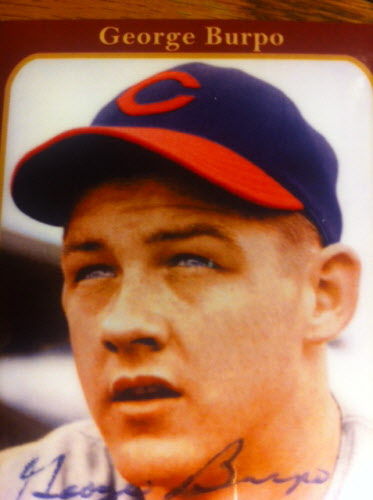
“George Burpo, Cincinnati Reds, 1946”
I was too polite to call him Moonlight. So I called him Mr. Burpo.
He handed me a baseball card from the ’46 season, and for a moment I could see him on the mound at St. Louis’ old Sportsman’s Park, 60 feet 6 inches from the immortal Stan Musial.
“I walked Musial,” he said. “I was wild, man was I wild.”
People are also reading…
Nobody has a baseball story like George Burpo, not even Moonlight Graham, the irresistible, real-life character Burt Lancaster made famous in the 1989 movie “Field of Dreams.”
Burpo got to “The Show” long enough to pitch in two games — June 9, 1946, against the Boston Braves, and on July 3, 1946, against the Cardinals, whose lineup that day included Musial, Joe Garagiola and Hall of Famers Enos Slaughter and Red Schoendienst.
Burpo’s arrival in the big leagues — and his very brief stay — is among the most improbable journeys in baseball history. He is Sunshine to Graham’s Moonlight.
“When I was 7 years old, living in the small coal-mining town of Jenkins, Kentucky, I knew I wanted to be a baseball player,” he says. “My dad, a railroad engineer, took me to one game at old Crosley Field in Cincinnati, and lo and behold, 17 years later, I was pitching on the same mound.”
Now 92, retired from a career as a business forms executive, Burpo has lived quietly in Tucson for more than 40 years. He pitched the first no-hitter for the Class C Tucson Cowboys of the old Arizona-Texas League. In 1940, he struck out 19 batters in a game at Hi Corbett Field. But that’s just baseball stuff. It’s the outside-the-lines part that makes Burpo’s story so captivating.
His idea of organized baseball was to pick up pebbles near the coal mine’s railroad tracks and throw them to his brother, who would attempt to hit them with a broomstick. He never played on a high school team or a town team or a little league team.
The break of Burpo’s life came in the late spring of 1939, when his high school football coach, a part-time scout for Cincinnati, told him the Reds were holding a 10-day tryout camp for 140 players in a town 100 miles away.
A week later, four remained. Burpo was the lone pitcher. The 16-year-old was dispatched to Crosley Field to pitch batting practice.
One of the players pulled him aside and said, “You’re as fast as anybody we’ve got.” At the end of the day, the Reds offered him $85 a month to pitch for Class C Muskogee (Oklahoma).
“You mean you’re going to pay me?” he asked, incredulous.
After walking 84 batters in 51 innings, the Reds assigned him to Tucson for the 1940 season. His wildness continued; he walked 73 in 59 innings. But his life forever changed one August day when he walked to a soda fountain on Congress Street and ordered the 75-cent luncheon special.
It was there he was introduced to Nancy Jean Riddell, a recent Tucson High School grad who just happened to be eating lunch at the same drugstore. Four days remained in the Cowboys season; Burpo and Riddell went to the movies every afternoon.
He then returned to Kentucky, spent a year pitching for Class A Birmingham, joined the Navy at the outbreak of World War II, and didn’t see or talk to Riddell again for three years.
His baseball career and his young romance appeared to be over. Several times he asked naval officials if they could please assign him to the aircraft carrier USS Hornet. His brother, Howard, served on the Hornet, and they wanted to be together.
In October 1942, Japanese torpedoes sank the Hornet.
He met Nancy again on a train ride from Oklahoma City to the naval base in San Diego, when the train stopped in Tucson for 20 minutes. At the depot, Nancy was waiting for a rushed reunion. They were married three years later, a union that lasted until her death in 2001.
Baseball? After the war, he resumed baseball at Cincinnati’s Class AAA affiliate in Syracuse, where he watched Jackie Robinson play. Burpo was then summoned to Crosley Field for his debut in June 1946. He pitched two games. Much like Moonlight Graham a generation earlier, Burpo’s big-league career was over almost as soon as it began.
A bum left shoulder forced Burpo to retire in 1948. He returned to Tucson, worked at J.C. Penney, and started a family (his son Robert ran unsuccessfully for governor of New Mexico in 2002).
At lunch Wednesday, Burpo pulled an old black and white photograph of Nancy from his shirt pocket.
“I got into baseball not knowing where it would lead,” he says. “I was never a star, but it didn’t matter. I’ve got this.”
He looked at Nancy’s picture and put it back in his pocket.
Home run.