
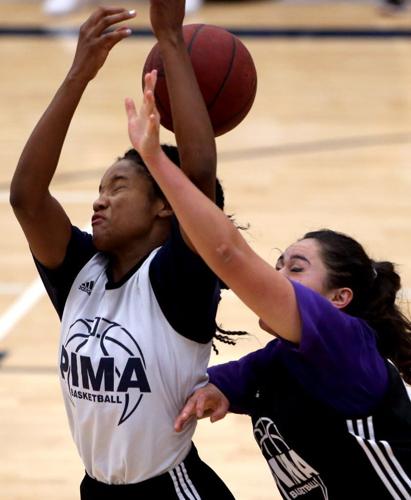
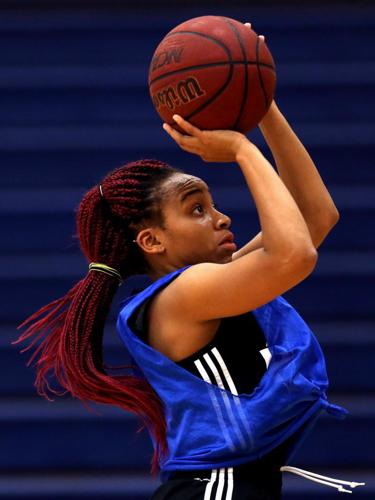
How do you build a basketball team around a cornerstone who isn’t even sure basketball is her best sport?
Pima College women’s basketball coach Todd Holthaus is about to find out.
His anchor is Shalise Fernander, a 5-foot-11-inch forward out of Flowing Wells High School, a returning third-team All-ACCAC and second-team All-Region I, Division II selection — and oh, yes, a track star, to boot.
She ranked in the top 12 in the league in 11 categories last season as a freshman, including points per game (10.9, 11th), rebounds per game (7.2, tied for 10th) and field-goal percentage (46.8, eighth). She became a freshman leader for the Aztecs, a key cog who far exceeded expectations.
Even — perhaps particularly — her own.
“Everything she did last year was kind of a pleasant surprise,” Holthaus said. “The thing that stood out about her was athleticism — she was much more known for track. I always just saw an athlete who liked to be coached. Even from last year to this year is unbelievable. She’s really fallen in love with basketball. There’s a spot in her heart that is really for basketball.”
People are also reading…
Normally, a coach wants there to be spots in all four chambers, in the lungs, knees, elbows, ears and toes, too. Pretty much everywhere.
But Holthaus knew what he got when he plucked Fernander from relative obscurity at Flowing Wells, a place very familiar to the Pima coach. A former head coach of the Caballeros, whose then-freshman team coach, Mike Perkins, is now head coach there, Holthaus understood that Fernander’s first love was her wheels.
She competes in the 400 meters and 1,600-meter relay for the Aztecs, and believes that track may just be her ticket out of here. She has always been fast — blazing.
Basketball was something she did — and she was good, a freshman on varsity who learned to take advantage of her speed and size — but track was who she was. Who she is, in fact, as she admits, “I’m kind of leaning toward running track after Pima, because I think I’m better at it than basketball.”
So there’s still some convincing to do. She says it took her a long time for her to feel comfortable on a basketball court.
“This year, honestly,” she said. “Last year, freshman year was a great learning experience. I fed off of the sophomores, and I was trying to get to know our strengths off the court. It was a new experience. This year, it’s all clicking for me — my leadership role, knowing what is important, how to go about it.”
Now she is tasked with grabbing the baton from last season’s star, Melody McLaughlin, and running with it.
She’s familiar with the task.
“As a freshman last year, I was a leader,” she said. “I don’t like to step into a situation and let it take its course on me. That helped me to become an even better leader this year, and I feel like a lot of sophomores on this team were the same way. It was a natural thing for us.”
Added Holthaus, “The torch being passed always helps. We’ve always had a sophomore who stood out, but a freshman in the background who has had to take that torch. You hope you get the same or more from Shalise and then fill out the rest of the puzzle. If you have a corner piece, you build the team around it.”
Funny thing, though: Fernander is still in the construction phase, too.
She took up the sport in the fourth grade — Chad Miller, principal at Hendricks Elementary School, saw her height at the age of 10 and made an exception to the rule that allowed just fifth- and sixth-graders to play — but she says now she is a work in progress. Holthaus believes she is packed with potential.
“When you have juco kids, only two years, there is not a four-year process to build someone,” he said. “There has to be a quick transition from freshman year to sophomore year — it’s like going from freshman year straight to a senior. You’re kinda the baby-sis freshman year and the big-sister sophomore year.”
That’s the goal at least.
One of many, for Fernander.
For now, a big season in the gym, and then another one on the track.
Then, a scholarship at a four-year school, in one sport or the other. Then, who knows?
“Being a runner in general, I’ve always been told I have so much potential,” she said. “I believe that. When I work out, I know I work harder, and I’m up there with the guys, and they feel threatened by me, like, ‘I’m not gonna let a girl beat me.’ I believe if I were to go a D-I school for track, my goal would be to get to the Olympics. That’s a bigger deal. In basketball, so you go D-I, then what? You’re gonna go to WNBA? That’s not likely. You’re pretty much gonna be done with basketball. With track, there’s something I’d be going for after four years.”
Holthaus hears her. He is not jamming basketball down her throat. He doesn’t sneak onto the track to tie her laces when she’s down on the block.
“I’m gonna put her out there, market her to the four-year schools as if she was just playing basketball. If she gets opportunities in track and basketball, at least she has options to get school paid for,” he said. “I have four kids of my own; I don’t want to tell them what they have to do. If she chooses to play basketball somewhere, I’ll be tickled to death. If it’s track, I’ll be tickled to death. In my heart, I hope it is basketball.”