

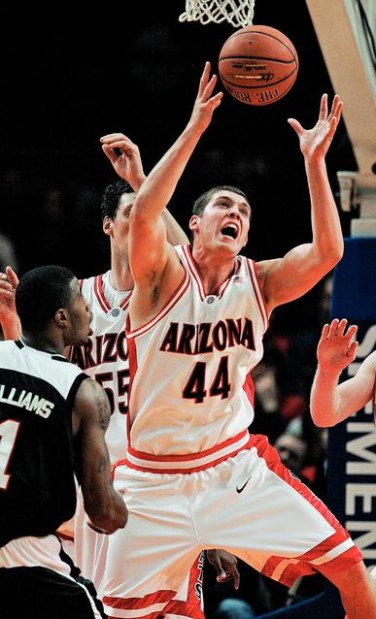
The 10 points and eight rebounds Bret Brielmaier had in the first round of last year's NCAA tournament did not show definitively that he had transcended the traditional role of the Arizona walk-on player.
Neither did the five rebounds he had against Kansas in Maui, nor all the non-statistical things the junior forward from Mankato, Minn., is known for: defending, screening and playing tough but intelligent basketball.
Brielmaier had really arrived when, while sitting out seven games with a knee injury last month, UA coach Lute Olson began talking about what a relief it would be to have him back in the playing rotation.
He mattered. A lot.
"I don't think we've ever had a walk-on who would be considered in the top seven guys on the team,'' Olson said. "In basketball, it's unusual to get a walk-on that becomes as important as Bret is to us."
People are also reading…
Three years ago, when Brielmaier was sifting through 40 mid-major and Division II offers, he was not sure he could matter at a high-major Division I school. But he knew he had to try.
Brielmaier was a star center at Loyola High School in Mankato, but at 6 feet 6 inches, he faced questions over whether he could play the post in an elite college program. Worse, Loyola played in Class A, the lowest level in a low-profile basketball recruiting state.
"We only have one Division I team here, the University of Minnesota, and if you don't get recruited by them, they label you as not good enough," said Dan Ireland, who coached Brielmaier at Loyola. In addition, Ireland said, Brielmaier "never got to play against other good big kids because there weren't many here. He wasn't getting pushed in practice, but you could just see how great an athlete he was."
Thanks to a little molding, Mark and Michele Brielmaier had long beforehand seen a powerful toughness and competitive streak in their son, too.
"The first time we ever played catch, I threw the ball at him, he put his glove up, and it hit him in the nose," Mark Brielmaier said. "He ran into his mother crying, threw his glove on the ground and said, 'I'll never do this again.' His mother patted him on the back and said, 'Go play catch with your dad.' He came back, and he's been fine ever since."
So when Bret began disregarding that pile of paid scholarship offers in favor of a sniff from Arizona, his parents knew better than to say no. Besides, they had told Bret and older son Ben, a standout football player at Princeton, that they could go wherever they wanted as long as they agreed to help financially.
"He loved the atmosphere and, quite frankly, he loved the challenge to see if he could play with these guys," Mark Brielmaier said. "He said, 'I could have scored 20 points a game at a D-II school, but I'll never know how good I could have been unless I played with the best.' "
The unique combination of Brielmaier's willingness to aim high, his undersized body and his lack of exposure made him a rare find for Arizona.
"It doesn't happen an awful lot in basketball because you get a chance to see players quite a bit" in recruiting events, Olson said. "Whereas in football, you may get somebody who's just not seen a whole lot."
Brielmaier became known to UA coaches only after a Mankato-based friend of UA assistant coach Josh Pastner told him that the "best post player in southern Minnesota" wanted a shot at the big time.
Pastner asked Brielmaier to send tapes and, before long, Brielmaier was sitting down with Olson and associate head coach Jim Rosborough getting the standard no-guarantee lecture about being a walk-on.
"Plain and simple, they said: 'You may never see the floor, or you may,'" Brielmaier said. "It was hard to accept that, being an all right high school player and having all these opportunities. But I wanted to take a shot at the top."
Brielmaier knew almost immediately he had made the right decision. He did not break into the playing rotation as a freshman in 2004-05 but showed enough promise to earn double-digit minutes in three games and a scholarship for the second semester.
Brielmaier was taken back off scholarship last season because of the UA's full roster, then given one this season when the Wildcats fell short of the 13-scholarship limit.
Ironically, now that he is the first post player off the bench, Brielmaier might be paying his own way again next season. Arizona already has eight scholarship players returning — if center Kirk Walters receives a medical redshirt — and five incoming freshmen next season to account for the maximum of 13.
Not that any of that matters, except for the $24,000 in out-of-state tuition and living costs Mark and Michele might have to pay. Bret Brielmaier says he has never been treated any differently than any other player, and his coaches don't see why he should be.
"You can't look him as being a walk-on," Pastner said. Holding a scholarship "means nothing once you're on the floor. He's a good basketball player who is helping us. We're very, very fortunate to have him."


