

Jackie Robinson broke baseball’s big-league color barrier 75 years ago today. Major League Baseball retired his No. 42 on the 50th anniversary. Since then, no one on any ballclub wears it – except for today, on Robinson Day, when everyone does.
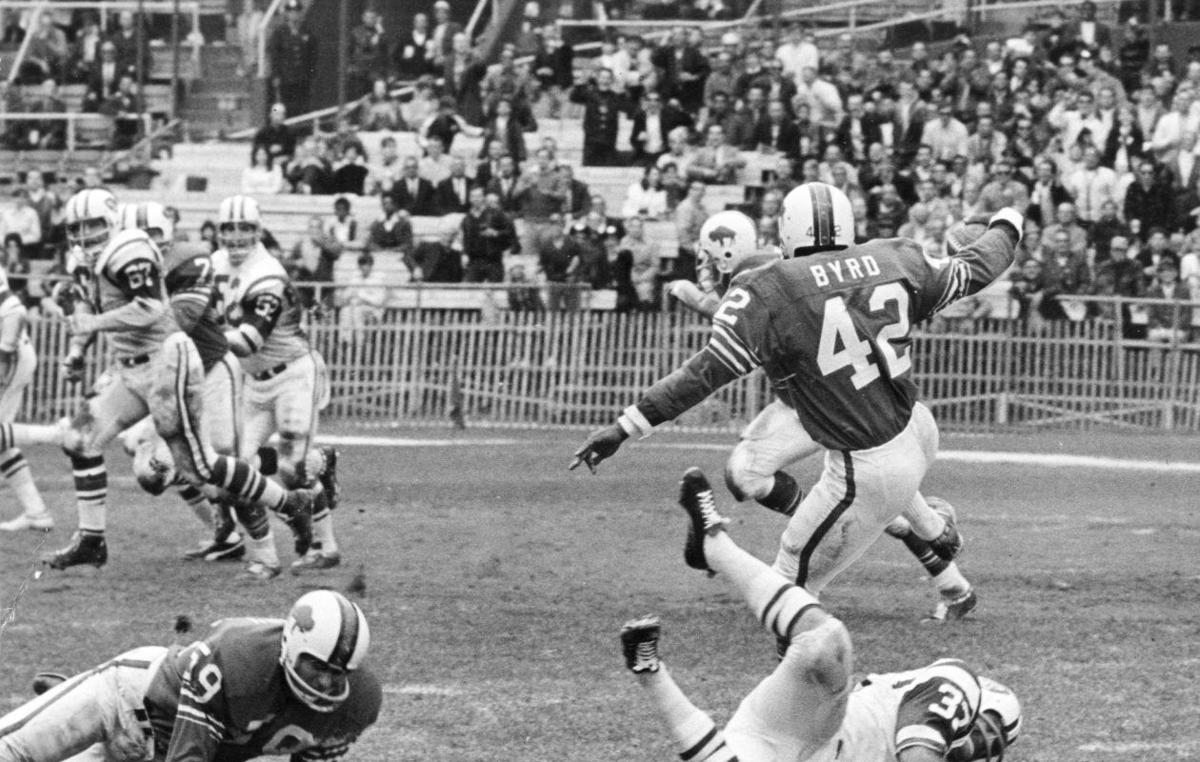
The time has come for the Buffalo Bills to honor their 42, too. Butch Byrd, who wore that number in the 1960s, still holds the franchise record for career interceptions, with 40. And he returned a punt 74 yards for a touchdown in the 1965 American Football League title game, which remains the last time the Bills won a league championship.
Byrd’s name and number belong on the Bills Wall of Fame. Of course they do. That they aren’t there already is hard to believe.
No Byrd? Absurd.
“I hope it will come someday,” he says. “I don’t want to sound conceited, but I think I had a pretty good career.”
People are also reading…
Byrd pauses. “I’d like not to have to make it posthumously.”
He is in good health at 80, but understands he is in life’s fourth quarter. And now he has some influencers speaking up for him, guys who do lobbying for a living.
Charlie Diamond is a statewide public-affairs consultant who hails from Watervliet, the Albany suburb where Byrd grew up, and Bob Christiansen is a retired schoolteacher there. They and Tony Masiello, the former mayor of Buffalo who also works in public affairs, are working behind the scenes to get renewed consideration for Byrd.
“When you look at the criteria, it says the Wall of Fame is to honor former players, coaches and administrators who have played a significant role in Bills history,” Diamond says. “Look at Butch’s credentials and you know he belongs. It is long overdue.”
Masiello played basketball at Canisius College in the late 1960s and early ’70s, overlapping with Byrd’s years with the Bills. Diamond attended Niagara University and worked for the Bills in the mid-1970s under equipment manager Tony Marchitte.
“We ought to get this done before too long,” Diamond says. “When it finally happens, it will be good for Butch – and good for the Bills.”
Traditionally, Wall of Fame honorees have been chosen by a panel of team personnel and select media members. The committee has not met since Cookie Gilchrist was chosen as the 31st member in 2017, and there are no meetings scheduled. The future of the Wall of Fame is unknown as the Bills begin their transition to a new stadium.
Byrd played in Buffalo for seven seasons, 1964 through 1970. His franchise record for interceptions stands the test of time. He returned five of those 40 for touchdowns and made the AFL All-Star team five times. Then there is that game-breaking punt return against the San Diego Chargers in 1965. Byrd remembers every step of it.
“Oh yeah, absolutely. John Hadl punted. I was back with Ed Rutkowski. I caught it and took two steps to my left. Ed put a block on the gunner, and I reversed field to the right. I had the sideline, and then Paul Maguire knocked down the last two guys and I was in. That’s how it happened. It was over in a flash.”
Byrd comes to mind today because he chose to wear No. 42 in Buffalo specifically because Robinson had worn it. Byrd had wanted it at Boston University, too, but a teammate already had it. When he got to the Bills, in 1964, as a fourth-round draft choice, he asked Marchitte for 42.
“Tony said, ‘Let me look,’ ” Byrd recalls. “Then he came back and told me, ‘It’s available.’ And I told him I wanted it because Jackie Robinson was my favorite baseball player.”
Byrd wanted it for deeper reasons, too, of course. Robinson’s entry into the previously all-white major leagues is one of the most important American moments of the 20th century. That’s why baseball will mark today’s 75th anniversary with pomp and ceremony.
Byrd was 5 when Robinson played his first game for the Brooklyn Dodgers. He figures he was maybe 7 or 8 when his Uncle Buster took him to see Robinson play for the Dodgers at Ebbets Field. They waited outside the stadium after the game in hopes of meeting No. 42.
“My uncle introduced himself, and Jackie stopped,” Byrd says. “And then my uncle said, ‘This is my nephew, Butch.’ ”
Their eyes met. They talked briefly. And that was that. “There really wasn’t much to it,” Byrd says.
He means in the moment. Looking back, of course, there was a lot to it – a whole lot.
Butch Byrd, as a child, met his hero. He is, in turn, one of ours.
Let’s get his name – and that shared number – right where they belong, up on the Bills Wall of Fame.


