

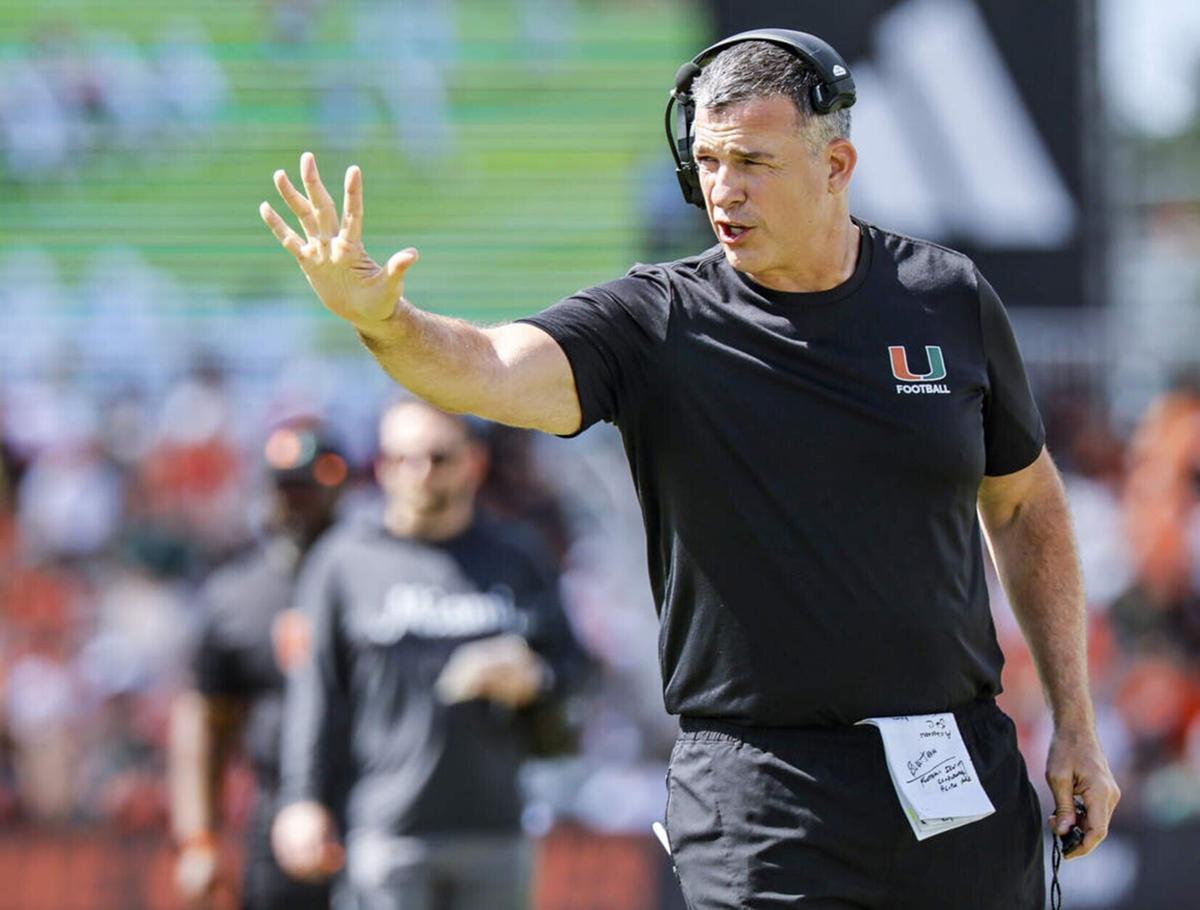
MIAMI — Mario Cristobal was 13, an age for dreaming, the night the University of Miami arrived as a national college football power.
“My grandfather’s house, on a black-and-white TV, watching Kenny Calhoun bat down that ball,” he says now.
He needn’t recall that moment 42 years ago, because the memory is always there. Calhoun, a defensive back, deflects a last-second two-point conversion pass with a fingertip and UM beats Nebraska, 31-30, for its first of five national championships. It was at the Orange Bowl, close enough for Cristobal to almost hear the cheering at his abuelo’s home.
And what a time to be coming of age in Miami! Everything was popping as 1983 turned to ‘84. “Scarface” was in theaters. “Miami Vice” was about to rock your TV set. The Dolphins had a rookie named Dan Marino. And for the Canes, Howard Schnellenberger and his pipe would soon give way to brash Jimmy Johnson and the full arrival of Hurricanes swagger.
People are also reading…
“I couldn’t imagine growing up anywhere else,” Cristobal said.
At 13 Mario had also discovered his first love. It was football.
“The entire world thanks God for football,” I heard him say to me in a recent conversation, following a team practice in preparation for his fifth year back at Miami, his alma mater. The season opens Sept. 4 at Stanford.
Cristobal, 55 now, has devoted his career, his life, really, to delivering the Hurricanes their long-elusive sixth national crown and first since 2001. He was so close last season but UM fell at home to Indiana in the College Football Playoff National Championship Game at Hard Rock Stadium, not so far from where stood the old Orange Bowl now long gone.
I ask how long it took him to get over coming so close but losing that game.
“I don’t think it ever leaves you,” he said. “It’s always a part of your process. I’ve always thrived on positive anger.”
Cristobal is born-and-raised Miami to parents who emigrated from Cuba before he was born, Spanish his first language.
“My parents were wired to be insanely hard workers, and tough, make-no-excuses people. ‘Shut up and work,'” Mario said. “I’m grateful for that. I live for it, and I love it. We owe Miami. ‘What can I do?’”
The U has never had a coach so Miami, with Hurricanes so embedded bone-deep. It’s weird. The weather threat brewing in the Atlantic in proximity to Miami happens to have been named Tropical Storm Cristobal. Seriously. They should have saved that name for a hurricane, because Mario is that, with a capital H, down to his soul.
Growing up, “I’d come out to every possible practice. The players were legends, bigger than life to me.”
Cristobal and older brother Luis would become two of those Canes players, out of Miami Columbus High. Mario, an offensive tackle, would help UM win national titles in 1989 and ‘91.
“Can I actually be a part of this tough, tough organization? Man, I better find a way,” Cristobal recalled thinking as Miami was recruiting him. “Jimmy Johnson and then Dennis Erickson gave us an opportunity. I was a nobody from down the street and these guys gave a nobody an opportunity. I owe the University of Miami. I found out the secret sauce of what that brotherhood was. The secret’s out there in the dirt. You find yourself your entire life searching for that feeling again.”
Mario recalled later, circa 1997, sitting in the campus office of then-head coach Butch Davis, interviewing to be a graduate assistant coach. Davis asked him why he thought he would like to be a coach.
“I want to sit in your seat one day,” he told Davis.
Along his coaching journey Cristobal has built winners everywhere he has been.
He lifted FIU across town from relentless losing to its only conference title and first bowl win — his dream job in Coral Gables so close in miles but, then, seeming so far away.
He turned around Oregon, taking a 4-8 team and winning two Pac-12 crowns and a Rose Bowl.
He has improved every year back at Miami, going 23-6 the past two seasons.
“Aside from Alabama,” he said, of being an assistant under Nick Saban between his FIU and Oregon stops, “every job I’ve ever taken has been a rebuild.”
They say Rome wasn’t built in a day? Cristobal might have taken on that challenge, too, had he been around then.
Was there ever any doubt Cristobal would succeed at his dream job? His homecoming? Yes, probably. Did you ever hedge in your belief? Was it when the Canes were 5-7 his first year?
“We were leaving a great team we’d built,” he said of Oregon, “and, watching film [of Miami] and analyzing the roster, it hit hard on the plane ride over that, wow, this will take a monumental overhaul.”
He inherited the need for a complete roster and program rebuild in Coral Gables — and a culture reawakening. There was no magic wand; it would take maniacal work. And he would begin it in the midst of upheaval in college football as the transfer portal and NIL money (name, image and likeness) turned the sport on its ear.
It was during that inaugural 5-7 season that Cristobal needed to sell UM football — no, to sell faith in himself — to recruits such as Reuben Bain and Francis Mauigoa, who bought in, would become future stars, and became first-round NFL draft picks this past spring.
“We were blunt about it. We sold ourselves as what we are,” Cristobal said. “We’re builders. We will let nothing stop us in any way to get to 1-0. Those guys bought into that. It was the truth from the beginning. It’s our DNA and mindset. We’re never gonna be satisfied. Never gonna tell you we have enough. We try to go to a level that others can’t fathom.”
It was no wonder the university recently rewarded Cristobal with a contract extension (and a raise) even though he is entering only the midway point of the original 10-year, $80 million deal he’d first signed. There had been little doubt Cristobal left a great situation at Oregon, but his dream job, the top rung for him, was always in Coral Gables. There should be even less doubt now that he will retire a Hurricane.
I asked Cristobal how he feels that his team is ranked only seventh or eighth in most preseason polls — after being national runners-up a year ago, a prohibitive favorite now to win the Atlantic Coast Conference, and after scoring big again in recruiting and the transfer portal including signing star quarterback Darian Mensah from Duke. Does it feel like disrespect? Like there remains some doubt whether The U is all the way “back”?
“Miami has 20-plus years of disrespect and doubt built-up inside,” he answered. “This is not Hollywood. We’re not driven by narratives or noise. There is a deeply entrenched feeling of Miami Hurricanes pride. Physical, violent, disciplined, tough, rugged. We keep getting better and better, and we have a ways to go. We train like a hunter. Practice like a team that’s on the hunt. It’s a constant warfare against the human nature to let down your guard.”
Cristobal calls reaching the national championship game last season “a major breakthrough.” And he knows there is one more of those left.
Miami is a football town. Always has been. The Heat has won three NBA titles and has Giannis Antetokounmpo now. The Florida Panthers have won two recent Stanley Cups and the Marlins two World Series. The incomparable global star Lionel Messi plays for Inter Miami.
Yet it’s a football town that belongs to the Hurricanes right now. That’s partly because the Dolphins have been wading in mediocrity for so long and are now in a major rebuild and facing a season of cellar-low expectations. It’s mostly because of the Canes’ trajectory under Cristobal and last season’s breakthrough.
The excitement is back, and it’s palpable. A pedigreed national brand dormant for too long is rising again, and flexing its muscle.
A recent UM football alumni reunion drew some 400 former players, with Ray Lewis, Greg Olsen, Jonathan Vilma and others sharing dinner and stories with today’s Canes — because no program in America has a greater generational connection than Canes football. More recently a local community event with current stars Malachi Toney and Mark Fletcher Jr. drew a mob scene.
The architect of the program’s revitalization will not be goaded into predictions or promises. Mario Cristobal cannot be budged off of his mantra that the only goal is the next game and “1-0.” But he nevertheless leaves zero doubt that his obsession is to deliver Miami’s sixth national championship as payback for all he believes he owes his university, his city. And he leaves just as little doubt about the depth of his drive and confidence to make it happen.
“Maybe I’m maniacal and OCD — all that stuff is irrelevant,” he said. “Our expectations are higher than what anyone on the outside world can place on us. No one and nothing will stop us.”
____


