The Apple Cup is a standalone affair for the first time in forever. Set for 10 a.m. Tucson time on NBC on the Sunday of Labor Day weekend, it will be the only football game in that broadcast window and receive unprecedented attention in the rivalry's 126-year history.
People are also reading…

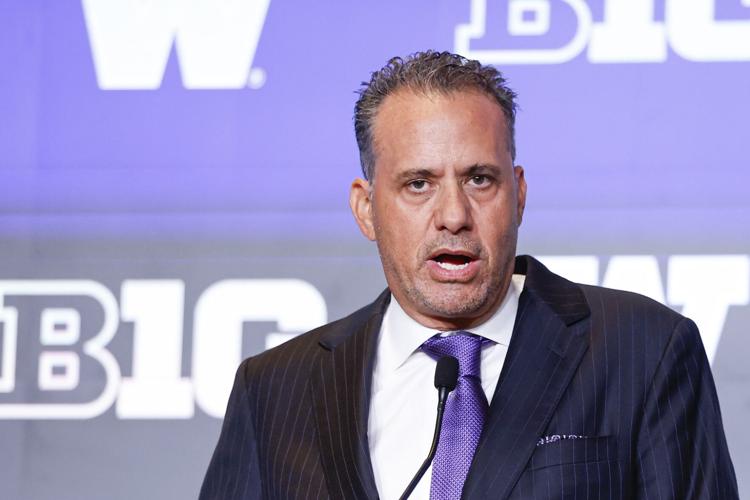
Washington football coach Jedd Fisch speaks during Big Ten Media Days at Hilton Chicago on July 30. Fisch coached UA from 2021-23.
In that regard, the trappings serve as a fitting start for Washington coach Jedd Fisch, who will be under the spotlight this season at a level not experienced in his career.
Year 3 pressure is a time-honored reality of the coaching condition, although the source of the heat has changed over time as the sport evolves.
The only previous instance in which Fisch was a third-year head coach came during his tenure at Arizona earlier this decade, and he passed with high marks: The Wildcats won 10 games and thumped Oklahoma in the Alamo Bowl to catapult Fisch onto Washington's radar when Kalen DeBoer left for Alabama.
But Year 3 at Arizona is not like Year 3 at Washington.
Arizona is a basketball school with limited expectations for football success. The bar for Fisch in 2023 was a bowl bid. That's hardly the case this fall in Seattle. If the Huskies don't reach the College Football Playoff, then ... what?
The Hot Seat is no longer a one-size-fits-all descriptor. Yes, the traditional definition -- win or be fired -- remains appropriate in certain situations. USC coach Lincoln Riley, for example, is in danger of losing his job if the Trojans don't reach the CFP.
But that's not the case with Fisch. So long as the Huskies don't crash and burn, there will be no termination.
Granted, nobody would be happy if UW loses four or five games. Not with a veteran lineup, gifted quarterback (Demond Williams Jr.) and manageable schedule. Not with the improvement the Huskies displayed last season (nine wins). But an 8-4 or 7-5 record won't result in Fisch receiving his termination papers.
Instead, Fisch's seat features an altogether different type of heat — a heat linked directly to the talent acquisition and roster compensation models that underpin college football in the mid-2020s.
This stands as a make-or-break season for momentum on Montlake. Either it continues to build or begins to dissipate. Whichever trajectory emerges at the end of November will set the framework for UW's near-term football future.
The connection goes something like this: On-field success creates off-field energy; off-field energy motivates donors; and motivated donors provide funding for the roster-building process in the era of NIL and revenue sharing.
Like every program in the Big Ten, the Huskies are spending approximately $15 million on football revenue sharing as allowed under the terms of the NCAA v. House settlement. (The exact amount varies by campus.) But that's hardly enough to field a roster capable of competing with Oregon and Ohio State and reaching the CFP.
To stand among the top programs in the Big Ten, the Huskies need an additional $15 million to $20 million in NIL funding. That cash comes from a constituency that includes fans, donors and the business community.
Momentum generates the dollars needed to re-sign Williams, for example.

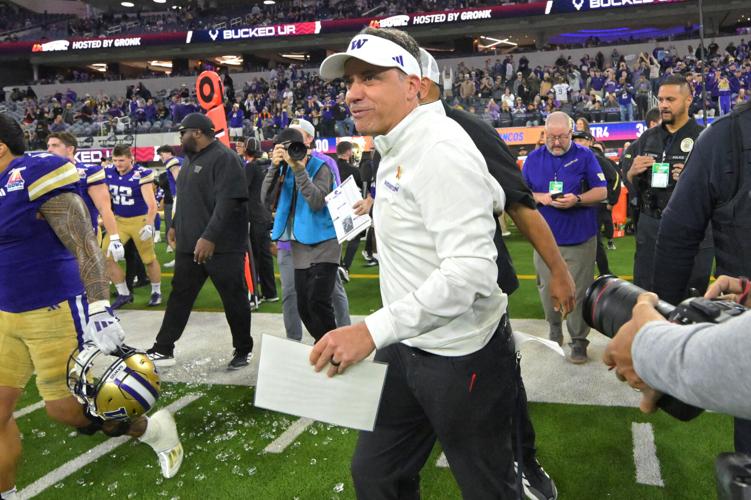
Washington Huskies head coach Jedd Fisch runs on to the field after defeating the Boise State Broncos in the LA Bowl at SoFi Stadium on Dec. 13, 2025, in Inglewood, CA.
Or to lure five-star offensive line recruit Kodi Greene.
Or to snare an impact transfer like cornerback Emmanuel Karnley from Virginia.
In case there was any doubt, Fisch is keenly aware of the dynamics at play. His understanding of the public-facing piece of the job — the need to engage authentically with donors, students, fans and the media — is first-rate.
Some coaches prefer five layers of insulation. Fisch? He's comfortable with Grade A exposure and understands both the expectations and the challenges.
And the Huskies have challenges. They are playing from behind financially like no other member of the Big Ten.
Washington is one of two schools receiving half shares of the conference's media revenue through the end of the decade, but Oregon has Phil Knight to offset its half-share status. The Huskies don't have an equivalent benefactor.
The $30 million gap creates pressure — there's that word again — across the athletic department.
Compared to their peers, the Huskies have limited flexibility with their appropriation of dollars and less margin for error with external revenue.
Ticket sales, sponsorships, merchandise, fundraising ... they need to get everything right. Misses cut deeper. Hits mean more.
That process is made exponentially easier with the momentum that comes from on-field success. We aren't referring to eight-win success. Or Las Vegas Bowl success. Or beat-the-teams-you're-supposed-to-beat success.
The Huskies need high-level success this fall. Beat-USC success. Beat-Oregon success. Reach-the-playoff success.