The family of the Arizona State University hockey player who remains on life support after collapsing during an Aug. 20 training exercise is pleading with the Maricopa County Attorney's Office for a criminal investigation.
The request from Matthew Mayich's family attorney comes more than three weeks after he first called out the university for investigating itself and asked administrators to turn the case over to outside law enforcement agencies.
"We have gotten no response," Phoenix lawyer Robert Carey told The Arizona Republic on Sept. 24.
He has accused the university of trying to "whitewash" the circumstances of the near-fatal workout and of repeated policy violations by the coaching staff before, during and after Mayich collapsed.
In his six-page letter to Maricopa County Attorney Rachel Mitchell, Carey noted that the ASU Police Department was tasked with investigating the incident. He questioned whether the department can remain impartial as it "answers to the administration."
People are also reading…
Carey instead wants Mitchell's office to open its own investigation, take over the evidence in the case and exercise subpoena powers to question those involved.
"The family is not asking you to prejudge anyone," he wrote. "They are asking that the question of criminal responsibility for what happened to their son be answered by someone who does not report to the people who may bear it."
Mayich, 21, collapsed during the first session of a planned three-day workout led by an ex-Green Beret who was invited by the head hockey coach to train the team. He remains incapacitated at Barrow Neurological Institute with zero chance of recovery.
The ASU Police Department began investigating the circumstances of Mayich's collapse after getting the 911 call about a heat-related incident. Administrators also promised a separate review of everything surrounding the workout.

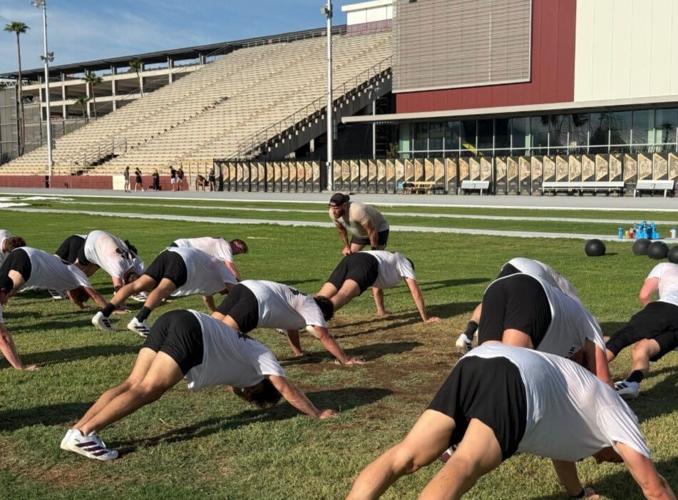
Arizona State University hockey players are shown during an Aug. 20, 2026, workout led by ex-Green Beret Tim Ziesel before a student-athlete collapsed. Matthew Mayich remains hospitalized in a coma.
ASU Senior Vice President James Rund released a preliminary report on Aug. 22 showing that hockey coaches failed to follow the university's heat-related guidelines and policies for vetting an ex-Green Beret guest trainer involved in the near-fatal outdoor workout.
Rund's investigative summary and four-page timeline do not identify anyone responsible for the failures or outline specific accountability measures.
Reporters across the country on Sept. 23 pressed ASU head hockey coach Greg Powers in what was his first public question-and-answer session since the incident. Avoiding questions about the incident, he declined to say whether he or anyone else should be held accountable for the decisions before, during and after the workout.
The Maricopa County Attorney's Office confirmed receiving the Mayich family's request on Sept. 24 and said it is under review.
"It is not something we can comment on," Erin Pellett, MCAO spokesperson, said.
Carey said the university's main concern is self-preservation.
"Rund's report speaks as to why the county attorney is needed here," he told The Arizona Republic.
What is known, unknown about near-fatal hockey workout
Rund's report confirmed much of The Republic's ongoing investigation, which found multiple potential policy violations connected to the workout and Mayich's collapse.
The Republic found the volunteer trainer did not go through the required vetting process or sign standard forms before starting drills on the first day of the 2026 semester. Ex-Green Beret Tim Ziesel was allowed to lead the workout based on a handshake agreement with Powers and other staff members, Ziesel's attorney said.
The Republic also found the school did not appear to follow its own rules designed to protect students from exertional heat illness.
Emergency guidelines for treating heat illness call for immediate immersion in ice water, but the university found Mayich was left lying on the ground as staff draped him in wet towels. ASU's heat-illness policy says athletes should be acclimated in steadily increasing workouts from seven to 14 days.
"Each exposure should gradually the intensity and duration of of activity as well as phasing in protective equipment until the acclimation period has passed," the policy states. "Training should occur within the same conditions that will occur during competition."
Hockey is played on ice. The university has offered no explanation for why the team was doing drills outside in conditions labeled "high" based on temperature and humidity, where the policy states "only fit and acclimated athletes can participate."
Ziesel ran the players through 45 to 50 minutes of sprints, push-ups and flutter kicks. He also had them lift and carry teammates and run with medicine balls.
Rund's report says Mayich arrived from Canada on Aug. 12 — eight days before he collapsed — and was medically cleared by a physician and an athletic trainer the next day.
The report said he participated in three "prior voluntary strength and conditioning workouts" that lasted between 1.5 and 2 hours and included "approximately 15 minutes of outdoor calisthenic or body weight exercises."
Rund's report indicates Mayich struggled during his final workout.
"When running, Matthew appeared to struggle, and then in rapid succession stumbled, dropped the medicine ball, and fell to the ground," Rund wrote. "He attempted to get up and resume running but fell to his knees."

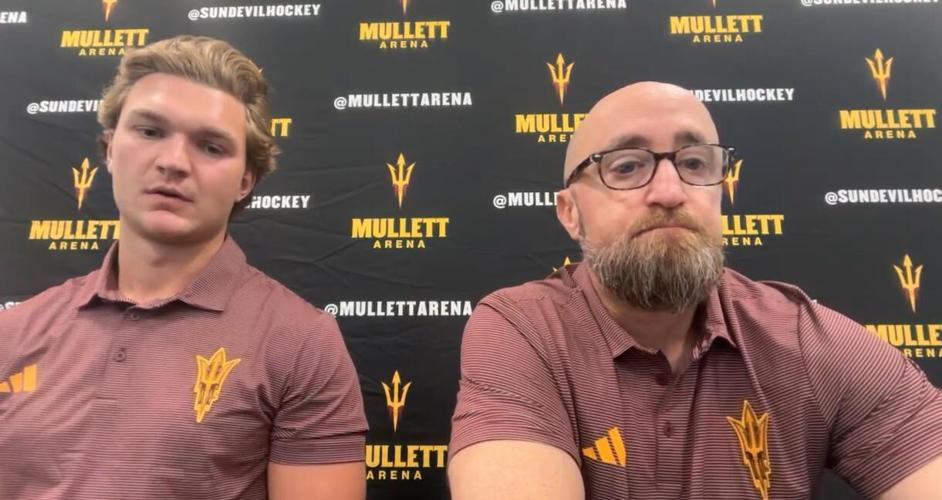
Arizona State hockey coach Greg Powers, right, and junior forward Ben Muthersbaugh take part in an NCHC media day session Sept. 23, 2026.
Carey said trainers and coaches should have responded to obvious warning signs.
"Whether the people who designed, approved and ran this session were aware of those risks and chose to disregard them, and whether the punitive structure of the session reflects exactly that disregard, are questions only an investigation with subpoena power can answer," Carey wrote in his letter.
Carey has said players and other witnesses he interviewed described the workout session as a punishment, where groups were made to repeat sprints for miscounting or finishing behind. The university’s report, he added, omitted those accounts.
“No one on the coaching or medical staff stopped it,” he wrote. "(The report) names no one as responsible for approving the consultant, monitoring conditions, or managing the emergency. A month after the event, the report identifies no one who has been suspended or disciplined.”
Family's attorney focuses on preservation of evidence
Mayich, a sophomore from Stoney Creek, Ontario, was in his first year at ASU. He was part of a 2026 transfer portal class that ranked first in the country. He appeared in 34 games, tallying seven goals and eight assists, in his freshman season at Clarkson University in Potsdam, New York.
He was drafted by the St. Louis Blues of the National Hockey League in 2023. Drafted players retain their college status while NHL teams hold their exclusive signing rights.
Rund, in his preliminary report to ASU President Michael Crow, called for a blue-ribbon advisory panel made up of experts who would recommend how the university should conduct outdoor athletic activities and use outside consultants.
But Carey said ASU has good policies in place that weren't followed. He asked in his letter to the county attorney why the coaching staff didn’t adhere to the university’s best practices.

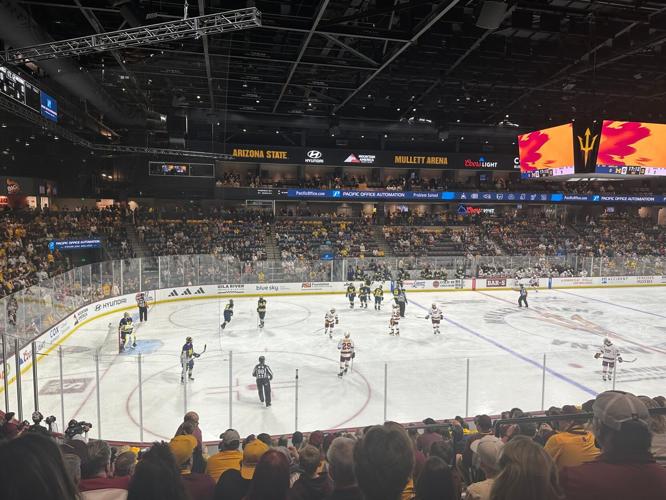
Action from the first period of Arizona State hockey vs. Michigan on Oct. 11, 2024, at Mullett Arena in Tempe.
“That is a question for a criminal investigator,” not a blue-ribbon panel, as the preliminary report suggested, Carey wrote.
Carey asked the county attorney to collect and preserve evidence, particularly digital evidence, including recordings of the workout.
“We have heard that there are numerous photographs, videos and digital messages showing that this session was run recklessly, including, I understand, warnings to the coaching staff that went unheeded,” Carey wrote.
Carey said he was not criticizing the ability of ASU police to conduct an investigation. He said he doubts there is enough separation between the agency and the administration to seek warrants, secure evidence and interview students and employees.
“The report itself notes that student-athletes were ‘invited’ to be interviewed, that none were required, and that ‘several’ have spoken to ASUPD,” Carey said. “On a roster of more than two dozen, that is telling. You should give the student-athletes a space in which they can be honest.”
Carey asked Mitchell to not rely on ASU police’s findings, but rather to open an investigation at the County Attorney’s Office after collecting evidence that he claimed is “at risk.”
“Should Matthew not survive, the same facts could support further charges under Arizona law, and the evidence that would prove them is the evidence at risk now,” Carey concluded in the letter.


 Fifita’s pursuit of Arizona QB history goes beyond 10,000 yards | Greg Hansen