


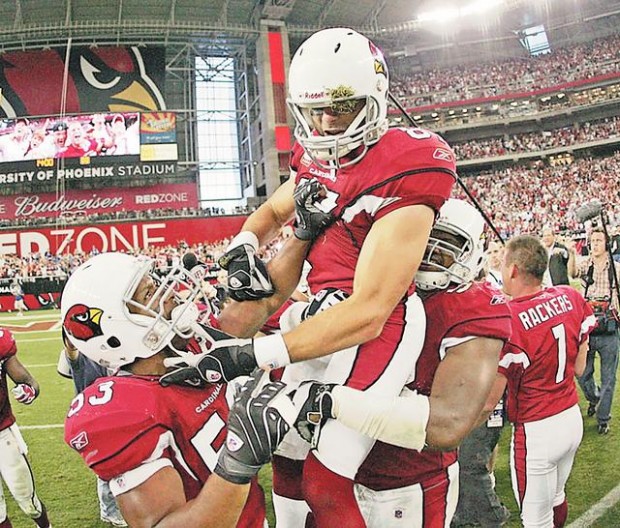
When Sean Morey dies, his brain and part of his spinal cord will be shipped to Boston University's Center for the Study of Traumatic Encephalopathy.
Morey isn't squeamish about that fact, and it's not because his job as a Pro Bowl special teamer for the Arizona Cardinals requires a complete absence of fear.
Morey is a Brown University graduate whose wife, also from Brown, is a graduate student in biology at Arizona State. He also is an organ donor.
But more than anything, Morey believes in the work done at BU.
Brain injuries have become perhaps the most important player issue — if not the most relevant story in the sport — this decade.
Chronic traumatic encephalopathy, a degenerative brain disease caused by repeated trauma, occurs when a toxic protein attacks and kills cells.
People are also reading…
It causes memory loss, emotional instability, erratic behavior and depression — and eventually progresses to full-grown dementia. Former NFL players who committed suicide were found to have had CTE.
It can't be diagnosed in living people. There's no drug to treat CTE — only its symptoms.
As a member of the NFL Players Association's Safety and Welfare Committee, Morey, 33, is as educated on the topic as any player alive.
He spoke with helmet manufacturers and researched head trauma this past off-season. He read "Head Games," a book written by the BU center's co-founder, Chris Nowinski, three times, taking notes along the way.
And then he decided — along with current NFL players Matt Birk and Lofa Tatupu and 40 retired players — to donate.
In a game where health dictates salaries, it's amazing.
"I don't feel like my career will be in jeopardy because I might admit I suffered concussions," he said. "Every player fortunate enough to have a long career in the NFL has suffered concussions."
On special teams, Morey doesn't always know what will hit him next. But he knows what will happen to his brain when it happens.
But he said that knowledge has not made him gun-shy.
"I've been able to play the game the way it's supposed to be played," he said. "I trust our medical staff and our trainers, and the helmets I'm wearing. And I trust my technique."
The NFL's technique, however, has been borderline embarrassing.
After years of denying there was reliable data about former players' brain functions, the league's own study — leaked last week by The New York Times — produced stunning findings.
The study, which has yet to be peer-reviewed, found former players ages 30-49 were 19 times as likely to be diagnosed with memory-related diseases. In former players 50 and up, the rate was five times that of the general population.
Nowinski, a Harvard graduate who was forced to retire from World Wrestling Entertainment because of post-concussion syndrome, suspects the higher rate in younger players is indicative of the sport's increased violence.
"The fact they agreed to the design of the study means they're backing themselves into an increasingly small corner in their ability to dismiss this as a massive public-health problem," Nowinski said.
Morey stressed the impact changes would have on youth players, who are at risk, because of "misdiagnosed or ignored symptoms."
He wants more resources for former players with dementia. Current players should be forced to sit the rest of a game if they lose consciousness, he said, and could benefit from a 15-day disabled list. With a new collective bargaining agreement in discussion, it could happen.
Changing the culture is more important, he said. Players never want to leave a game, especially for an injury not as obvious as a broken leg or dislocated finger.
"To try to put everything in perspective," Morey said, "is really difficult."
Jack Thompson has seen it. A Washington State legend, the "Throwin' Samoan" was one of eight who signed to donate at an informal former NFL players symposium in June.
There, the havoc of life after football was as obvious as a limp, bowed frame or story about diminishing memory.
Helping in the solution, he said, was just as apparent.
"No pun intended," he said, "but it was a no-brainer."
FINLEY FIVE: THINGS WE'LL TALK ABOUT THIS WEEK
Playoffs
1 Baseball's postseason starts this week, and again the Red Sox are Southern Arizona's team. Manager Terry Francona and bench coach Brad Mills are UA grads, as is outfielder Brian Anderson. The Tigers' Ryan Perry is a former Wildcat — and so is Angels owner Arte Moreno.
Good book
2 We've been reading Jon Krakauer's latest book. "Where Men Win Glory," a look at the cover-up surrounding the death of former Arizona State and Arizona Cardinals player Pat Tillman in Afghanistan. The book, which also discusses the Afghanistan war in general, is clinical yet compelling.
SC's back
3 After the Trojans whupped perennially underwhelming Cal 30-3 on Saturday, USC coach Pete Carroll said freshman quarterback Matt Barkley "is playing as good of football as anybody we have ever had, already." And the rest of the conference shudders.
Snow!
4 Pima College hasn't won a football game since August 2007, but there's a reason to watch Saturday at Tucson High School. Opponent Snow College, one of the best junior college football teams in America, is 5-1, averages 40 points per game and was ranked No. 9 before beating Mesa 44-0 Saturday.
Watching football
5 If you're like us and have Cox Communications cable piped into your house, this is a revelation — ESPN360.com. There, for free, you can watch ESPN's games from other coverage areas, something not available on the cable package until recently. It's one more way to be a couch, or desk, potato.


