Angel Hernandez is not the worst umpire we have ever seen. We’d give the honor to Ken “The Hatchet” Kaiser or Russ “Rough Guess. Goetz.
But Hernandez’s lingering presence in Our National Pastime was an annoyance. That finally ended this week when he reached a financial settlement with MLB and moved down the trail into retirement.
Managers and players rejoiced.

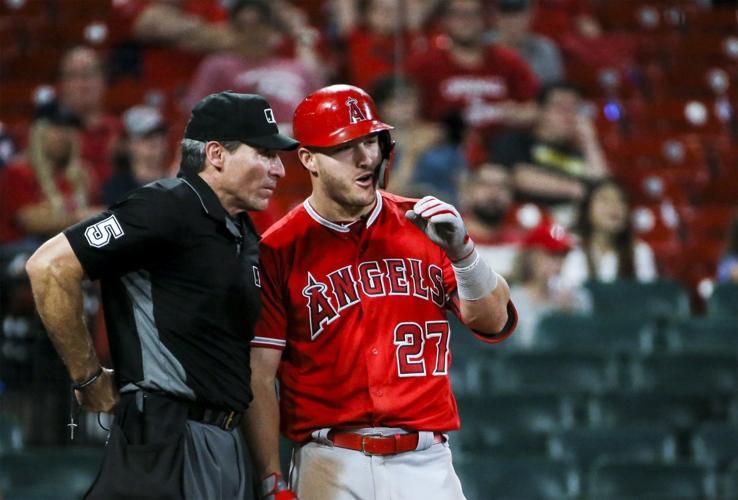
Los Angeles Angels center fielder Mike Trout (27) discusses the last call by umpire Angel Hernandez (5) after striking out during the ninth inning of a game on Sunday, June 23, 2019 at Busch Stadium in St. Louis. Photo by Colter Peterson, cpeterson@post-dispatch.com
Umpires are human. They make mistakes. But Hernandez was prone to making spectacularly bad calls, then compounding his blunders by being confrontational with protesters.
His lousy reputation was well-earned, yet he had the temerity to sue MLB for discriminatory treatment after being passed over for promotions and postseason assignments.
That lawsuit went nowhere, but not before MLB court filings to spelled out just how bad Hernandez was at umpiring.
People are also reading…
Umpires are under greater scrutiny than ever before thanks to replay challenges, strike zone graphics on telecasts and independent umpire grading analysts.
With baseball embracing legalized gambling — with bets placed from at-bat to at-bat during games – MLB will inevitably implement some of automated ball-strike system to eliminate egregious errors.
Writing for The Athletic, Sam Blum and Cody Stavenhagen covered the good, bad and ugly of Hernandez in a thorough profile. Here is except from that piece:
Hernandez generally does not interact well in arguments. And his actions, including quick or haphazard ejections, don’t de-escalate those situations.
These interactions were likely a significant reason Hernandez lost the lawsuit that he filed against MLB in 2017. He alleged that he was passed over for a crew chief position and desirable postseason assignments because of his race.
The basis for the suit was a belief that MLB’s executive VP for baseball operations Joe Torre had a vendetta against Hernandez. The suit also pointed to a lack of diversity in crew chief positions, and attorneys cited damaging deposition testimony from MLB director of umpiring Randy Marsh, who spoke about recruiting minority umpires to the profession. “The problem is, yeah, they want the job,” Marsh said, “but they want to be in the big leagues tomorrow, and they don’t want to go through all of that.”
MLB contended in its response that “Hernandez has been quick to eject managers, which inflames on-field tensions, rather than issue warnings that potentially could defuse those situations. Hernandez has also failed to communicate with other umpires on his crew, which has resulted in confusion on the field and unnecessary game delays.”
And yet Hernandez soldiered on, driving players (especially Bryce Harper) crazy.

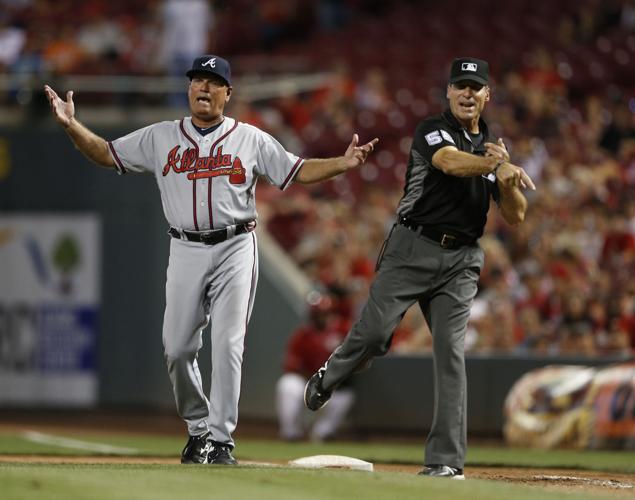
Atlanta Braves interim Manager Brian Snitker, left, reacts as he is ejected by umpire Angel Hernandez (55) during the tenth inning of a baseball game, Tuesday, July 19, 2016, in Cincinnati. (AP Photo/Gary Landers)
Here is what folks have been writing about the overdue end of Hernandez’s career:
Barry Petchesky, The Defector: “The worst thing an umpire can do is teach fans their name. The best officials are invisible, because the best-officiated game is one where you don't notice the officiating. On the other end of the spectrum are the celebrity umps: The ones who either crave the spotlight, as if fans paid good money to see them rule and not the players play, or the ones who gets calls wrong so frequently or egregiously that ignoring them is not an option. Ángel Hernández was both of these types, and now he's retiring, and the baseball world rejoices. ... Hernández was an equal-opportunity infuriator, thanks to a strike zone that was as large as it was inconsistent, and a quick trigger finger for tossing anyone who dared complain. But the rub with Hernández was always a little more nuanced than the calls. He was not the least accurate umpire working in most of his three decades in the game. He was in fact about league-average most of the time. But the job is not just about getting the calls right. It's also about being professional toward one's coworkers, and Hernández was a petty, grudge-holding tyrant to coaches and players. The best umpires de-escalate tension; Hernández always seemed to ignite it. ... Umpiring is a tough job. It's impossible to get every call right, and fans will be convinced you have it out for their team anyway. The least an ump can do is approach their job with humility, and strive for pleasant workplace interactions. Actually, no, I take that back: The actual least an ump can do is everything Ángel Hernández did.”
Gabe Lacques, USA Today: “In eight games behind the plate in this, his final season, (Hernandez) clocked a 93.2% accuracy rate. That puts him tied for 63rd among 85 umpires, alongside respected veteran Bill Miller. Rank and file, basically. While he missed much of 2023 with an injury, his last full season in 2022 was similar: His median accuracy rate for 29 games called was 93.6%, with seven games in the high rent district between 95-97%. The trouble with Hernández was when he was bad, he was pretty bad. A half-dozen games that year were in the bottom tier of 91% or less, with two games at 88%. That, too, matches the eye test: It almost seemed like bad calls compounded on each other with Hernández behind the plate, his rabbit ears hearing every boo and his mind, perhaps, imagining every online grievance. Hernández did himself no favors with his body language, which took on a stance that exuded confrontation. He found little sympathy when he unsuccessfully sued MLB in 2017, alleging discrimination for his dearth of postseason assignments and failure to receive a crew chief assignment.”
Jeff Passan, ESPN.com: “With a penchant for bad calls — during a 2018 playoff game, he had three calls reversed by replay in the first four innings — Hernández received a disproportionate amount of odium from fans. The lawsuit only added to the animus Hernández generated, and the groundswell grew to the point that Hernández retired after missing much of the 2023 season with a back injury. Hernandez is well-liked among umpires, who have borne the brunt of more criticism in recent years and rallied around him as a person. His on-field work, however, left enough to be desired that Hernández became a constant trending topic on social media platforms and among the most maligned figures in the game. Just this season, Hernández called three strikes on pitches well off the plate from Houston's J.P France to Texas’ Wyatt Langford. In 2022, Philadelphia designated hitter Kyle Schwarber was ejected by Hernández after he slammed his bat following a called strike three on a Josh Hader fastball that was off the plate. Other Hernández mishaps predated the league's institution of instant replay, including an incident in which Chicago Bears great Steve McMichael was ejected from Wrigley Field after criticizing Hernández over the stadium's loudspeaker during the seventh-inning stretch. Particularly after the retirement of Joe West before the 2022 season, Hernández became the face of umpiring — a job that has taken on increased importance with umpires relied upon to implement pace-of-game measures, including the pitch clock. Ball-and-strike umpiring, which became front and center in the criticism of Hernández, could soon be assisted — or altogether taken over — by the use of MLB's automated ball-strike system, which is currently utilized in the minor leagues but won't be in the big leagues until at earliest 2026.”

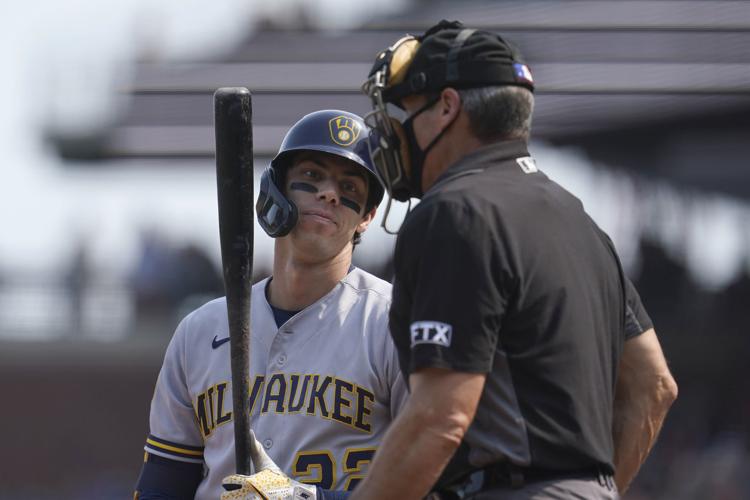
Brewers' Christian Yelich looks at umpire Angel Hernandez after striking out against the Giants during the ninth inning Thursday.
Matthew Trueblood, Baseball Prospectus: “He was an agent of chaos, in the uniform of the very stewards of the game’s gentlemanly order. Standoffish, sometimes defensive, and far too often wrong, he made baseball a lot more like pro wrestling than any other umpire of his era, save the more intentionally bombastic Joe West. McMichael was exactly the person a mischievous God would put in Hernandez’s path to create maximal baseball entertainment, on a rare, beer-soaked, hot night in August, with a vague playoff hope still in play and the home team feeling desperate. Hernandez was helpless to resist the pull of fate; he played his part in the upward spiral of that insanity perfectly. ... Hernandez didn’t perform the job of an MLB umpire very well. Then again, it’s a hard job. He did (to general ridicule, but probably with a bit more legitimate foundation than we prefer to admit) fight what he perceived as discrimination in the assignment of prestigious playoff duties, based on race. He did add an extra, sometimes-fascinating ingredient to the piquant dish that is a great baseball game, even if it was like an overly hot pepper sometimes—more heat and intensity than was necessary.”
Chelsea Janes, Washington Post: “Over the past few years — and particularly since social media has allowed more constant monitoring of umpire performance and regurgitation of mistakes — Hernández emerged as one of the more criticized and villainized umpires in history. According to Umpire Scorecard, which tracks umpire ball/strike accuracy, and to internal MLB performance assessments, he was not the worst of MLB’s 76 full-time umpires. But reputation meant his missed calls, some so egregious as to inspire disbelief among players, were turned into montages. His willingness to eject frustrated players and unwillingness to go quietly in arguments fostered accusations about a desire to be in the center of attention. And players and managers rarely felt the need to filter when it came to their frustrations with him. Beloved longtime starter CC Sabathia once said Hernández ‘shouldn’t be anywhere near a playoff game.’ When Ron Washington was managing the Texas Rangers, he said: ‘Angel is bad. That’s all there is to it.’ Active career ejections leader Bryce Harper offered reporters more than one rant about Hernandez’s tendency to stir the pot over the years. All umpires earn some consternation. Hernandez, fairly or not, fostered endless aggravation.”
Mike Vaccaro, New York Post: “It’s almost certain that Angel Hernandez wasn’t the worst umpire of all time. Hell, he didn’t even come out on top every time when they’d poll players and managers anonymously about who the worst modern-day umpires are. That was hard to argue Tuesday, though. If you Googled ‘worst umpires in MLB history,’ the first 40 posts were related to Hernandez. Within an hour of the announcement beginning to circulate early Monday evening, there were soon more greatest-hits packages of Angel Hernandez than the Rolling Stones, the Eagles and Billy Joel put together. But it was Hernandez who had the misfortune of being, for three decades, the consensus worst umpire in the game at a time when every pitch — literally every single pitch — was available on video. And every time you would see a tweet or a TikTok that began ‘you won’t believe this call’ ... well, before you ever clicked you knew there was a good chance Angel Hernandez’s name was going to be there."
MEGAPHONE
“Anybody that says he’s the worst umpire in baseball doesn’t know what they’re talking about. He does his job the right way. Does he make mistakes? Yes. But we all do. We’re not perfect. You’re judging him on every pitch. And the scrutiny on him is not fair.”
—Former umpire Joe West, defending Hernandez to The Athletic.