WASHINGTON — It was a predictable franchise rebuild, complete with all the modern trappings — a thirty-something president of baseball operations, an even younger manager, a lot of high-tech gizmos nobody’d seen before — that we’ve come to expect in this hyper-optimized era of Major League Baseball.
Yet when it came to the men actually donning the uniforms of the Washington Nationals, the club’s new brain trust took a different tack.

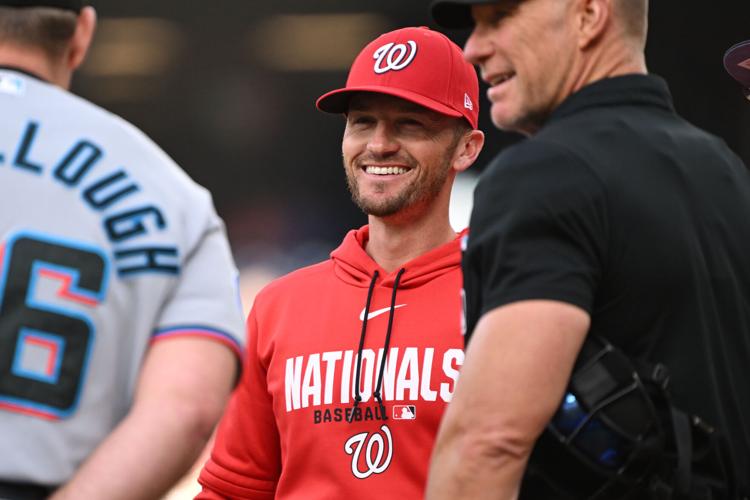
Washington Nationals manager Blake Butera smiles before a game between the Washington Nationals and the Miami Marlins at Nationals Park, June 1.
The front office didn’t madly churn the waiver wire, seeking a miracle from the 41st man on some other team’s 40-man roster. They didn’t send packing the players responsible for the team’s 96-loss disaster that resulted in the firings of longtime GM Mike Rizzo and manager Dave Martinez.
Instead, they brought back, in near entirety, the hitting group responsible for finishing 25th in the majors in OPS, in the back half of runs scored and largely responsible for three consecutive years of at least 91 losses, with a simple directive.
People are also reading…
Listen to us. Learn. And look within yourselves to get better.
“All of us knew we needed to take some kind of jump,” center fielder Jacob Young tells USA Today Sports. “A lot of guys had good years last year — but there was still room to grow.
“That’s what the staff’s brought out of us — finding that room to grow and getting it out of us.”
The results have been stark. The Nationals have scored more runs than any National League club and their .733 OPS — a 40-point improvement on 2025 — ranks sixth in the major leagues. A long-overdue modernization of an organization that flailed since winning the 2019 World Series was expected to yield dividends.
Yet those typically arrive years later, the fruit of superior drafting and development, areas the Nationals have badly lagged since a series of high draft picks yielded franchise cornerstones that would help them to five playoff berths from 2012-2019.
Running it back with a lackluster group that only added utility infielder Curtis Mead in a late-spring trade with the Chicago White Sox? That would only seem to extend the misery.
But look at this: Through 63 games, six Nationals regulars have boosted their adjusted OPS, with five of them jumping 25 to 70 points. Now 31-32, the Nationals were over .500 at the end of May, the first time since 2021 they’ve been in the black so late in the season.
It’s perhaps even better than new club president Paul Toboni and 33-year-old manager Blake Butera could have imagined. Yet for all the vast changes in personnel and protocol — the club at long last invested in Trajekt pitching machines, now routine around the bigs, for one — the leaps fall mostly on the young hitters willing to accept a better way to do things.
“The mindset Toboni and Blake set with the group early on in spring training was we’re going to work really hard to get a little bit better each day,” says first-year hitting coach Matt Borgschulte. “We’re probably do some things a little different than you’re used to. But it’s all with the approach to get the most out of you, make you guys as good as we possibly can.”
“All these players have the desire to be really, really good. They want to be better at it, they want to be coached, and that’s all you can ask for.”
The results have been apparent from the club’s biggest stars to its once-humbled hitters.

Washington Nationals shortstop CJ Abrams (5) reacts after striking out against the Miami Marlins during the eighth inning at Nationals Park, June 2.
Reclamation and redemption
Rizzo’s last great act as GM was cashing in Juan Soto for a blockbuster package from the San Diego Padres that netted eventual All-Stars James Wood, CJ Abrams and MacKenzie Gore in August 2022. The club’s failure to draft and develop, however, led to six consecutive losing seasons and both stagnation and advancing service time with no payoff in sight for their trade gems.
Toboni had little choice but to trade Gore, to the Texas Rangers this past winter. Meanwhile, catcher Keibert Ruiz, who arrived as the centerpiece of the Trea Turner-Max Scherzer return in July 2021, was regressing badly.
Rizzo signed him to a mutually fair eight-year, $50 million contract and Ruiz produced a combined 2.9 WAR in 2022 and ’23, with 18 homers and a .717 OPS in the latter season. Yet he was so punchless to the point of being unplayable the next two seasons, his OBP dropping to .277 and .260 and his adjusted OPS to 74 and 69.
A pair of concussions ended his season, and his poor production before then left his career at a crossroads. Yet Ruiz has benefited significantly from specialized attention from coaches and analysts, and fed off the energy of his teammates.
“It’s the information,” says Ruiz of the new staff, “and the little things that they work with with each guy. They push you to work every single day. It’s great.
“It’s about swing decisions and pitch selection before two strikes, trying to do damage.”
At first glance, a .273/.291/.496 slash line and five homers doesn’t scream “Moneyball II: D.C. Boogaloo.” But Ruiz has nearly doubled his adjusted OPS to 121, well above league average, and with improved defense equaled the 0.8 WAR he posted in 68 games last year.
“He’s such a good kid,” says Butera, just six years Ruiz’s senior. “It makes it really easy to root for him. To see him gain confidence and success is great.”
Says Young: “I know he wanted to take a big step this year. And so far he’s done it.”
If Ruiz was a refurbish project, Young’s rise more a matter of unlocking a safe and realizing there was more gold in there.
On a given day, Young might rate as the greatest defensive center fielder in the majors. That was enough to get him in the lineup and keep him there, even as his offensive numbers were anemic.
This winter, he and the new regime decided he’d no longer be typecast as an elite defender with well below league average offensive production.
“I definitely think that can happen,” Young, 26, says of getting pigeon-holed. “Especially when you get to the big leagues as a young guy. You’re just trying to find a role, a way to get into the lineup. I knew my way getting into the lineup was defense and getting the ball in play.
“It worked for a little bit. But you always want to get better and there’s always a next step in your career.”
Safe to say he’s taken it.
In his second at-bat of the year, the 5-11, 192-pound Young drove a Ben Brown pitch to the opposite field and deposited it into the basket above the right field fence at Wrigley Field, a how-about-that moment that only seems to happen on Opening Day.
Only it hasn’t stopped: Young’s eight home runs in 61 games have nearly tripled his career high of three, achieved in 150 games in 2024. His 93 adjusted OPS is a huge jump from his 67 mark a year ago.
And fret not about defense: His nine outs above average are tied with Ceddane Rafaela for second among major league center fielders, trailing only Pete Crow-Armstrong’s 12.
Young’s offensive adjustment echoes hundreds before him: Hit the ball in the air more often. While easier said than done in this era of hyper velocity, Young realized he was catching the ball way too deep in the zone, leading to ground balls; now, he’s intent on catching the pitch out front and launching.
It shouldn’t be this easy: Young’s fly ball rate spiked from 14.9% a year ago to 26.4%, and his pull rate from 16% to 25.8%.
No, he won’t soon be confused with the heavy lumber in the lineup. But he still takes some cues from them, anyway.

Washington Nationals right fielder James Wood (29) prepares for a at bat in the on deck circle against the Miami Marlins during the sixth inning at Nationals Park, June 1.
All-Star sustainability
Wood and Abrams have grown into the All-Stars Rizzo might have envisioned. Yet it hasn’t been linear, nor lasting.
Both aim to change that this season.
Abrams was a 2024 All-Star, when he posted an .831 first-half OPS; it sank to .586 after the break, with a ghastly .203 OBP.
A year later, it was Wood’s turn: He had 24 homers and a .915 OPS in his first 95 games — and seven homers and a .690 OPS in his final 62.
That both are likely All-Stars and off to dazzling starts (Wood with 16 homers and a .929 OPS, Abrams 12 and .903) might create a sense of déjà vu. That’s why Butera can’t go more than a day or two without mentioning the protein shakes they prepare before going home after ballgames.
The rookie manager says Wood, Abrams and Mead — who has claimed the third base job with eight homers and an .823 OPS — are the last to leave each night. That Wood realizes his legs were the first to go last year, and that his success must be sustainable.
And while Wood is 23 and Abrams 25, they look around the clubhouse and realize they’re the ones needing to set the tone.
The Nationals did not add a veteran bat simply to have one around, unlike last year when Nathaniel Lowe and Paul DeJong mixed in with the group. This year, it’s the kids having to lead the way, which has created esprit de corps.
“The more years you have under your belt, the more knowledge you have for anything. And I feel like picking the brain of CJ and James, being left-handed hitters, pitchers start to attack us the same way,” says outfielder Daylen Lile. “It’s always nice to have a veteran in the clubhouse, especially guys like Josh Bell who have nine, 10 years. But for as young as we are, we have confidence and belief in ourselves knowing who we are as players.
“We’re confident in our ability and who we are as hitters that sometimes, when things aren’t going the way we want, we can still figure it out ourselves.”
A future almost in sight
There’s still plenty of lessons to be learned. Butera has leaned heavily into the player development piece, with situational hitting drills, extra infield work and pitcher fielding practice filling up the early afternoon hours.
“We can do these things,” he says, “because they want to do them.”
Yet the longtime Tampa Bay Rays minor league manager realizes the work must ease as the summer heats up, that the few off days in the big leagues will require lighter practice loads.
The club’s opening-day payroll of $88 million ranked 27th, and ownership’s penurious ways shows up in starker ways on the pitching side, where the bullpen ranks 25th with a 4.79 ERA. Veteran starters Miles Mikolas and Zack Littell signed at the start and toward the end of spring training, and only recently have steadied.
Butera has navigated through it all, stacking openers and piggybackers with Mikolas and Littell as Toboni shuttles relievers to and from Class AAA Rochester with frequency. That’s made for a lot of slugfests, and little wonder only the Pittsburgh Pirates’ 2 hours, 50 minutes game time is longer than the Nationals’ 2:48.
All the more time to grow. Presumably (possibly?), ownership will invest in the on-field product when the time is right, yet the group assembled are the only ones who bring that period closer to reality.
Even if this year’s one to grow on, it’s evident the growth is finally occurring.
“I’m proud for the team and where we are,” says Lile, “because I know a lot of people had doubts about us, especially as young as we are.
“And I feel like we’re shutting a lot of people up. So hopefully, we can continue that.”