
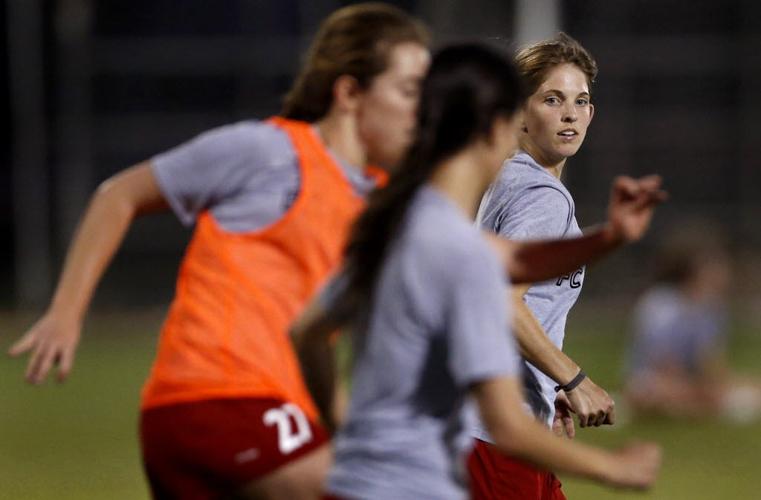
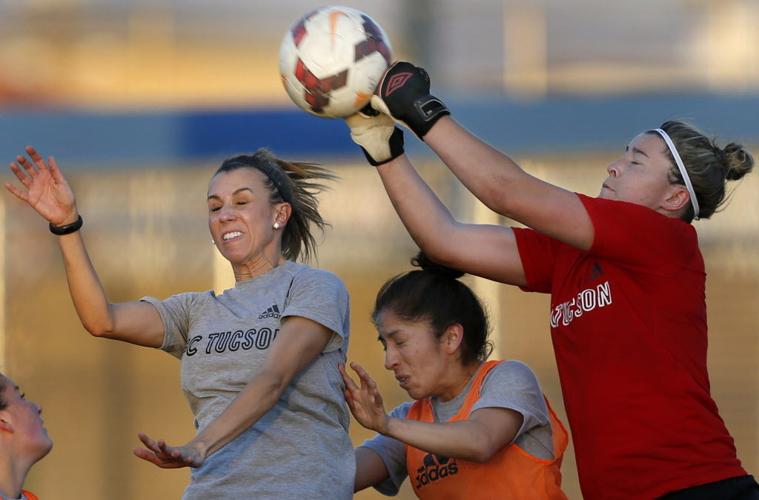
The sidewinding path that FC Tucson players sometimes take back to soccer can be as short as a few months — for a recent college grad, even a few weeks without their sport can sometimes feel like a lifetime – and for others, it can take some pretty big turns.
After her four-year Stanford career ended, Melissa Esparza found herself unable to come to grips with the loss of her primary place of focus: the field. For so long, she’d worked toward all these goals related to this one thing: all-star teams and club teams, high school ball and club ball, starting nods and bending corners.
It was, she said, “my identity.”
“It’s really hard — you put so much of your time and energy into soccer growing up and for so many of these girls, all over the place, it was the biggest part of their lives for 20-plus years,” she said. “It’s very hard to not have something after college to look forward to.”
People are also reading…
There would be no professional career in the offing. Esparza walked on at Stanford after prepping at Tucson’s University High School, and she knew once it was over, it was over. Then the mourning began and took her all the way to South Africa.
On a different continent, half a planet away, Esparza found herself volunteering with an organization called Grass Roots Soccer, which uses the sport to help educate children about HIV and AIDS. She found herself in the process, and her love for the sport, as well.
“That was sort of a perfect transition for me,” says the FC Tucson first-year player, whose team will host Pateadores at 7:30 p.m. on Friday at Kino North Stadium. “I was having a hard time giving up soccer, one of the biggest parts of my life, and this mixed both soccer and health. I was able to see soccer in a different light, not just as a career goal or something I was working at 100 percent of the time.”
She returned to Tucson last summer to begin her residency as an orthopedic surgeon, and this year she returned to the pitch.
And she brought a friend.
Like Esparza, Lea Mac-
Kinnon came to grips with the end of her soccer career long ago. They played together at Stanford in the mid-2000s, overlapping two years from 2005 — MacKinnon’s freshman season — to 2007, Esparza’s last year. MacKinnon, who completed her radiology residency at the UA, dabbled in indoor soccer the last couple of years but hasn’t played outdoors in a while. She’s been with FC Tucson only a couple of weeks, but she’s loving it, despite being, what she calls “brutally rusty.”
“I’m content (with my career),” MacKinnon said. “I’m happily retired and only recently came out of retirement. This is a good way to stay fit, stay out of trouble, and I’m excited to do radiology and have this be my extracurricular deal.”
Both players insist that soccer helped them in their medical careers — taught them discipline, patience, tolerance. “You’re used to being on a team,” MacKinnon said, “and you’re used to suffering a little bit and not complaining.”
Particularly in Palo Alto.
“Coming from Stanford, and Melissa will say this I’m sure — everyone there, you hoped you could be half as good as the people around you, if that,” Mackinnon said. “Then you were perfectly content.”
One thing is clear: FC Tucson head coach Amy Garelick is loading up on wonder women.
“When you have these women here who know this isn’t going to be their career — this is just an avenue, an outlet for them — it’s pretty interesting,” Garelick said. “Look, we have one in nursing school, two doctors, one doing a (physical therapy) internship … ”
Many of them are successful in more than one field, a growing trend, and one that is helping plenty of women succeed in life after soccer.
“There’s sort of a trend with that in general; girls who grow up playing soccer, it gives you a lot of qualities that help you succeed in life no matter what you go into,” Esparza said. “Leadership, discipline, hard work, team work — all those things that are valuable that help you in your career path, whatever that is.”