Editor’s note: This is part of the Star’s ongoing “Big 12 Blitz” series, where we introduce U of A fans to the on- and off-field need-to-know details surrounding each member of the new 16-team Big 12. Today: Iowa State University, located in Ames, Iowa.
The Star's Big 12 Blitz is presented by Tucson Appliance Company.


Tucson Appliance Company has something for everyone! We specialize in new, reconditioned, scratch-and-dent, and high-end appliances. Known for…

is the longtime sports columnist for the
Arizona Daily Starand
Tucson.com.
Confession: Before Arizona was admitted to the Big 12, my knowledge of Iowa State was limited to four things:
One: Iowa State is a wrestling school. Always and forever.
Two: The only time I’ve been to Ames, Iowa, was after an early morning drive from Iowa City, the night after Lute Olson beat No. 3 Iowa in his epic return to Iowa’s Carver-Hawkeye Arena, December 1987. I gave Sean Elliott’s dad, Robert, a ride to the Ames Municipal Airport that morning. He paid for the coffee. A week later Arizona was ranked No. 1.
People are also reading…

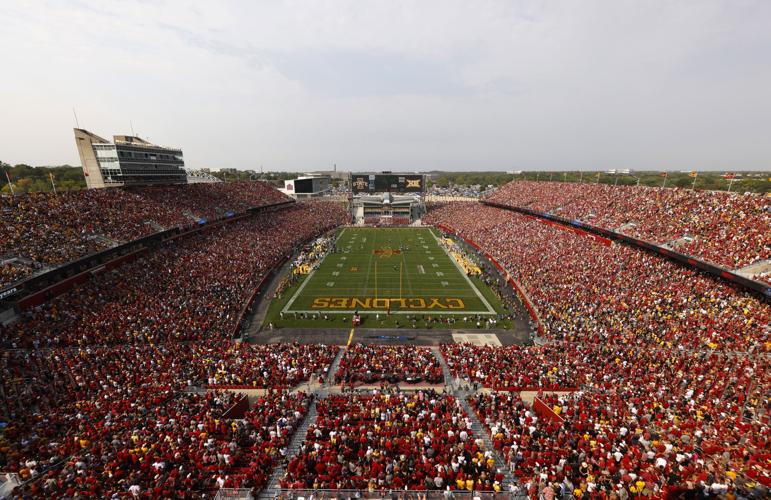
Iowa State takes on Iowa in front of a sellout crowd of 61,500 at Jack Trice Stadium on, Sept. 11, 2021, in Ames, Iowa.
Three: Most sports fans would tell you the most high-profile athlete from Iowa State is San Francisco 49ers quarterback Brock Purdy. Nope. It would be former Cyclones and NBA guard Fred Hoiberg, who is known as “The Mayor’’ in Ames. His jersey No 32 is retired. He grew up near campus and returned home to be ISU’s head coach, finishing No. 9 in the AP poll in both 2014 and 2015. He is to Ames what Steve Kerr is to Tucson.
Four: Because Arizona didn’t go to the Rose Bowl in 46 Pac-12 seasons, I once looked up what school had gone the longest without winning an outright football conference championship You guessed it: Iowa State has spent the last 112 years playing in the Big 12, the Big 8, the Big 7, the Big 6 and the Missouri Valley Intercollegiate Athletic Association without winning a football title (ISU shared the 1912 Missouri Valley conference title).
Iowa State and Arizona have little, almost no sports history against one another. Beginning this season, the Cyclones will be strangers in our midst.
Well, except for these two hangover items that were left on the ISU v. UA table from the 1900s:
It’s pay-back time. The Cyclones don’t play baseball. After 88 years they eliminated baseball in 2001. But no question, the greatest win in Iowa State baseball history came against Arizona in the 1970 College World Series.
It was the Cyclones last (of two) appearances in the CWS, qualifying with a bare 21-9 record and assigned to play mighty Arizona, 44-16, whose coach, Frank Sancet, was playing in his ninth College World Series in 19 years.
Iowa State won, 7-1, shutting down the Wildcats with a freshman pitcher, Donny Powers, whose only “scholarship’’ was $20 a quarter to pay for books. It was not only Iowa’s last appearance in the CWS, it was also Sancet’s. He retired a year later without an elusive national title.
Believe it or not, the most enduring Arizona-Iowa State athletic rivalry — I use the word “rivalry’’ lightly — was in wrestling.
In 1963, Arizona hired legendary Iowa wrestler Bill Nelson — an NCAA champion in 1947, 1948 and 1949 — to teach physical education and coach the new UA wrestling team. Nelson, a graduate of Northern Iowa University, coached six All-Americans at Arizona and was elected to the UA Sports Hall of Fame after he retired in 1981. Somehow, in a wrestling-lite community, Arizona finished in the Top 20 seven seasons.
Nelson was not one to be intimidated. After building the UA wrestling program from scratch, he scheduled Iowa State, making it a multi-year deal, meeting the eight-time NCAA champion Cyclones in 1969, 1971, 1975 and 1976.
It wasn’t pretty. Iowa swept all four matches by a combined score of 154-19. But Nelson persisted. He was elected president of the National Wrestling Federation and, amazingly, was able to schedule the 1976 NCAA Championships at McKale Center. Imagine that.
Iowa and Iowa State dominated. Arizona did not score a point.
“The Hawkeyes and Cyclones could beat 98 percent of the teams in the country with their fourth string,’’ said Nelson, who was elected to the Helms Foundation National Wrestling Hall of Fame.
His national stature didn’t help him much. Only 3,000 attended the NCAA finals at McKale, and thereafter UA athletic director Dave Strack, whose budget was overwhelmed by the UA’s move to the Pac-10, made the difficult decision to eliminate wrestling in 1981.
Many people in the Tucson wrestling community relay a lot of credit for Sunnyside High School’s domination of Arizona prep wrestling to Nelson. Sunnyside’s dynasty began in the 1970s, when Nelson and the UA were at their peak. Sunnyside has since won 37 state championships.

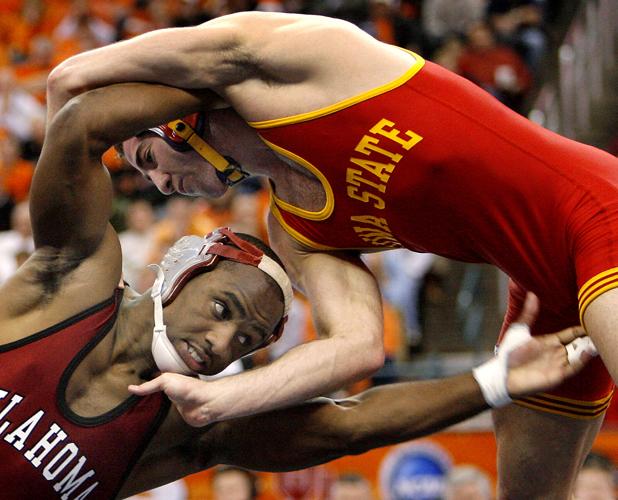
While the Iowa State Cyclones and Arizona Wildcats have some, but not a lot of, history facing each other, perhaps the greatest direct connection for ISU to Tucson: Sunnyside High School wrestling brothers Nate and Nick Gallick, who went on to compete for the Cyclones’ nationally renowned program in the mid-2000s. Pictured, Nate Gallick wrestles Oklahoma’s Teyon Ware in the finals of the 141 pound division at the 2006 NCAA Wrestling Championships. Gallick won the title, 3-2.
Tucson’s wrestling excellence has connected with Iowa State in a most impressive manner. In 2003, Cyclones wrestling coach Bobby Douglas, a four-time a USA Olympic coach, flew to Tucson to recruit Sunnyside’s two-time state champion Nate Gallick, and, later, his brother, four-time state champ Nick Gallick.
How’d it work out?
Nate won the NCAA championship for Iowa State in 2006 and was second a year later. Nick was second in the nation in 2007 and third in 2009 and 2010.
They became part of the colossal Iowa State wrestling legacy, along with wrestling immortals Dan Gable and Cael Sanderson.
So, yes, there is an enduring sports history connecting Arizona and Iowa State. The schools will reconnect Nov. 23 when their volleyball teams play at McKale Center, 48 years after the Wildcats and Cyclones met in the NCAA wrestling finals on the same court.

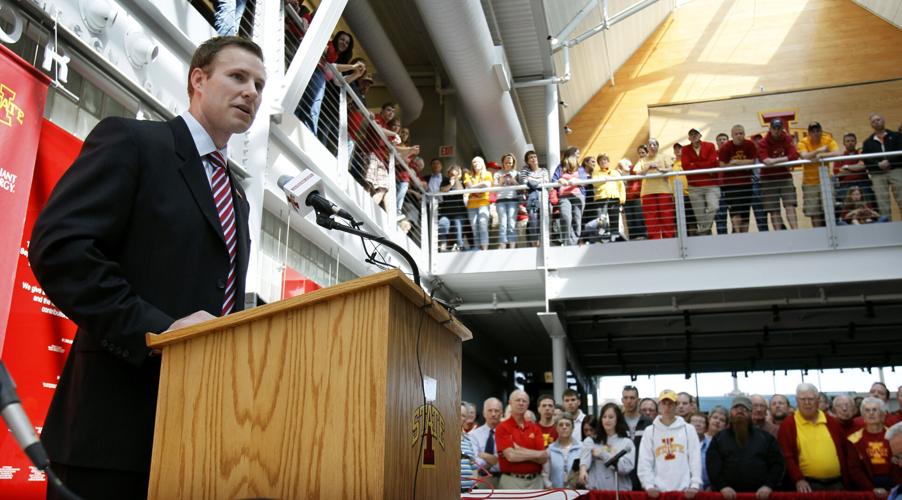
Fred Hoiberg — affectionally known in Ames, Iowa, as “The Mayor” speaks during an April 28, 2010, news conference, announcing Hoiberg’s hiring to coach men’s basketball for his alma mater. Iowa’s high school Mr. Basketball in 1991, Hoiberg was an all-conference player for the Cyclones (his No. 32 retired in Hilton Coliseum), before playing a decade in the NBA. As head coach, he’d lead ISU to four NCAA tourney appearances in five seasons, including a Sweet 16 run in 2014. He left Ames for an NBA head coaching job, leading the Chicago Bulls for three seasons before returning to college basketball as head coach at Nebraska in 2019.
Contact sports columnist Greg Hansen at GHansenAZStar@gmail.com. On X(Twitter): @ghansen711

Greg Hansen
Columnist