

CARLSBAD CAVERNS NATIONAL PARK, N.M. - One by one, the tourists' headlamps grow dim and disappear as they venture farther into a fracture in the limestone, deep beneath the surface of southern New Mexico's scrubby desert.
They shimmy through a narrow cave passage, ducking to keep their helmets from scraping tiny crystals overhead as they leave behind a huge subterranean chamber filled with towering columns of calcite and otherworldly formations that have captivated explorers and scientists for more than a century.
This is exactly what the novice cavers signed up for - a personal tour of the underground backcountry of one of the most famous - and unique - cave systems in the world, Carlsbad Caverns National Park. For less adventurous visitors, there are paved paths, hand rails and lights in other parts of the caverns. But here, more than 800 feet down, the beauty that nature spent eons perfecting is intertwined with the challenges of negotiating slippery flow stone and squeezing from one chamber to the next through slots with names such as "The Florida Key."
People are also reading…
For ranger Mark Joop and his group of 12 amateur cavers, the excitement comes from anticipating what's around the next bend in a portion of the park called Lower Cave.
"Caves are like the unknown," Joop says. "Since I can't go to the moon and explore other planets, this is the last unknown realm on the planet. We've gone to the highest peaks and everything, but there's so much yet to be found and explored here underground."
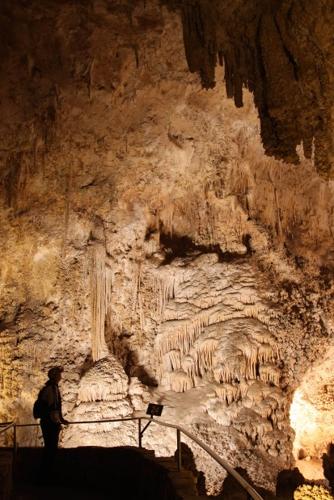
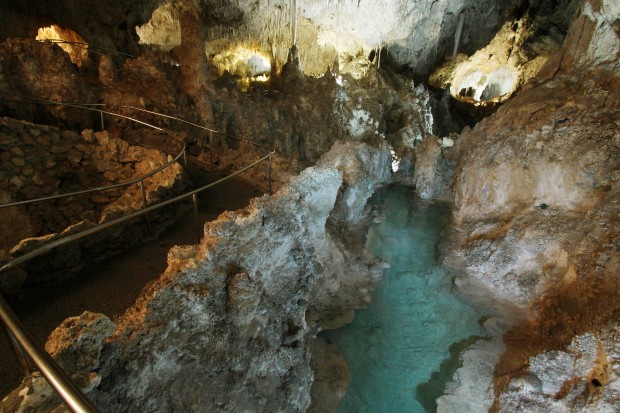
More than 400,000 people visit Carlsbad Caverns each year to get a glimpse of the monumental stalagmites and stalactites, delicate soda straws, translucent draperies and reflective pools that decorate the park's main attraction, the Big Room. But only a fraction of visitors get a chance to experience the more extreme tour through Lower Cave or a lantern-lit history lesson in Left Hand Tunnel.
And because of limited reservations for "off-trail" tours, even fewer people get to crawl through the Hall of the White Giant and Spider Cave, which are the most difficult - and quickly booked - of the ranger-guided caving tours.
Joop finds a spot along the narrow passage in Lower Cave where everyone can gather around.
As they stand crammed shoulder to shoulder with their headlamps blinding one another, he makes a suggestion: Turn off your lamps, your cameras and anything else that might glow.
In a few seconds, darkness takes on a whole new meaning.
"Try waving your hand in front of your face," he says. "Some people claim they can see their hand moving, but that's just your brain freaking out, thinking that it can actually see something. It's just too dark."
Aside from the absolute blackness, the silence inside the passage is stifling. Everyone holds their breath to see how quiet it is. There's no dripping water, no breeze, no crickets, nothing.
Actually, though, crickets have found a way to survive quietly deep inside the caverns. Rangers point them out along with horsehair worms in the drip pools when a scanning headlamp is lucky enough to spot one of the elusive creatures.
There are also the mummified remains of a not-so-lucky bat along the trail and another whose tiny body was entombed in a stalagmite as it formed eons ago.
Carlsbad Caverns' discovery was something of an accident. As the story goes, teenage cowhand Jim White was mending fences just before sunset and saw what looked like a plume of smoke rising in the distance. When he got closer, he realized it was a cloud of bats pouring from the mouth of the cave for their nightly dinner run. That was around 1898.
Over the next few years, White spent much of his time underground, exploring with an oil lamp fashioned from a coffee pot and homemade ladders made from fence wire and wood.
Photographs of the caverns made their way into The New York Times, followed by a National Geographic Society expedition that put the place on the map in 1924. In 1930, Congress designated Carlsbad Caverns a national park.
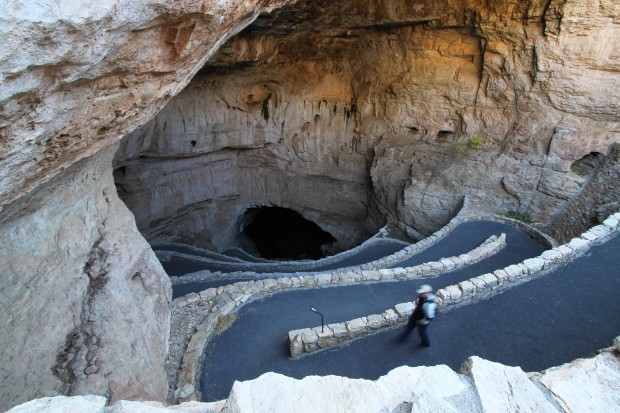
For those not up to hiking the steep paved path that winds down from the cave's natural entrance, a high-speed elevator zips down the 75 stories in less than a minute. Long before the elevator and paved walkway, cave visitors rode in huge buckets on a rope-and-pulley system erected by workers who mined guano (bat droppings) for fertilizer.
The fascination with Carlsbad Caverns comes partly from the way it was formed, a process responsible for just 5 percent of the world's caves. It started 250 million years ago with the creation of a reef formed from the remains of sea sponges and other creatures. Then came evaporation, erosion and uplift.
Rainwater seeped down while hydrogen sulfide-rich water migrated upward from the vast oil and natural-gas deposits below. The resulting sulfuric acid ate away the limestone, forming the massive chambers that visitors see today.
"It's fantastic. It's so beautiful you just want to touch everything, but you can't," said Judy Weinberg of Toronto. The rangers' mantra is: Don't touch! The oil from hands and skin damages cave formations.
"This is caving 101," Joop tells his group. "There are ropes, three flights of ladders, slippery surfaces and narrow passages. Does any of this scare anybody?"
No way! This was why they signed up.
The park has been offering adventure tours since 1995. Aside from giving tourists a chance to see parts of the cave that are normally off-limits, the tours help rangers educate visitors about just how fragile the caverns are.
"That's why we have limits now. There has to be a balance between preservation and access," said Marie Marek, the park's chief of interpretation.
Joop hopes the tours provide a taste of excitement and mystery.
"It's a world that most of us don't get to experience," he says, "and when you have an opportunity like this, it gives the normal person a chance to see what the underground world is like."
If you go
• Carlsbad Caverns (www.nps.gov/cave): Click on "Fees and Reservations" to see options for ranger-guided tours. Many guided tours sell out, so reserve well in advance. Guided-tour fees, $7-$20; admission for self-guided tours, $6. Open daily year-round. Through May 27, last cavern entry is 2 p.m. via cavern entrance, 3:30 p.m. via elevator. (Longer hours in summer.)
• Carlsbad Caverns National Park is a seven-hour drive, or about 465 miles, east of Tucson. Take Interstate 10 to El Paso, then take US 62/180 to Whites City and turn north on New Mexico 7. The entrance road stretches a scenic seven miles from the park gate at Whites City to the visitor center and cavern entrance.


