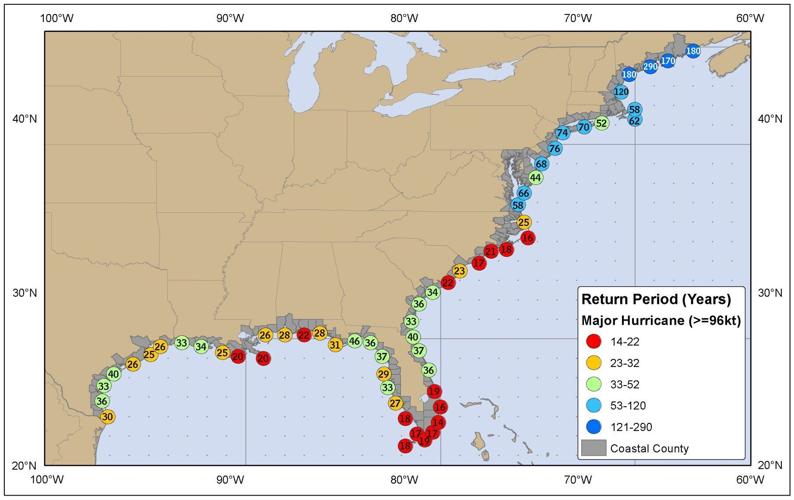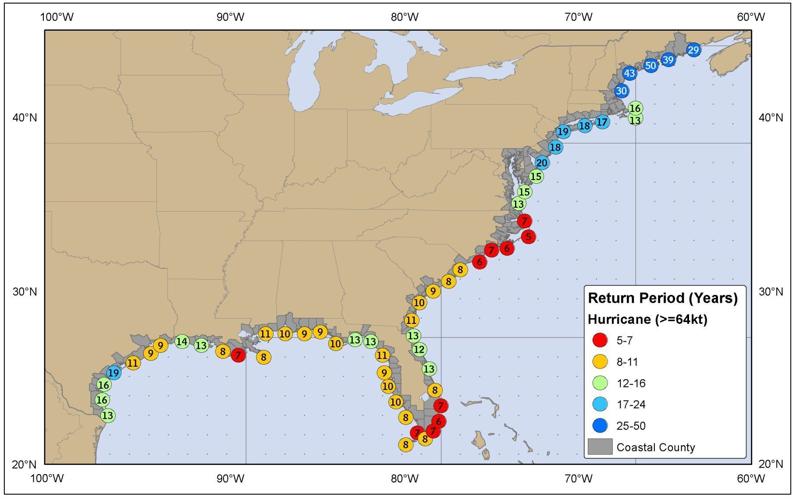

The return period for a hurricane to strike the South Jersey coast is every twenty years, on average and every 68 years for a Major, category 3 or greater hurricane. This is one of the lowest on the Eastern Seaboard and it all comes down to location, location, location.

On average, South Jersey sees a hurricane within 58 miles of South Jersey once every 20 years. A hurricane has not made landfall in New Jersey since 1903.

South Jersey averages a major, category 3 or greater hurricane within 58 miles of the shore, once every 68 years.
With the exception of coastal Massachusetts and Maine, South Jersey is the least likely place to see a direct hurricane landfall. Even compared to the northern Jersey Shore, we are less likely. Of course, that does not mean we do not have our brush bys with tropical storms (Irene) or the heavy remnants of a storm (Lee).
Much of this comes down to two factors, longitude and latitude.
Let's start with the longitude. South Jersey does not jut out into the open water like Maine, Cape Cod or Long Island does on the map. Also, tropical systems generally weaken quickly after landfall. Therefore, these places, just because there is not much land to their south, makes them more susceptible for a clean run in with a hurricane.
People are also reading…
Directly to our south is open water but just to the south-southwest is Virginia Beach, Norfolk and the Outer Banks. Since tropical systems typically run in a north to northeast direction, unless a odd storm path comes about (like Sandy), a tropical system will need to thread the needle for an uninterrupted path to our area.
Second, it comes down to latitude. To maintain their strength and grow, a tropical system needs ocean waters of about 80 degrees. According to the National Oceanic and Atmospheric Administration, average coastal waters in Atlantic City do not rise above 73 degrees. Therefore, by the time a hurricane is nearby, they lose strength, dropping it below hurricane status.