
THE RIALTO – Tucson’s finest appointed theater, built at a tremendous cost, will be the most perfect photo play house in Arizona — perfect not alone in its artistic appointments, but from a practical standpoint as well.
[photo moved to image asset]
1920 Star files
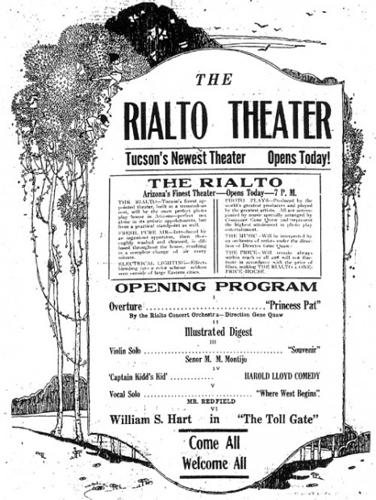
The advertisement for opening night.
It was Aug. 29, 1920, when the Rialto Theater opened its doors for the first time. The gala evening featured not only a motion picture, but also musical and vocal solos and an orchestra under the baton of an esteemed conductor from back east.
FRESH, PURE AIR – Introduced by an ingenious apparatus, then thoroughly washed and cleansed, is diffused throughout the house, resulting in a complete change of air every minute.
People are also reading…
ELECTRICAL LIGHTING – Effects blending into a color scheme seldom seen outside of large Eastern cities.
The Rialto’s special light system featured lights that could be switched into four colors, white, green, red and a deep shade of blue. The blue ones would be used during the movies.
[photo moved to image asset]
1984 Star photo
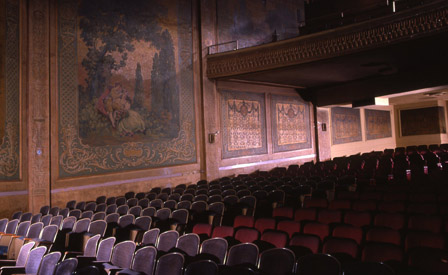
The interior of the Rialto Theater in 1984.
The walls were decorated in old rose, blue and gold, with draperies and seats in grey. The floor was a dark blue. On each side of the stage were two paintings that were recessed into the wall.
PHOTO PLAYS – Produced by the world’s greatest producers and played by the greatest artists. All are accompanied by music specially arranged by Composer Gene Quaw and represent the highest attainment in photo play entertainment.
THE MUSIC – Will be interpreted by an orchestra of artists under the direction of Director Gene Quaw.
The Rialto accommodated 1000 people, with the choicest seats the 100 in the mezzanine. There was a balcony for 200 and the main floor seated 700.
Both road shows and vaudeville acts could perform on the new theater’s large stage. And the audience would watch movies projected on two modern Simplex machines. No mention of a sound system as the movies were silent.
[photo moved to image asset]
1920 Star files
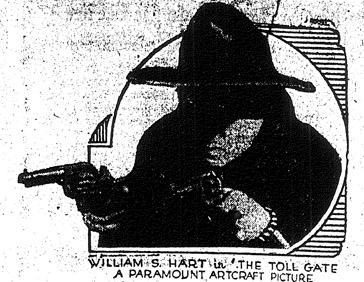
William S. Hart as Black Deering in “The Toll Gate.”
The movies showing on that first night were the Harold Lloyd comedy “Captain Kidd’s Kid” and a William S. Hart western flick called “The Toll Gate.” It was about an outlaw who wanted to give up his bandit ways, but first he had one more job to do. Alas.