BEIJING — AI and alcohol have three main similarities, according to Beijing bar owner Song De: hallucinations, bubbles and distillation. As AI enthusiasm sweeps across China, Song hopes his bar can ride the wave.
He opened AGI Bar, named after the concept of artificial general intelligence where AI systems surpass human intelligence, last year in Zhongguancun, the capital's high-tech neighborhood in the Haidian district. It is now a hub for Beijing's AI developers, investors and students.

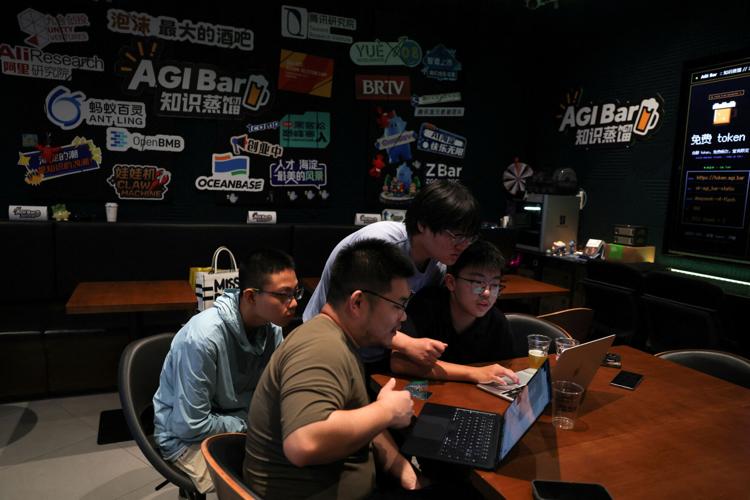
Song De, owner of the AI-themed bar AGI Bar, discusses AI-related issues with customers on Sunday in Beijing's high-tech neighborhood of Zhongguancun, China.
"You'll see people sitting around a table coming from different labs, competing companies, and different universities, all chatting about industry trends right here," said Song, an independent AI developer in his 30s who runs the bar in his spare time.
Located on Zhongguancun's Inno Way startup street, the bar is a stone's throw from the elite Tsinghua and Peking universities that produce China's top AI talent, as well as the offices of well-known Chinese and Western tech firms, including DeepSeek and Microsoft. It has hosted parties for Chinese AI labs including Z.ai, and regularly holds developer seminars, open-source AI symposiums and university research meetups.
People are also reading…

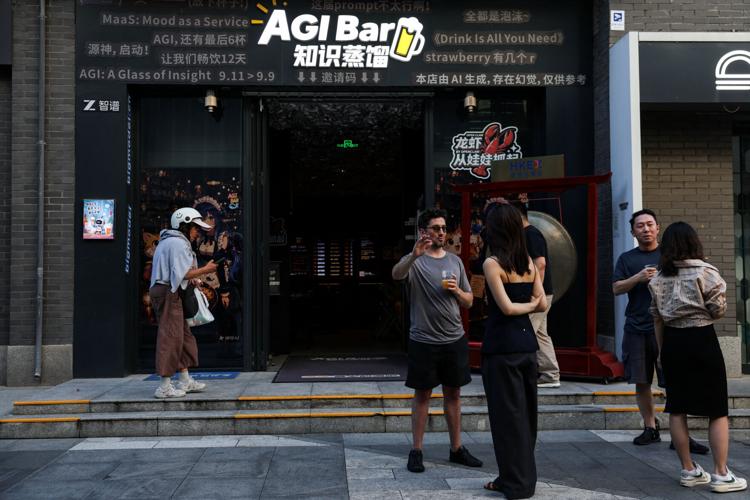
Customers chat on Sunday in front of the AI-themed AGI Bar in Beijing's high-tech neighborhood of Zhongguancun, China.
"This is a very unique and advantageous location," Song said. "Haidian (district) has always been the heart of scientific research in China. Internet companies are clustered here, and the tech atmosphere, industry investments, and VC incubators provide massive momentum for the sector."
Inside, the walls are plastered with logos, colorful figurines and merchandise from China's major AI firms, while the giant brass gong struck by Z.ai when it listed on the Hong Kong Stock Exchange in January stands proudly outside the entrance.
The bar is a symbol of China's drive to use AI to turn its economy into a high-tech powerhouse, which has even led retirees to adopt AI agents and made coding education for primary school children mainstream. The initiative has already brought about some job disruption and prompted universities to add AI to their curricula.

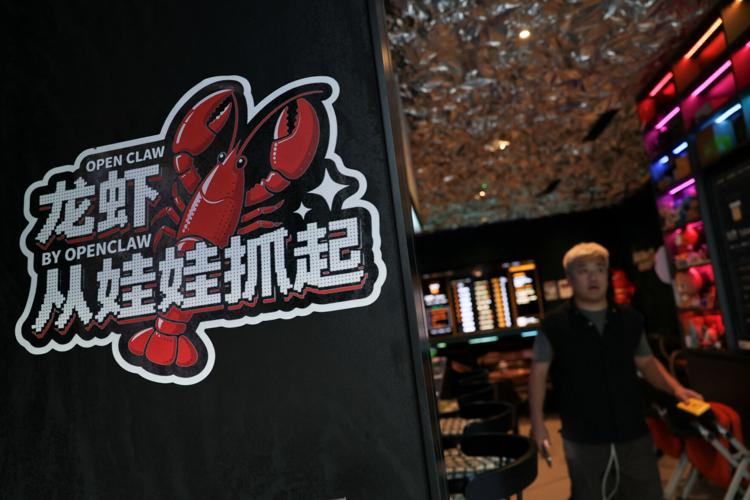
A sticker representing OpenClaw is pictured on Sunday at the AI-themed AGI Bar in Beijing's high-tech neighborhood of Zhongguancun, China.
DeepSeek tokens for customers
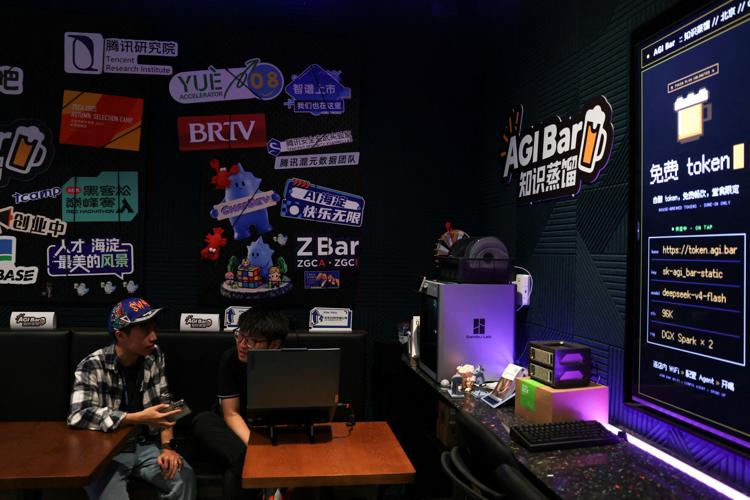
The bar's signature drink, also called AGI, is a $1.50 glass of foam. Customers can connect to the bar's AI agent through WiFi to access free unlimited DeepSeek tokens for coding, which run on two Nvidia DGX Spark computers on display.
"We say AI is a future public utility like water, electricity and the internet. AI should be like WiFi," said Song, who believes the discovery of AI is more important than the Industrial Revolution.
The bar's registered Chinese name means "knowledge distillation," a tongue-in-cheek pun on liquor distillation and AI model distillation.
"First off, it's an AI technical term for transferring knowledge from large models to small ones, but between humans in a bar, that's also a form of knowledge distillation," said Song.

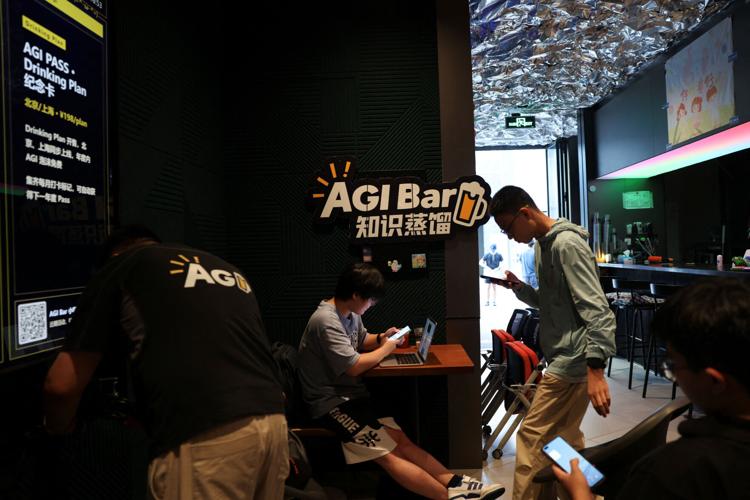
Customers chat on Sunday at the AI-themed AGI Bar in Beijing's high-tech neighborhood of Zhongguancun, China.
Bar to add humanoid robots
Although the bar still employs people, Song has automated many of its systems for inventory, reservations, utilities and membership.
Due to huge demand, Song hopes to expand the bar's Beijing floor space this year and use humanoid robots, another symbol of China's innovation drive, to serve customers drinks. He opened a Shanghai branch in June.
"We've hooked up all our lighting, software and hardware in the store to APIs for AI processing. We're trying not to waste human labor on tedious, unnecessary operational tasks," he said.
However, like many Chinese open-weight models that users can access for a much lower cost than U.S. proprietary AI models, Song is yet to make money.
"The bar is completely losing money," he said. "The amount of drinks given away is definitely 10 times more than what's sold."

Customers use their phones on Sunday at the AI-themed AGI Bar in Beijing's high-tech neighborhood of Zhongguancun, China.