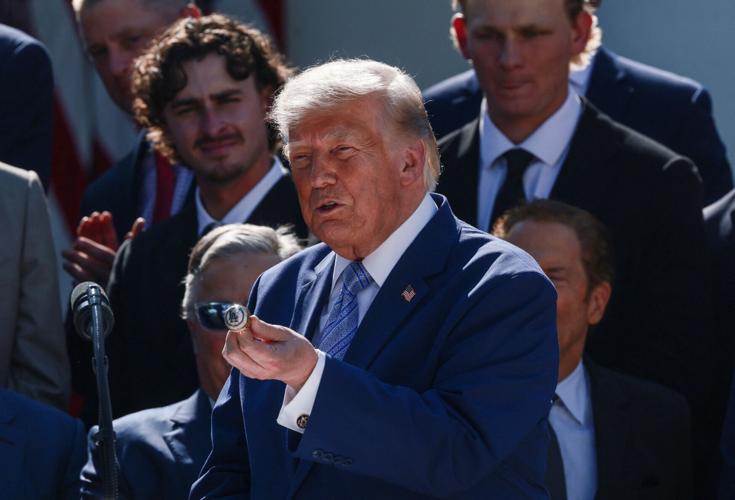

President Donald Trump holds a World Series ring Thursday while hosting a reception for the reigning Major League Baseball World Series champion Los Angeles Dodgers in the Rose Garden at the White House in Washington.
WASHINGTON — The United States imposed new tariffs of 10% and 12.5% on goods from 60 trading partners Friday, including the EU and China, alleging those countries failed to suppress imports made by forced labor, just as a temporary 10% global tariff expired.
The move is the White House's first step in efforts to rebuild President Donald Trump's near-global tariff wall after the U.S. Supreme Court in February struck down his "reciprocal" duties of 10% to 50% imposed last year under a national emergencies law to try to shrink the U.S. trade deficit.
Meanwhile, two U.S. small businesses on Friday challenged Trump's latest round of tariffs, saying that the new policy, like most of Trump's previous tariffs, went beyond the president's authority to tax imports.
The lawsuit, filed in the U.S. trade court in New York, argues that the new tariffs require more detailed country-specific findings about "forced labor" to be legally justified. The two small businesses, backed by a nonprofit legal group that successfully sued over previous rounds of tariffs, argued that the president is trying to reimpose tariffs that were already ruled illegal by the U.S. Supreme Court.
People are also reading…
New tariffs were expected, but trade partners around the world joined in strongly disputing the justification for them. Some, however, noted they would make no difference to current levies or even marked a slight improvement.
Bond yields edged higher as the tariffs added to inflation risk, but reaction was generally limited in financial markets more focused on the Middle East conflict.
The new tariffs, announced in a Federal Register notice, cover 99.4% of U.S. imports but include product exemptions such as oil and gas, fertilizer and certain food items.
Forced labor claims
The Trump administration claims trading partners failed to clamp down on trade in goods made with forced labor passing through their supply chains, an accusation those countries deny.
"The United States has had a forced labor import ban for nearly a century, and rigorously enforces it. It’s well past time for our trading partners to do the same," U.S. Trade Representative Jamieson Greer said in a statement.
"Today’s action will begin to correct what is both a human rights abuse and distortive trade practice to improve the welfare of workers everywhere."
Imposed under Section 301 of the Trade Act of 1974, the new duties allow the administration to maintain a tariff floor on virtually all U.S. imports despite the Supreme Court setback. The tariffs are also likely to face less legal risk as Section 301 survived prior court challenges.
Trump's temporary 10% global tariff expired at 12:01 a.m. EDT on Friday after 150 days. The new duties took effect at that exact same moment, with goods in transit exempted until 12:01 a.m. EDT on Tuesday.
Tariff details
The U.S. imposed a 10% duty on goods of Argentina, Bangladesh, Britain, Cambodia, Canada, Ecuador, El Salvador, Guatemala, Honduras, India, Indonesia, Jordan, Malaysia, Mexico, Pakistan, Sri Lanka, Trinidad and Tobago saying they had bans or plans to ban forced labor imports but were not effectively enforcing such prohibitions.
The European Union, Taiwan, Japan, South Korea and Switzerland were assigned rates that, combined with preexisting most-favored-nation tariff rates, totaled 10% or 12.5%.
The other 38 countries were assigned a 12.5% rate. These include Vietnam, which issued a new decree this week that sets out more detailed rules banning imports of goods made with forced labor, and China – accused by the U.S. of detaining Uyghur minorities in work camps, which Beijing denies.
Greer previously pledged that for countries with trade deals with Washington capping U.S. tariff rates, the new forced labor duties would not push them above those caps — a point which the European Union noted in its response.
"The EU notes positively the fact that this outcome is in line with the U.S. tariff commitments agreed under the EU-U.S. Joint Statement," a European Commission spokesperson said, adding it provided "positive momentum" to continue the work on exploring further tariff exemptions and deepening cooperation.
French Trade Minister Nicolas Forissier said that, while the legal basis raised questions, the tariffs nonetheless provided greater visibility for businesses.
While disputing the allegations underlying the forced labor investigation, the Swiss government also said the United States was adhering to past commitments on tariff ceilings, in its case of up to 12.5%.
Former EU chief negotiator Ignacio Garcia Bercero, now a senior fellow at think tank Bruegel, said the United States sought to ensure the new duties respected the tariff aspects of the EU-U.S. trade deal, but noted that additional tariffs from a further Section 301 investigation into excess capacity were still to come. That targets 16 trading partners, including the EU, China, India, Japan, South Korea and Switzerland.
Britain, which is not a target of that second probe, said the latest move would have no negative effects.
"Our agreement with the U.S. remains in place, and today we see an improvement to our trading terms with zero tariffs on whisky and medical technology," a government spokesperson said.
Telegraphed move
The action drew stronger protests from some trade partners.
China said it opposed all unilateral tariffs, adding that trade wars did not serve any parties.
Trump administration officials told Chinese counterparts they intend to rebuild Trump's second-term tariffs on Chinese goods back up to the 20% that was agreed upon in a trade truce with Chinese President Xi Jinping in November 2025 — but not exceed that level. Prior to Friday's action, China's tariff rate had fallen to 10%, excluding the 25% imposed during Trump's first term on industrial goods.
Australia and Brazil described the new tariffs as unjustified and said they would seek to have them removed, while Norway said there was "no basis" for them. Canada — hit on Monday with new Trump tariffs on $20 billion worth of goods — issued a muted response.
"We will continue engaging constructively with the United States on this matter, as well as other outstanding issues, over the coming weeks to the mutual benefit of our citizens," said Dominic LeBlanc, Canada's minister in charge of U.S. trade.

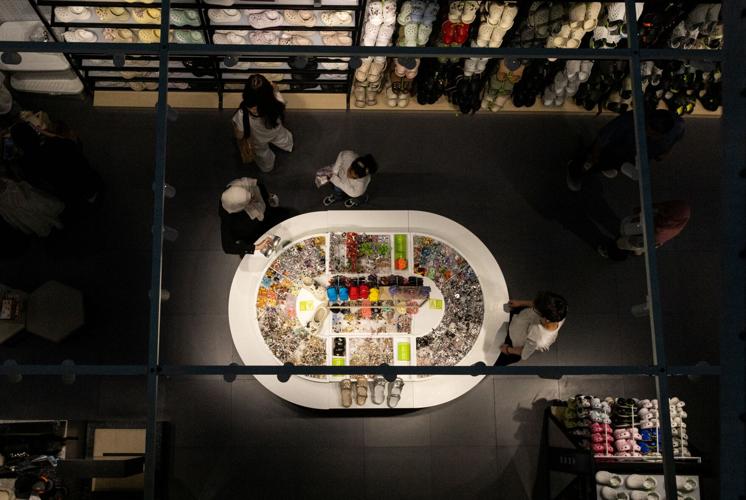
People gather Friday in the Crocs store in a shopping mall in Beijing.

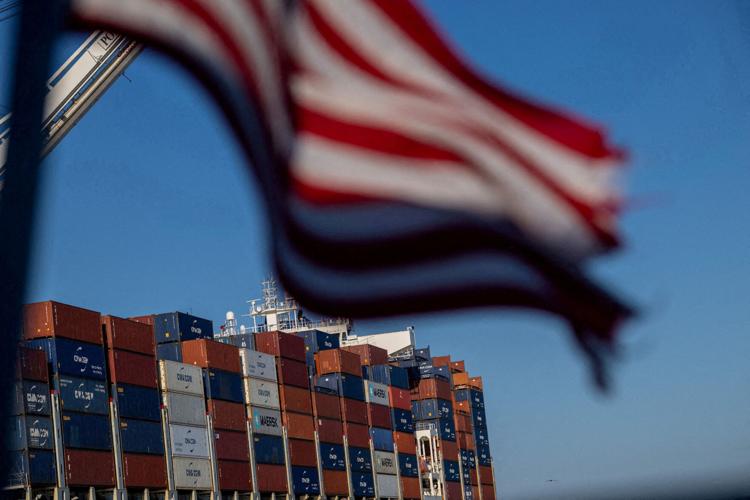
A cargo ship full of shipping containers is seen Aug. 4, 2025, at the port of Oakland, Calif.

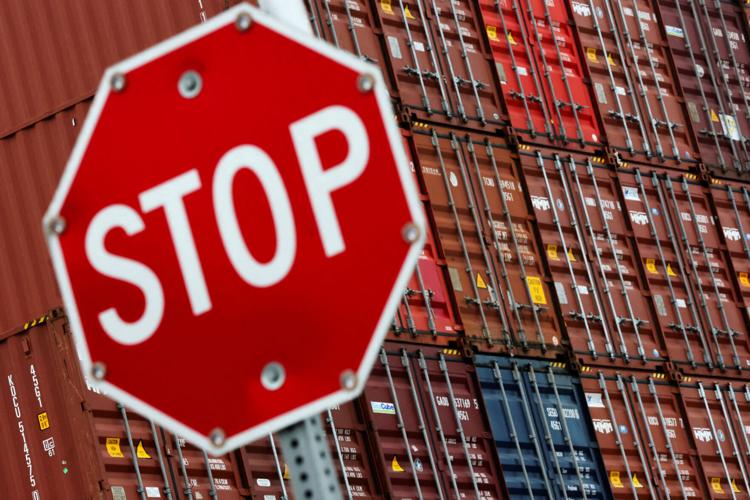
A stop sign is pictured July 11, 2025, in front of shipping containers at the Port of Long Beach in Long Beach, Calif.

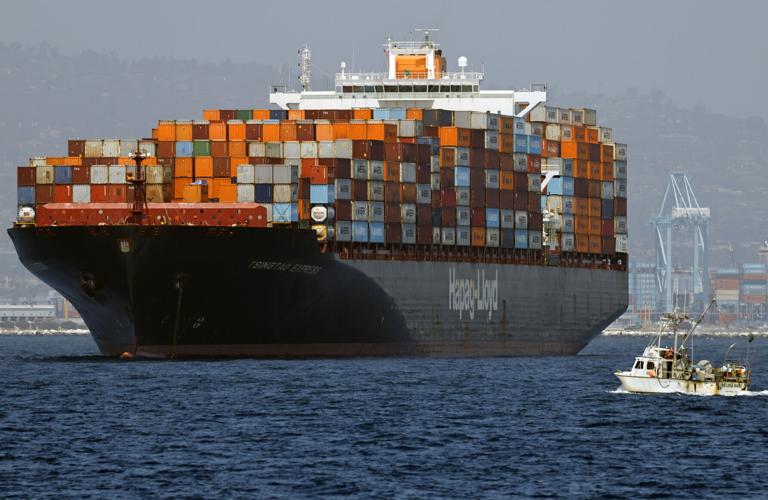
A fishing boat passes a container ship floating July 17 off the Port of Los Angeles.