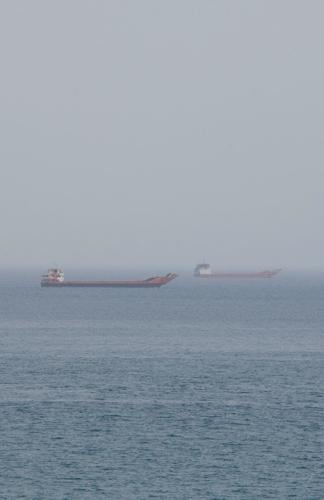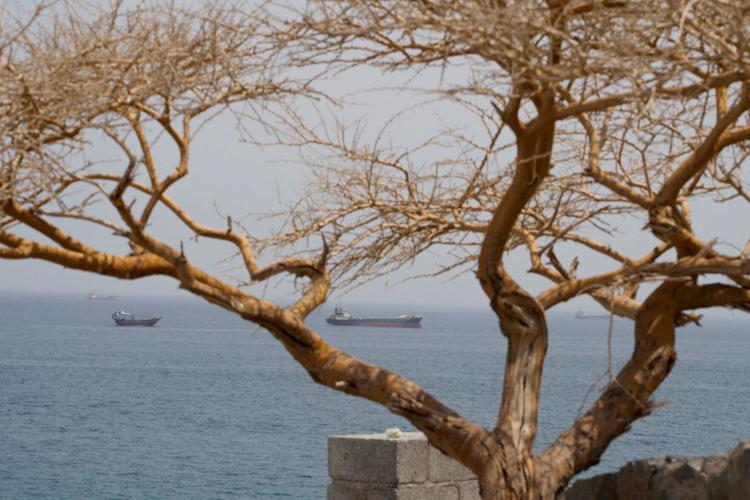

Vessels are seen in the Strait of Hormuz on Monday from Musandam, Oman.

Vessels are seen in the Strait of Hormuz on Monday from Musandam, Oman.

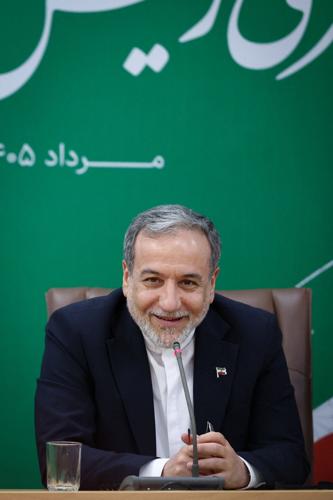
Iranian Foreign Minister Abbas Araghchi attends a news conference of Iranian President Masoud Pezeshkian on Saturday in Tehran, Iran.
WASHINGTON — President Donald Trump responded Monday to Iran's conditions for a peace deal with his own demands that Iran pay compensation for people killed in wars, attacks and protests, in a rhetorical escalation likely to complicate efforts to reopen the Strait of Hormuz.
Trump's proposal, which wasn’t raised before, was a response to Tehran's demands for compensation and an end to sanctions. The Iranian demands were largely in line with the terms of a preliminary peace deal signed in June, which since broke down.
Since the war began in February, Trump repeatedly oscillated between threats of escalation and claims that a peace deal is imminent.
"We're going to ask for money for the damage they've done over a 50-year period," Trump said at the White House, saying payments would cover deaths among both civilian demonstrators and U.S. forces in the region.
People are also reading…
"So if there's damages to be paid, I think Iran should pay those damages," Trump said.
Oil prices settled 5% higher on Monday after the demands dimmed prospects for a deal to reopen the strait.
Compensation
Referring to Tehran's crackdown on demonstrations in late 2025 and 2026, Trump said Iran killed about 52,000 protesters as of six weeks ago. While some Iranian opposition and exile groups claimed tens of thousands killed, the U.S.-based Human Rights Activists News Agency in February reported about 7,000 deaths including 6,500 protesters.
Trump encouraged protesters to overthrow the Iranian government when the war began with U.S. and Israeli airstrikes in February. Rights groups say the Iranian government continued to crack down on opponents since then.
Trump also said Iran should compensate families of the 17 U.S. sailors killed in an October 2000 attack in Yemen on the naval vessel USS Cole, which has been blamed on al-Qaida, not Iran.
"Also, with respect to the Iran negotiations, Iran should be responsible for the damages and death caused to the people of Lebanon, Syria, Yemen, and Gaza!" Trump wrote on social media.
Iran earlier said it was nearing a final pact with Oman defining new shipping lanes between them through the Strait of Hormuz but repeated that the U.S. must meet conditions, including compensation and an end to sanctions and military threats before the key waterway is reopened.
The strait, through which about a fifth of global oil and liquefied natural gas flowed prior to the conflict, has been effectively blocked since the war began, pushing up oil prices and inflation.
Under pressure
Ironically, the agreement with Oman would give Tehran more leverage over the key waterway than it had before the war began.
Trump is under pressure to end a war that is deeply unpopular at home ahead of midterm elections in November, and high fuel prices are a top issue in rural areas that have backed him in the past.
"What you're seeing here is the beginning of a capitulation," Democratic U.S. Rep. Bill Keating said on CNN. "This is reality. It's sinking in."
Earlier on Monday, Iranian Foreign Ministry spokesman Esmaeil Baghaei said talks with Oman were "progressing smoothly and constructively," with an agreement reached on a shipping route map, while some technical issues remained unresolved.
Baghaei said the discussions also covered services which would normally involve payment, such as safe navigation, environmental protection, maritime services and combating crime.
U.S. officials repeatedly ruled out any deal that would allow Tehran to charge fees for access to the strait.
But months of U.S. military efforts, including a two-week campaign of strikes in July, have not broken Iran's grip on the strait, despite Trump's misleading claim, repeated on Monday, that the strait was open and, "The only one that has control of the Strait of Hormuz right now is the United States Navy."
Washington and Tehran agreed to a ceasefire in June, but the U.S. reimposed a blockade on Iranian shipping in July, a move that Tehran said violated the truce.
Iran has been striking back with missiles and drones against Washington's allies in the region, while also targeting commercial ships transiting the strait without its permission.
Oil spill
Meanwhile, leaking crude oil from a tanker grounded off a nature reserve in Oman created a slick covering about 150 square miles, the country's government said on Monday.
The Caroline Bezengi is loaded with close to a million barrels of Russian oil bound for Asia and first reported difficulties on June 8 off Yemen, with two maritime security sources saying initial assessments indicated a blast had occurred onboard.
No party has taken responsibility for attacking the vessel.
Oman, in its first public disclosure on the environmental impact, said on Monday it seeks to tackle the oil leak near the Hallaniyat Islands.
Oman's Sultan Haitham bin Tarik issued a royal decree last year creating a nature reserve around the islands, an area that is home to wildlife including Arabian Sea humpback whales and Socotra cormorants.
A spill of this scale requires dispersant be sprayed across the affected area by aircraft and the use of booms and other equipment to collect the oil before it reaches the shore or sinks to the seafloor, said Tony Gutierrez, professor of environmental microbiology and biotechnology at Edinburgh's Heriot-Watt University.
"If this oil is kept offshore, the impact will be much less than if the oil reaches shallower waters and the actual coastline," he said, citing the impact on diverse marine life such as coral, birds and fish.

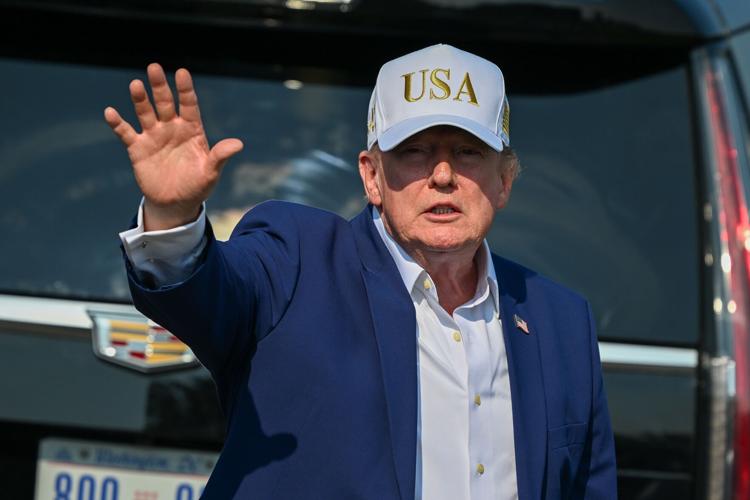
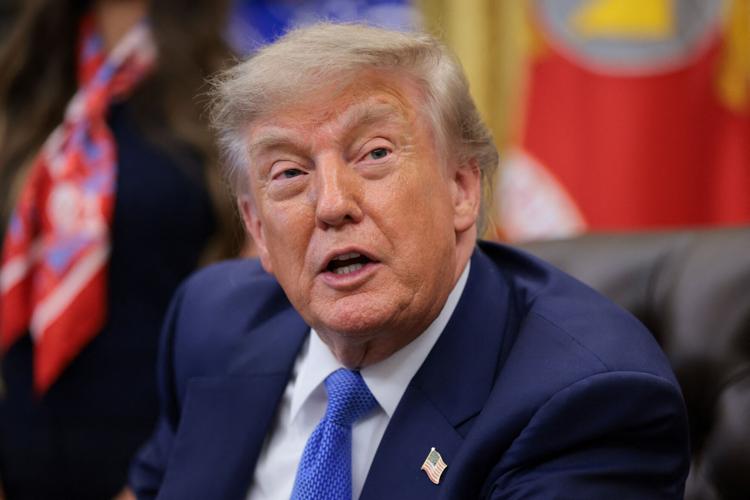
U.S. President Donald Trump speaks Monday in the Oval Office at the White House in Washington.