

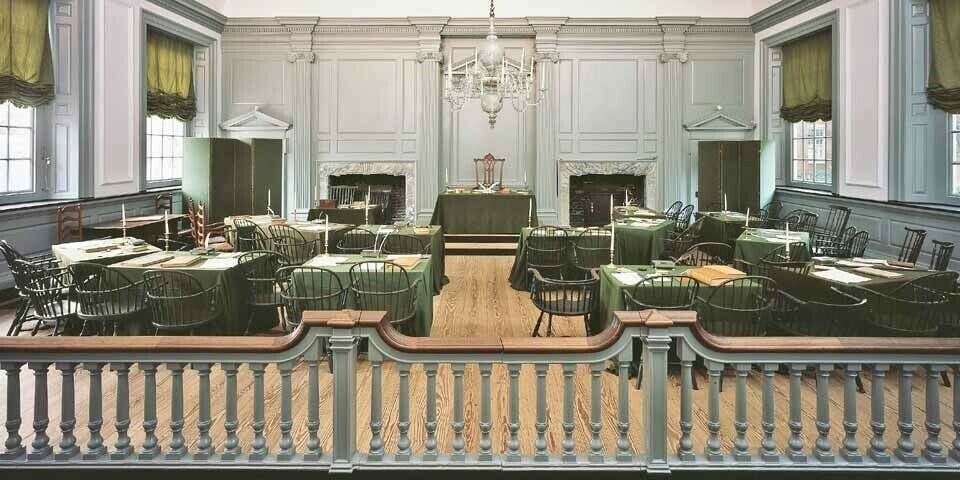
I recall standing on the hard, rough-hued wooden floor of Independence Hall in Philadelphia, the crucible of our nation's freedom, where 56 patriots signed the Declaration of Independence. Little did they know that what they signed would set our nation on a course toward democracy and freedom. In a time of war, the unknowns were immense. The potential loss of life and everything they owned hung in the balance during the Revolutionary War, a risk they faced with courage.
I was allowed to walk freely in the restricted area between tables and desks draped in green cloth, spindle-backed wooden chairs, feather quills in inkpots, candlesticks, books and documents scattered about—the sizeable crystal chandelier overhead, crowning the room's ceiling, in the center of the chamber. Two grand fireplaces framed the Speaker's high-back chair and elevated desk. The Speaker's Rising Sun chair was adorned with a gold sun and a red liberty cap carved into the chair's top rail at the room's far end. I heard my heels click on the hard-worn, historic floor's heavily grained timber.
People are also reading…
I stood in the birthplace of American democracy, in the footsteps of true American patriots. There were Thomas, Benjamin and Big John; 56 compatriots were willing to risk it all for freedom. Our founders' oratory, eloquence and resolute declarations thundered through this hall.
What they said and accomplished in this room on this floor is nothing short of a miracle. Our Declaration of Independence and U.S. Constitution were debated and adopted, then, with pomp and flourish, signed in this chamber—the test of American democracy and freedom—while our fledgling America was at war.
In the fall of 1976, I was honored to walk across this revered floor with Shirley Temple Black, U.S. Ambassador of Protocol for the State Department in President Ford's administration. (That would be Shirley Temple, of Hollywood's "The Good Ship Lollipop" fame.) She served as the U.S. State Department's Ambassador of Protocol under President Ford. I was a registered foreign agent representing Liberia and responsible for traveling with William Tolbert Jr., the President of Liberia. He was on a two-week official State visit. We toured this celebrated assembly hall in the City of Brotherly Love, Philadelphia. The dignitaries in the group were invited to walk beyond the visitor's railing onto the legislative floor. The memory of this experience is indelibly etched in my mind.
July 4 is the unofficial midpoint of summer, and Independence Day celebrations date back to the 18th century and the American Revolution. On July 2, 1776, our Continental Congress voted for independence from Great Britain and King George III. On July 4, delegates from the 13 colonies adopted the Declaration of Independence, drafted by Thomas Jefferson.
On July 4, 1778, General George Washington doubled the rum rations for all his soldiers to honor the anniversary of Independence, even as combat continued. On the 50th anniversary of the adoption of the Declaration of Independence, John Adams and Jefferson died on July 4, 1826, just down the road from each other's estates near Charlottesville, Virginia. Jefferson outlasted Adams by five hours. Later, in 1831, James Monroe died on July 4—the three served as Commander in Chief for our burgeoning nation.
In 1941, Congress established the Fourth of July as a paid federal holiday. That same year, President Franklin Roosevelt delivered his July 4 address over the radio from the Roosevelt Library in Hyde Park, New York. He proclaimed the holiday an American tribute, calling it "a beacon for the world in its fight for freedom."
We Americans have much to be thankful for on our country's 250th birthday. Democracy and freedom are worth the sacrifice. “Celebrate, celebrate dance to the music!”
Jerry Wilkerson lives in SaddleBrooke and was a former press secretary to two U.S. congressmen and a correspondent for CBS NewsRadio Chicago and the Chicago Daily News. He has served as a police commissioner and is a Navy veteran. Email: franchise@att.net.


