On July 30, Lollapalooza returns to Chicago, promising “four days of the world’s best music under the iconic Chicago skyline” with dozens of artists on multiple stages, from Charli XCX and Lorde to Wet Leg and The Smashing Pumpkins.
When the festival launched at Compton Terrace in Chandler in 1991, it was the first stop on a farewell tour for Jane’s Addiction in support of 1990’s “Ritual de lo Habitual,” the double-platinum breakthrough that did much to foreshadow the coming alternative-rock explosion of the ‘90s.

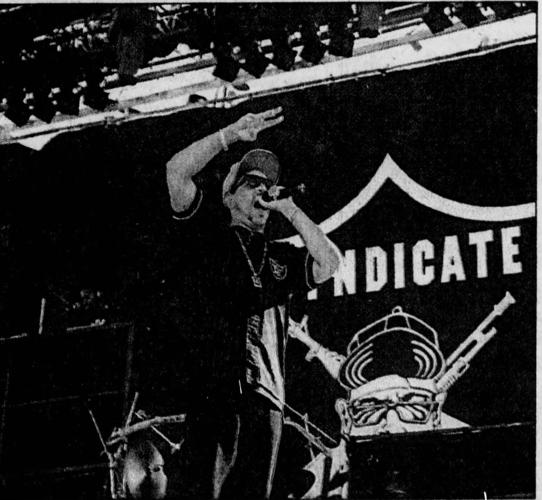
Ice-T onstage at Compton Terrace for first-ever Lollapalooza in which the rapper unveiled Body Count following a set of well-know hip-hop tracks.
The opening date drew 18,000 music fans to the amphitheater on July 18 for a festival that also featured Siouxsie and the Banshees, Living Colour, Nine Inch Nails, Ice-T (who unveiled his metal-hip-hop hybrid Body Count), Butthole Surfers and the Rollins Band.
The Arizona Republic called it “the most ambitious rock tour ever.” Danny Zelisko of Evening Star Productions, the local promoter who brought the tour to Phoenix, has fond memories of the whole experience.
People are also reading…
"It was a real freak show," he says. "I loved it."
And this is all despite the fact that, as Rolling Stone would note years later, “Nearly everything that could go wrong did.”
Trent Reznor said, 'We had no option but to destroy all our equipment'
The July heat was brutal, which should come as no surprise to anyone at all familiar with the summer heat in metro Phoenix.
“By the time gates opened,” Billboard would later report in an article on whether Phoenix is too hot for outdoor concerts, “those who were there estimate it was 110 degrees.”
As Zelisko, who begged them not to launch the tour in Arizona in July, recalls, with a laugh, "It was about one hundred and ... 80."
There was also no shade at Compton Terrace.
“But it was the perfect place for the show because there was so much room to put up all their different gear, all the booths and tables and all the political stuff,” Zelisko says. “They had health food. They had all the body painting and all the different kinds of weird stuff. It was like an alternative supermarket or fan fair or something."
Nine Inch Nails famously stormed off in the middle of their second song, Trent Reznor flipping over amps and mic stands as he made his exit in the midday sun. Their sequencers were plugged into a faulty quad box that kept shorting out after baking in the Arizona sun.
Years later, Reznor would reflect on what went wrong in Rolling Stone.
“We had no option,” he said, “but to destroy all of our equipment and walk offstage.”
Zelisko was having a smoke on the back of the stage with Farrell when the band did just that.
"They went on and they had their loop machines and Echoplexes and all this different electronic stuff to go along with a very small band setup," he recalls.
"And within minutes, it started feeding back and falling off and breaking down. They destroyed everything on the stage and walked off. I think it was one, maybe two songs. And they just came past us as fast as they went on, swearing and everything. I said, 'Is this part of the act?' Perry said, 'No.' They blamed the heat and everything like that, but I don't know what that would really have to do with it."
Zelisko told Jane's manager Ted Gardner he didn't plan to pay Nine Inch Nails for that performance.
“And he told me ‘You are,’” Zelisko recalls.
"I said, 'Why am I gonna do that?’ He goes, ‘You’ve got a contract to pay the show, not each band.' I said, ‘Yeah, but you're breaking it down, telling me what to pay everybody, and they shouldn't get paid.’ I'm not saying they did it on purpose or anything weird like that, but it's up to them to perform. I mean, it ain't my fault. We provided the stage, their dressing rooms, their catering, everything they needed. They didn't give me a show. Why did they get paid?"
Gardner won that argument.
As Zelisko says, "Ted was a good guy. If it was somebody who was really a jerk, I wouldn't have paid him. I didn't usually get into things like that with anybody. I hate confrontations. Who doesn't? But I didn't know who they were. It’s like, ‘Jesus, what a bunch of losers. You can't figure out how to play a show without all your dumb feedback machines or whatever the hell you got?’ And apparently they couldn't,”
Several artists who were there reflected on the heat in an excerpt from "Lollapalooza: The Uncensored Story of Alternative Rock’s Wildest Festival,: a book by Richard Bienstock and Tom Beaujour, that ran in Rolling Stone.
“The first show was brutal,” King Coffey of Butthole Surfers recalled. “It was 120 degrees, I think, maybe only 110. Either way, you’re in Arizona in the full sun in the daytime playing a show. And it’s the first show, too, so you’re still getting your bearings.”
Ice-T proclaimed the temperatures “too (expletive) hot for humans on the face of the (expletive) earth." Michael “Curly” Jobson, Lollapalooza’s stage manager, said, “We were dying. You couldn’t touch the steel of the stage; people’s equipment was melting.”
Navarro: 'I had gotten too high on heroin ... then I was given cocaine'
The headlining set by Jane’s Addiction ended in a fight between guitarist Dave Navarro and lead singer Perry Farrell, the driving force behind the festival
Mark Mayfield, a local DJ who was there, described the scene to The Republic, whose reporter wasn’t close enough to see what happened.
“Navarro appeared to get upset,” he said. “He whipped off his sunglasses, then he went back and knocked over the amps. Then he stood on the very front of the stage and chucked his guitar out at the audience. Then he picked up his effects box and he looked like he was getting ready to throw that out, too, when somebody, one of the stagehand types, yanked him off the stage.”
It eventually came to blows between the bandmates, according to several sources, not the least of which is Jane's Addiction bassist Eric Avery, who told Phoenix New Times, "It turned into literally them entangled falling off the side of the stage fighting."
To Zelisko, Navarro and Farrell "were as hot and cold as it gets. I mean, they were the Martin and Lewis of alternative rock. Always at each other's throats. But they were both using heavily. I remember these guys going out late at night to the most sordid places in Phoenix to get their jollies. I didn't know what they were doing and I didn't care. I didn't want to know. But they were definitely out of balance with each other. One of them clocked the other one and the show ended.”
Navarro credited drugs for his behavior in "Lollapalooza: The Uncensored Story of Alternative Rock’s Wildest Festival."
“I had gotten too high on heroin and I couldn’t really get up,” he recalled. “So then I was given cocaine by an unnamed source that got me too speedy. Then I had to come down from that, so I took a handful of pills and drank a bunch. By the time I got onstage, I didn’t know which way was up. And Perry and I got into it.”
Farrell to MTV: 'Some kind of egg’s about to crack, I think'
Rolling Stone and MTV were there to report on the opening date of a touring festival that hit 21 markets that summer and became a staple of the summer touring industry through 1997, eventually returning as the destination festival it is today.
On MTV's The Week in Rock, 120 Minutes host Dave Kendall, surrounded by festivalgoers in Chandler, told viewers at home, “It’s 109 degrees and the excitement is running high on the opening date of Lollapalooza,” signing off with, “If tonight’s opening date is anything to go by, Lollapalooza could be the tour of the summer.”
The Week in Rock segment included a backstage interview with Farrell, who said the tour launch had surpassed his expectations. This was obviously before the fight.
“From what I can tell now, it’s kind of like the whole country’s involved,” Farrell said with a laugh. “I kind of wanted to keep it low-key because I thought alternative music was a shoo-in to keep it kind of alternative, but it seems like maybe people are so (expletive) bored with the mainstream, maybe its time has come, you know? Some kind of egg’s about to crack, I think.”
In 1999, Rolling Stone wrote that “Lollapalooza ’91 — which drew almost half a million people in twenty-one cities — transformed the summer-concert business.”
In 2020, Spin proclaimed the first year of Lollapalooza the greatest U.S. tour of the past 35 years, saying it "changed the trajectory of the '90s, helping usher the alternative era into the mainstream" and “provided a common home for artists on the mainstream periphery” as "the template for what became the modern American festival."
Farrell: 'This is kind of like how you throw a big party'
Lollapalooza was conceived by Perry Farrell with the help of Gardener, drummer Stephen Perkins and band booking agents Marc Geiger and Don Muller.
In a phone interview with The Arizona Republic days before the festival hit Chandler, Farrell said, “We were supposed to play the Reading Festival and we never got to because I got sick. Everybody was bummed out about it, especially my booking agent, Marc Geiger. He thought that we would be very well-suited for festival-style music and suggested to me that we put something together.”
Farrell jumped on the idea, telling The Republic, “I’ve put on shows like this at a smaller scale. I’d rent lofts or warehouses and put on parties with live music, and this is kind of like how you throw a big party. You know, a party of this size, this is the way you throw it.”
In that same conversation, Farrell championed the tour’s eclectic lineup.
“I have been able to enjoy a lot of different kinds of music,” he said. “The best of all of it. Anything with a heart is good for me. If it’s real and sincere in intent. It could be any kind of music.”
To Farrell, the diversity of styles on that first tour was “mild compared to how far you could take an idea like this as far as mixing music. Human beings recognize talent no matter what village you’re in. You can travel and see something, and it strikes you. That’s what I’m trying to (bring together)… things that are striking from around the way.”
Zelisko says that first date playing Phoenix was the “culmination” of several conversations he’d had with Farrell.
“He was already working on it,” Zelisko recalls.
“He had this idea to do something that was more than a concert. And we had become close over the couple of years prior to that from doing shows. I can't remember what show it was or why we were together, but we were at the Pointe Resort over on 16th Street. And we sat up all night talking about this and bouncing names off each other. And Lollapalooza was what we ended up with."

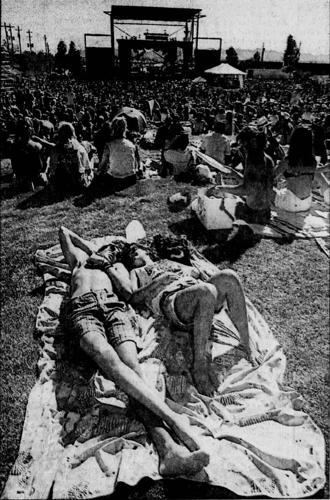
The crowd at Compton Terrace in metro Phoenix for the first-ever Lollapalooza on July 18, 2026
'In the early going, the crowd seemed subdued, probably due to the heat'
The crowd was “a gathering of various tribes of fans, each notable for their own forms of dress and style,” The Arizona Republic’s Sal Caputo noted in his coverage from the tour launch.
“There were punk rockers in high, spiked hairdos and mohawks. There were people dressed in clownlike makeup. Others looked relatively collegiate. Also, some skateboarders with their turned-around baseball caps and baggy shorts. And countless young women dressed in all black with their hair dyed red and their lipstick a similar shade.”
Fans moshed in small clusters to the Rollins Band, the day’s first act, while awaiting relief from the heat, which came from water cannons pointed at the crowd.
“Although more rugged individuals were dancing,” Caputo noted, “in the early going, the crowd seemed subdued, probably due to the heat.”
Henry Rollins led the Rollins Band through “a crash-and-burn set that alternated between Rollins’ soft hypnotic incantations and sudden bursts of thunderous thrash metal,” Caputo wrote, adding that the former Black Flag frontman’s “best piece was a long tirade against heroin use that ended his set.”
The lawn was almost a third full by the time Butthole Surfers followed Rollins with “a blend of thudding psychedelic rock and sound effects.”
Phoenix New Times: Most of the day’s highlights were supplied by Ice-T
Phoenix New Times’ Robert Baird felt most of the day’s highlights were "supplied by an act that looked, on paper, to be an unlikely choice for this tour, rapper Ice-T,” who opened with “a crackling set” of well-known hip-hop tracks before unveiling Body Count.
Seeing Ice-T take “an energetic stab” at funk-metal was the best part of the festival for Baird, who added that guitarist Ernie C had “distinguished himself by ripping out screaming leads that found something new in a style that Bad Brains, 24-7 Spyz, and Living Colour have beaten to death.”
Most of the day’s “low points,” Baird wrote, “were provided by Jane’s Addiction, whose lead singer/love god Perry Farrell organized the tour — judging by his performance, only for the money. This is a new twist for Farrell, who has usually stood for love, art and madness.”
Of the other acts on that day’s lineup, Baird felt there were “two hits, two misses and one draw,” trashing Nine Inch Nails for stomping off “like spoiled children.”
Henry Rollins was “suitably gritty and loud,” he wrote. “Watching ‘Hank’ grind and growl in 100-plus heat gave new meaning to the word ‘sweat’.”
Butthole Surfers “may never be ready to play in front of 18,000 people,” Baird wrote.
“The band’s exorcising brand of noise/hard-core doesn’t translate well to a large space. With vocalist Gibby Haynes sucking on Beck’s beer and furiously working his effects rack, the group put on a quick but mildly eccentric set and then disappeared.”
The best of the later acts to hit the stage, he wrote, was Living Colour. “The group has toured a lot and so presented no big surprises,” he wrote. “But it is, without a doubt, the best-looking band in America.”
For New Times, Jane's Addiction was 'the biggest disappointment'
Siouxsie and the Banshees turned in “a take-it-or-leave-it set combining oldies like ‘Cities in Dust’ with newer material like ‘Cry,’” Baird wrote.
“Playing in front of overworked smoke machines and the event’s most lavish set — a flashing backdrop of two lovers out of the Kamasutra — the band would have been a big deal ten years ago. Then they were brave punks. Today Siouxsie’s harem gestures and leather hot pants seem like museum pieces. And the music just laid there, expecting the synthesizers to carry it away.”
The Banshees were followed by the concert’s “biggest disappointment,” Baird concluded
“If this performance was any indication, the end is near,” he wrote of Jane’s Addiction.
“That’s a pity, because when this group is on, it’s the best. Tortured vocalist and Lollapalooza creator Perry Farrell never connected with the audience. Though he admitted to being ‘a little drunk,’ that wasn’t enough to explain his strangely nonsensical and cranky stage banter. If I were a surgeon, I’d say Perry’s heart wasn’t in it. He’s still got plenty of great performances left in him, just not with this band."
Baird added, "You could almost see Perry thinking, ‘Now that Jane’s is huge, we’ll squeeze a few more dollars out of it before we call it quits.’”
There was obviously more to Farrell's thinking than a cash grab.
"Perry's a really smart guy," Zelisko says. "And the Lollapalooza thing enabled him to really explore his … what's the word I'm looking for? Adventurous self. To this day, he's like a counterculture spokesman as a result of it. It was a lot of people that were involved in it, and it continues to this day, but it was completely his vision that made that thing happen."
Despite the chaos as their set was ending, Zelisko recalls Jane’s Addiction and Ice-T as the highlights of the day.
“But the sum of the parts was greater than any of the individual acts as far as I was concerned,” he says. “The fact that they were chosen or agreed to be there said a lot about them and what Perry thought of them. And he was really good at that. It was a really cool show. It wasn't so much about any one band being great or bigger than the other or better than the other. They were all part of the fabric. That’s what made it so unique and so cool."
It was a paradigm shift that, as Spin would later note, ushered alternative music and culture into the mainstream (for better or worse).
"It was like a pushback against the conventional type of shows because it added so many different features to it," Zelisko says. "Multiple bands, different styles. The arts and crafts and all the rest of that stuff. And to me, the audience was the show. It was some great people watching. They really dressed up. But nobody had any idea how big it would get. I think Perry did. Perry had a real idea."
Years later, in 2015, Farrell told The Arizona Republic he regretted the decision to retire Jane’s Addiction at the time.
“You break a band up, people quickly forget about you,” Farrell said. “It’s amazing. We were riding high, on top of the world, if you think about it, headlining Lollapalooza, the festival we started. We changed the course of music history, really, with alternative music. In comes Nirvana, Pearl Jam, Soundgarden, Alice in Chains, hip-hop. And then, I just disappeared. I could have used those years, as a careerist, to really establish myself. So that’s what I do regret, is that career-wise, it seemed like it was, like, a suicidal move. But I was a young man and very self-absorbed, I’ll be honest with you.”