

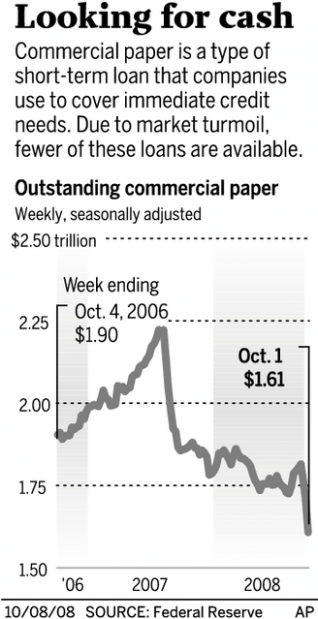
BOSTON — Why is the commercial-paper market so pivotal to easing the credit crunch that the Federal Reserve announced Tuesday it will intervene to prop up the market? The Associated Press offers some insight based on interviews with experts:
Q What exactly is the commercial-paper market?
A It's a low-cost source of cash for companies to meet short-term financial needs. A key advantage is that it's cheaper than tapping a line of credit from a bank. The market really began to grow in the 1970s with the emergence of money-market mutual funds that became large buyers of commercial paper.
Q: What type of companies raise money in the commercial-paper market, and what do they do with it?
A: The big and financially sound firms that typically issue commercial paper have plenty of revenue to fund long-term needs. But they also sometimes need short-term cash to cover everything from buying supplies to paying vendors and making payroll, so they turn to the commercial-paper market.
People are also reading…
Such borrowing is often unsecured, with no assets serving as collateral. Such transactions are backed by the borrowing company's high credit ratings and regular cash flow, and expectation that it can make repayment once it receives money due from its own customers.
Companies with low credit ratings tend to raise cash through bond offerings, not short-term commercial paper.
Q: How are the commercial-paper market's troubles affecting businesses?
A: The flight of money funds and other participants from commercial paper has left companies facing higher interest rates to raise short-term cash, especially for borrowing with repayment periods of weeks or months rather than days. That means they must rely on higher-cost credit from banks or forgo borrowing at all.
Consequently, as the freeze persists, companies could have to scramble to find cash for short-term needs. The Federal Reserve's move Tuesday to begin buying three-month unsecured and asset-backed commercial paper directly from eligible companies is intended to head off such problems.
"Until last week, the word of a company like Chevron or Toyota was good enough for the commercial-paper market," said Peter Crane, president of fund-tracking firm Crane Data. "It still is, but investors are demanding a premium, and the money-market funds are having to deal with forced liquidations and panic outflows."
Crane said he has not yet heard of instances of major companies being unable to meet short-term obligations because of the freeze in the market. But such instances would likely begin to crop up in coming weeks without a catalyst to thaw the market, they said.