

TEMPE — If the sci-fi predictions of the 1950s had come true, laser-wielding robots might be threatening humans.
Instead, modern-day robots are too busy doing household chores to wage war.
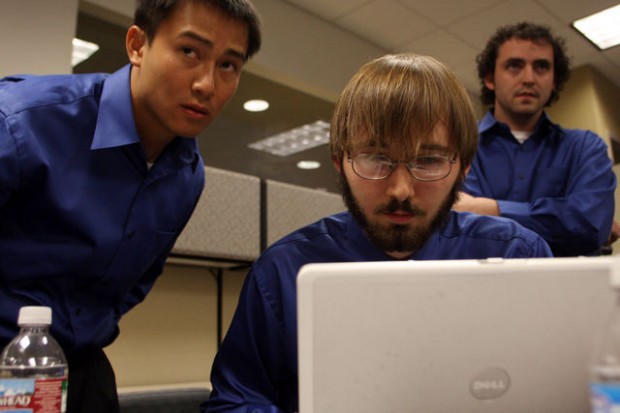
At the Intel Corp.-sponsored Arizona Robotics Competition Friday, student-designed robots worked to prove themselves as future security guards for the home and office.
Engineering teams from the University of Arizona and Arizona State University vied for robotic superiority in the threehour contest at ASU's Brickyard in Tempe.
The UA took first place in the competition, which required the robots to map out the testing ground, detect fire and locate objects and human intruders.
To the likely disappointment of sci-fi junkies, these robots are all about safety and practicality.
People are also reading…
"The market is home," said Charles Higgins, an associate professor in the UA Department of Electrical and Computer Engineering.
"We don't want the robot to kill people or run over the cat," said Higgins, who served as a technical adviser to the UA's five-member team.
The UA team members are Thanh Ho, John Stockbauer , Joe Joyce, Michael Anderson and Tony Leung.
Anthony Lewis, also a UA ECE associate professor, served as a team adviser.
Four student teams ranging from five to seven students competed in the event — with three of those teams coming from ASU.
The testing ground was an office space filled with tan-colored cubicles and a few cardboard boxes to serve as obstacles.
School rivalry was apparent as opposing teams cheered when confused robots crashed into cubicle walls or began turning endless circles.
The robots serve as final "capstone" engineering projects for all the students.
The contest is designed to "foster innovation" more than create a product, said Marcos Garciaacosta, Intel's business alliance manager.
"We want to get brains going. The work the students are doing now is setting the stage for tomorrow," he added.
Robots on the market today are already being used as office helpers.
Mobile Robots Inc. provides robots that can do everything from deliver mail to offer security or butler service. But the company's security bot — named Agent 007 — costs nearly $35,000.
The purpose of the student project was to develop a home-security robot that could be bought by average people, Higgins said.
The Roomba — an automated vacuum from iRobot Corp. — is a great example of a successful home robot, he added.
"It was made at a low price of about $150, then sold for $200 to $300. People will buy robots at the price," Higgins said.
As the technology matures, security robots can be built for less, he added.
The future of the home-robotics market is looking good, according to a market research report by Robotic Industries Association.
By 2015 the market will be worth $15 billion, said the report, out in December 2007.