

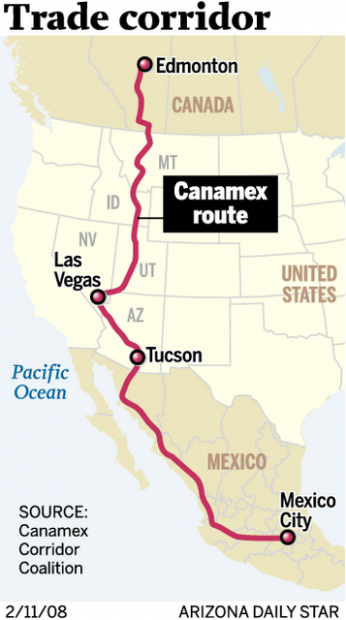
For the last two years, Marisa Walker has led the effort to build a a four-lane commercial route from Mexico to Canada through Tucson, known as the Canamex Trade Corridor.
Walker is the executive director of the Canamex Corridor Task Force and its multistate coalition, which includes the transportation and tourism departments of Arizona, Nevada, Idaho, Utah and Montana.
Walker, a former UA director of Mexico programs, spoke at a Tucson Metropolitan Chamber of Commerce breakfast Friday. Here are excerpts from an interview:
Q After your nearly 10-year career at the UA, what led you to take this position as executive director of the Canamex Corridor Task Force?
A My work experience at the UA progressively started to build so that I was perfectly situated to take over this position. I ended up working a lot with the border community, so I became much more familiar with the border-crossing environments and the federal and state entities that worked along the border. I also became a little more knowledgeable about the whole process of being able to develop ports of entry and corridors and how important that supply-chain perspective is.
People are also reading…
Q: What are the day-to-day challenges you face in leading a multistate coalition?
A: Being able to juggle and balance all the various priorities that are being advanced. Clearly the projects and initiatives that are important to the northern states of Canamex are slightly different from the focus that we take. One of the things that I have to address is the fact that I'm not only responsible for the governor's Canamex task force — that has a very big agenda — I also have a multistate coalition, which are interested in slightly different things.
Q: What do you feel is the biggest reason for the stop-and-start progress of the Canamex initiatives?
A: One is funding, which fuels the fire. It also has to do with being able to keep up the enthusiasm for the project. Canamex is not a finite project — you're not going to have an end date necessarily. Because so much of the early work in Canamex has been to focus on getting the road from Canada to Mexico through the United States completed, it's hard for that to translate on a meaningful level for someone living in a community that's traversed by the Canamex.
Q: How do you deal with people who feel the Canamex project is a potential threat to national security?
A: There has been a lot of concern because of the immigration debate, and the concern about the loss of sovereignty associated with trade corridors. Some of it is a matter of explaining what our organization is about, what our intention is. Frankly, there's an obvious misperception that we're trying to somehow lose U.S. jobs. In large part, this is being advanced by the commerce and transportation directors of the five states, and they're mandated to figure out ways in which infrastructure and economic development activities are going to stimulate job creation. So that's precisely contrary to what we're trying to do.
Listen to the complete interview at www.AzStarBiz.com