

One businessman imagines a Latin rock star singing with his microphone. Another pictures an Australian beauty with his temporary tattoo emblazoned on her shoulder. Still another imagines a rocket in China with its pressure being monitored and controlled by his device.
Their products may be diverse, but the plan for growing their Tucson businesses is the same: putting their goods on the global market. They are doing so through the State Trade Export Promotion (STEP) program, a federal program administered by the Arizona Commerce Authority.
The STEP program launched in October 2011 in response to President Obama's National Export Initiative, which has a goal of doubling U.S. exports by the end of 2014.
"Only 1 percent of U.S. companies export," said Kevin O'Shea, Arizona's STEP program manager. "This means that 99 percent of U.S. companies are not engaging with the world's consumers who live outside our borders."
People are also reading…
The NEI says 87 percent of the world's economic growth between 2010 and 2015 will take place outside the United States.
The STEP program, with funding from the U.S. Small Business Administration and the Arizona Commerce Authority, offers business owners assistance with specialized marketing, export compliance and product registration in foreign countries. STEP also reimburses companies up to 50 percent of the cost of attending a trade show.
The hope is to help Arizona businesses increase sales and grow jobs in the state, O'Shea said.
Statewide, 160 Arizona companies are using the STEP program - 39 in the Tucson area.
Cloud Microphones
The voices of singers, preachers and radio announcers may sound a little deeper.
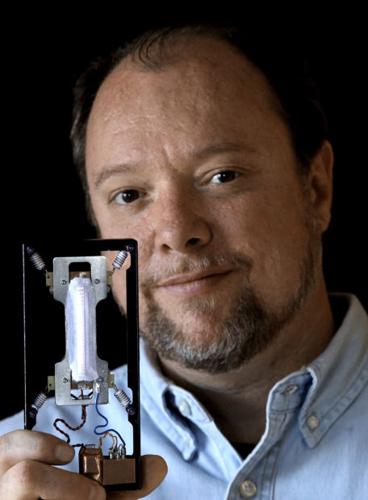
Ribbon microphones manufactured at a small central Tucson shop re-create the sound of the old RCA microphones fancied by big band singers in the 1950s and 1960s. Inline preamplifiers called "Cloudlifters" add clarity and depth to the sound of other microphones.
In its fourth year, Cloud Microphones joined the STEP program in 2012 with the hope of shipping its products around the world.
In its first sales year, the company sold fewer than 100 units. Last year, it sold more than 2,100 units as it entered the global market. Cloud has three employees.
Customers include recording engineers, voice-over artists, churches and aspiring musicians doing home recordings.
"If they use microphones, they're in our industry," said Rodger Cloud, one of the company's founders. "The Cloudlifter products dramatically enhance the performance of the microphones and preamps that people already own. Therefore, we believe it is important to be in every relevant market."
Through the STEP program, Cloud Microphones has been connected with sellers and partners throughout Europe and Asian as well as Australia, Mexico, Brazil and South Africa.
"With the 50 percent reimbursement for certain expenses related to exporting, we're literally able to double our activity," said Scott Haughey, Cloud's general manager. "With the STEP program, we can double our reach."
He's learning about international patents and trademark laws in different countries. The company has pending patents and/or trademarks in more than 40 countries.
Cloud takes pride that its products are manufactured wholly in Arizona. Haughey enjoys putting a sticker of the U.S. flag on the boxes before he ships them abroad.
The circuit boards are assembled at Tooh Dineh Industries Inc., on the Navajo Nation, and the enclosures for the microphones and Cloudlifters are fabricated by Clean Cut Metals in Tucson. Locally, Rainbow Guitars carries their products.
The microphones utilize a thin, corrugated aluminum ribbon to produce smooth sound. That technology fell out of favor when the recording industry moved to tape and needed the edgy sound of dynamic microphones to transfer the sound, Cloud said.
With the dawn of the digital recording era, the smoothness of the ribbon microphone is once again popular. The microphones range in price from $1,499 to $1,599. Dynamic microphones range in prices from $10 to several hundred.
The best-selling product is the Cloudlifter, which has the active circuitry broken out into an enclosure that can be used with other microphones. The unique device provides 25 decibels of clean gain and costs $149 for a unit with a single plug and $250 for a double plug.
Cloud jokes that he hopes the improved sound will prompt improved music.
"I want to empower musicians," he said.
Visit cloudmicrophones.com for more information.
TM International
There's only one summer in the United States, and this business does best when skin is on display.
"When skins comes out, tattoos show up," said Stephen Tooker, CEO of TM International, maker of temporary tattoos. "It's summer in Australia now."
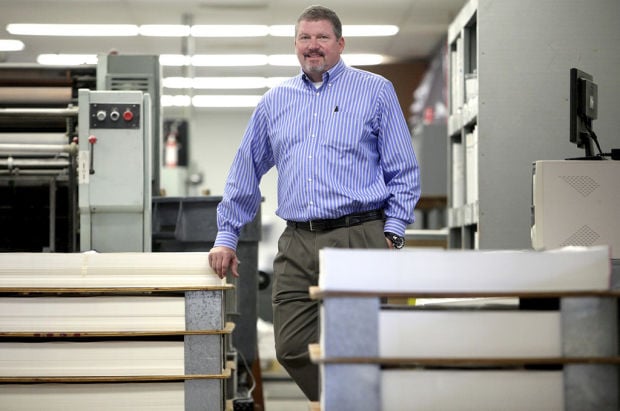
The 24-year-old company of 100 employees produces 7 million temporary tattoos each day at its manufacturing plant on the southeast side of town.
The tattoos are for kids, sports fans and political rallies, and there is a line of upscale, adult fashion tattoos. More than 3,600 designs are available. Corporate logos and team mascots are the most popular custom-ordered tattoos, Tooker said.
The novelty items can be found at large retailers in more than 30 countries, and the company hopes to expand its international sales after joining the STEP program last year. The tattoos are available for retail sale at Walmart, most novelty stores and online.
"The STEP program helped us build product awareness," Tooker said. "It's encouraging to see an agency of the government doing what it's supposed to do and support small business."
STEP has connected TM International with retailers and distributors throughout the world, he said. Its biggest markets outside the U.S. are Germany, South Africa and Australia.
George Arden, the company's director of strategic marketing, said the company hopes to double exports by 2014.
"I think we're going to exceed it," he said.
Visit tattoosales.com for more information.
Alicat Scientific
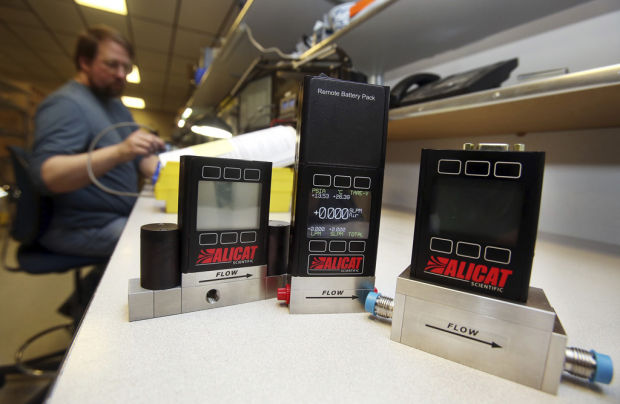
Devices that measure and control the flow or pressure of liquids and gases are manufactured at a north-side Tucson plant; customers include rocket makers.
Used in research labs, they're especially popular in energy research and manufacturing, said Michael Diaz, the company's sales manager.
The 22-year-old company of 50 employees sells about 10,000 units a year.
Diaz said joining the STEP program holds promise to help grow the business.
"This has allowed us to do more partner searches and get distribution agreements," he said. "Working with STEP means we can do more."
Alicat has foreign companies working to promote its products in several countries.
The devices have been used for pressure control on a NASA rocket, Diaz said, but the coolest use was on an episode of television show "MythBusters," where the device was used to determine how much pressure would be needed to blow up something with gas.
Stepping up
To qualify for the STEP program, a business must be smaller than 500 employees, in business for at least a year, profitable, export-ready and willing to provide feedback on export experience. There is no enrollment fee.
O'Shea stressed that the exporting is of products, not jobs.
"They are retaining Arizona jobs and employees and creating more Arizona jobs via exporting products and services," he said. "'Made in the USA' still carries considerable cachet and credibility and still stands for quality and reliability in the international marketplace."
Visit azcommerce.com for more information.
Contact reporter Gabriela Rico at grico@azstarnet.com or 573-4232.