

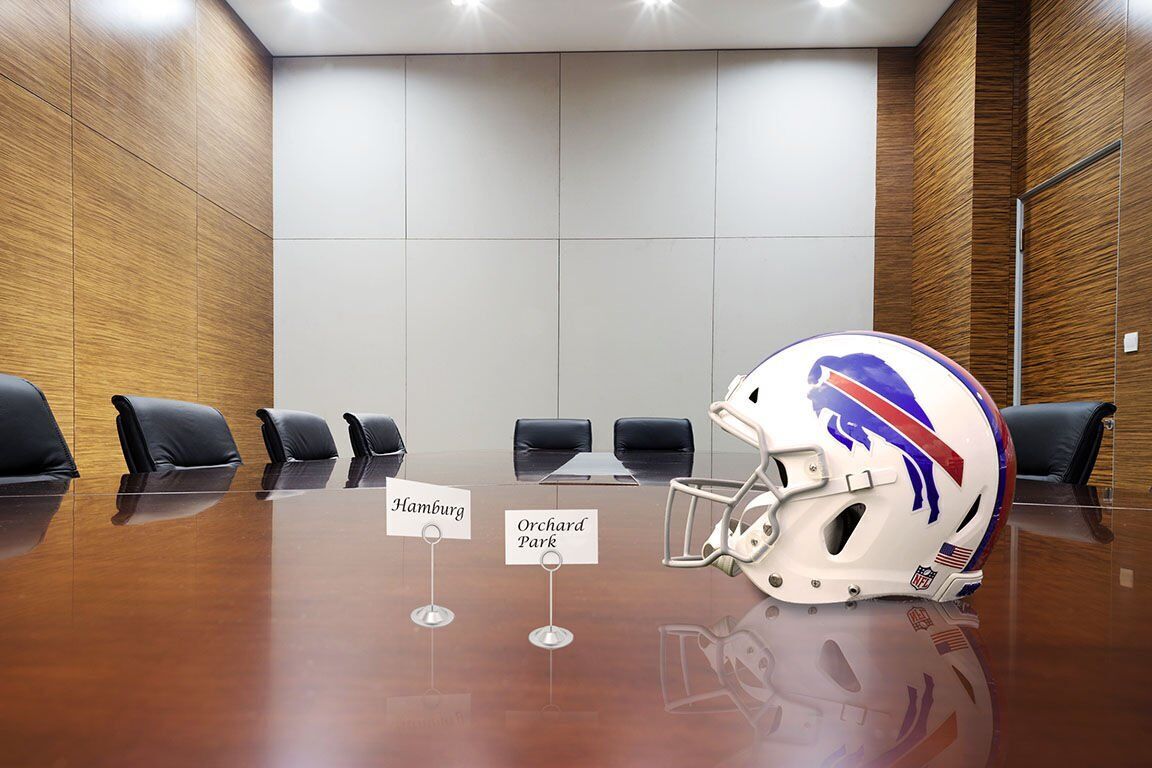
With negotiators in the late stages of talks on a deal for a $1.4 billion open-air stadium for the Buffalo Bills, officials representing Orchard Park and Hamburg are focusing on what comes next.
And after being shut out of the stadium negotiations, they're eager for a seat at the table once the deal is signed to discuss how it will impact their communities – and how they can maximize the benefits from it.
The existing stadium, home to the Bills for nearly half a century, has done little to create spinoff development near the site, beyond a handful of restaurants and game day parking lots. There's also a severe lack of hotels close by to accommodate visitors and limited public transit connecting outside neighborhoods to Orchard Park.
They want the new stadium to have a much bigger impact.
“We just don’t need parking lots everywhere. We can do other things there,” said Drew Reilly, Hamburg's planning consultant. “If you’re going to improve that area, you can make it a gateway into the town. You have an opportunity to create a great destination and make it work better.”
People are also reading…
For that to happen, some officials are considering zoning changes to make it easier to build commercial establishments, like hotels, near the stadium.
Others are pushing for a community benefits agreement that would provide funds for other projects around the stadium, including affordable housing and public transportation, and reimburse Orchard Park for police services provided on game days.
They’d also want to tackle questions about what will happen to the property where the Bills currently play and across the street, where there are residences and parking lot owners on land that may be used for the new complex.
Meanwhile, the fate of the Erie Community College south campus, situated right next to where the proposed new stadium would go, hangs in the balance.
Pegula Sports and Entertainment continues to negotiate with Gov. Kathy Hochul and Erie County Executive Mark Poloncarz on financing a new stadium, across the street from Highmark Stadium, which will seat 60,000 to 62,000 fans, with room for up to 5,000 additional spectators on a standing-room-only party deck.
The public is likely to contribute more than $1 billion, or around 73%, of the construction costs, consistent with stadium deals in smaller markets across the NFL, The Buffalo News has reported.
Though officials representing the Southtowns’ neighborhoods surrounding the potential new stadium site have not been a part of the negotiations, they have begun discussions on their own about how to make the area a destination for visitors and those who would like to live, shop and eat near the home of the Bills.
“It will be important that no matter what decision is made on the location of the stadium that the Town of Hamburg, along with Orchard Park and Erie County, have a seat at the table to discuss and make a plan,” said Hamburg Councilwoman Beth Farrell. She is leading an effort to develop a new comprehensive plan in Hamburg that will address the potential new stadium.
Ron Raccuia, executive vice president at Pegula Sports and Entertainment, said the Bills at some point will be meeting with “all of their partners” about what’s next. The organization is also conducting forums to elicit the opinions and ideas of some season ticket holders.
“This is a public-private partnership,” Raccuia said. “It isn’t just New York State, Erie County and the Bills. The NFL is involved in this, and the towns also will have a say. I mean, the entire community does.”
'We should really start taking a harder look'
The towns are looking at how a new stadium would change the area, not only from a traffic pattern aspect but also how it could create a more attractive place for businesses.
The new stadium could itself provide for additional uses that the current one never did, bringing in new and different kinds of clientele.
A consultant’s study commissioned by New York State and released last year determined construction of a new stadium in Orchard Park would not generate much new development in the town unless a concerted effort was made by area stakeholders.
“This could change through concerted policy efforts by the municipality, county, state, and/or team, however, community facility uses are likely the most feasible given demand trends,” according to the AECOM report.
As of now, much of the property around the stadium in Orchard Park is zoned for residential use, except for a commercial strip at Abbott Road and Southwestern Boulevard, according to Orchard Park Councilman Conor Flynn.
“I don’t have all the answers to these questions, but we should really start taking a harder look at how the town can plan for a new stadium,” said Flynn, who would like to see the Orchard Park Town Board create a Stadium Committee.
Reilly, Hamburg’s planning consultant, said the town should be just as involved in the process, pointing out that the border of Hamburg abuts the area of the stadium and its parking lots.
Reilly, of Wendel architects and engineers, said the “stadium impact area,” which includes the “seven corners” at McKinley Parkway in Hamburg up Southwestern Boulevard toward Highmark Stadium, is mostly a mixture of light industrial and heavy industrial zoning and includes some residential property. Right now, commercial uses in the area are limited.
A community benefits agreement, or CBA, as part of a stadium deal could result in the building of affordable housing around the stadium and the expansion of public transit to the stadium, according to Assemblyman Pat Burke.
The state’s legislative branch is not a part of stadium negotiations either, despite the demands of some lawmakers like Burke and Sen. Patrick Gallivan, who is behind a bill asking for more transparency in the negotiation process.
“There’s a lot left to be desired as far as who has a seat at the table and who is affected and who should be able to advocate for their constituents,” Burke said.
CBA could assist Orchard Park
Sen. Sean Ryan and Erie County Legislator April Baskin are among local leaders pushing to make sure communities like Orchard Park benefit from the Bills presence in town as part of a potential CBA. Ryan, for instance, has pushed for Orchard Park to be reimbursed for police services.
Orchard Park spends at least $70,000 per year on police overtime for stadium events, and because of it, the town may lose money by hosting the Bills. While the Erie County Sheriff’s Office and State Police patrol Bills property on game days, the Orchard Park Police Department patrols everything around it.
“I think that’s something people don’t understand,” Flynn said. “I know the economic impact from having the team here is limited for us.”
County and state legislators will need to sign off on any stadium deal before it passes.
“I find the whole thing to be unpalatable, even if it is necessary. It is definitely a difficult pill to swallow to fork over that kind of money to billionaires,” Burke said. “I think squeezing every drop of community benefit is what we have to do as state legislators, as well as people at the negotiating table.”
Push for public transit
Burke would like to see the new stadium turned into an opportunity for the expansion of public transportation. He is calling for a project that would create a commuter train connecting the stadium to downtown Buffalo and other surrounding areas.
He said with gas prices reaching record highs there has never been more of a need for electrified public transportation, a topic of conversation that has been ongoing in the area since the 1990s. He also sees this as a way to create sustainable economic development not only in Orchard Park but along the entirety of the transportation system.
Burke said there are state and federal programs to help fund an overhaul to public transit and provide more train transportation options.
“This is an opportunity to tie what is a popular project – the stadium and keeping the Bills in Buffalo – into a long-term public transportation solution,” he said.
Other questions persist
Officials representing Orchard Park and Hamburg have additional questions that they’re eager to get answered once a deal is inked. They include:
• If a stadium is built across the street, what will happen with the vacant land where the stadium is now? The land is owned by Erie County and isn’t on the Orchard Park tax roll or subject to local zoning codes because it operates for a public purpose in housing the stadium. Flynn said he wonders if the county will hold on to it and use it as stadium parking or try selling it to Bills owners Terry and Kim Pegula for development.
• The future of ECC South remains uncertain with the potential for the stadium to move right next door, abutting the campus, and layoffs and cost-saving measures in the works at the school. Raccuia has said a new stadium “might need some ECC land, but it would be very minimal, if any.” The south campus is one of three ECC campuses.
• It is still uncertain what will happen to lot and property owners across the street from the current stadium if the Bills move to the other side of Abbott Road.
Flynn joked that the phone number for Eric Matwijow, the owner of Hammer’s Lot on the ECC side of Abbott Road popular for its tailgating, is now in his saved contacts because the two have spoken so often of late.
“He sometimes knows more than we do about what’s going on and what’s going to happen there,” Flynn said.
