

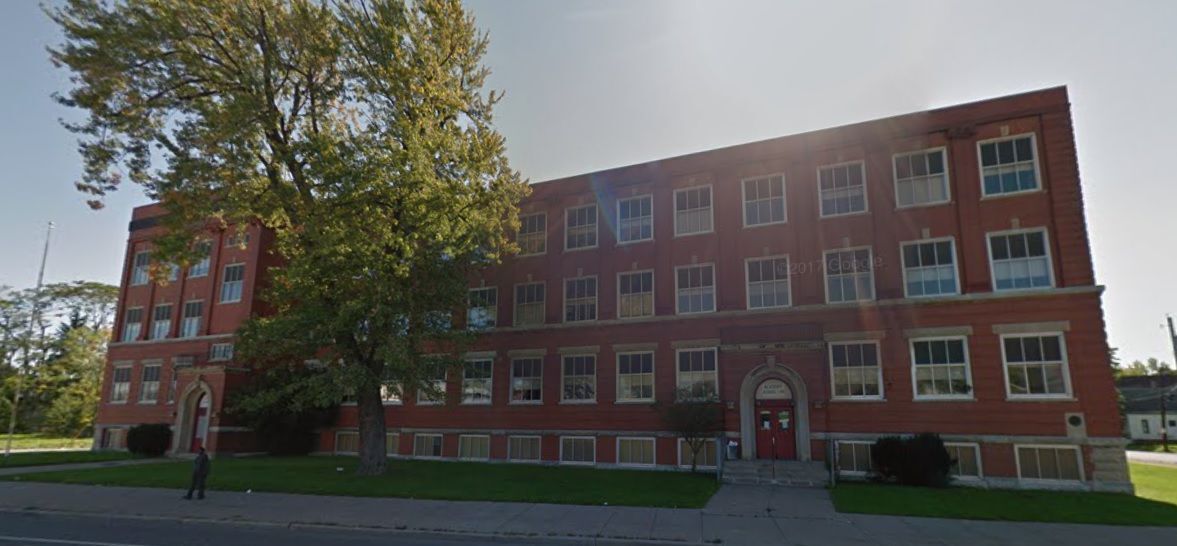
It's been more than four years in the making, but the long-delayed conversion of the former Lincoln Academy building into affordable housing is finally coming back around.
Developers David Alexander and Ernst Valery are seeking city site plan approval for their adaptive reuse project to transform the former Buffalo Public School 44 into 65 mixed residential apartments.
Plans by architects at Carmina Wood Morris PC call for the 127,000-square-foot building at 1349 Broadway to be renovated into a combination of 24 one-bedroom, 27 two-bedroom and 14 three-bedroom units, along with an 80-space parking lot, a patio and a playground.
The apartments will range in size from 740 square feet to 1,600 square feet. The building will also include a community room and a computer lab.
All the apartments will be affordable for those earning no more than 60% of the area median income, although "we never build something that looks 'affordable,' " said Connor Kenney of SAA/EVI, the development company owned by Alexander and Valery. "We think everyone should have a great place to live."
People are also reading…
Thirty-three units will be set aside for victims of domestic violence, who will receive services from Catholic Charities.
The $26.8 million project will be funded in part by state and federal historic tax credits, so the work will be performed in conjunction with the National Park Service and State Historic Preservation Office standards. Work will include window replacement and masonry restoration, according to the application to the city.
The rest of the funding will come from 9% federal and state low-income housing tax credits, HOME funds from the city, grants from the New York State Energy Research and Development Agency, the deferred development fee, gap financing through New York State Homes and Community Renewal, and funds from the Supportive Housing Opportunity Program.
Once approved and financed, construction is expected to take about 18 months. Officials hope to start work by 2022.
The 2.65-acre site is zoned for mixed-use edge development. The Planning Board was slated to review the application in a public hearing on Monday, but that meeting has been canceled due to lack of quorum, so the review will be in two weeks. Regardless, approval is not expected immediately, as the project must first go through an environmental review.
Constructed in 1907 and expanded in 1930, the three-story brick building was designed by Howard Beck and includes an unusual smokestack tower, a basement level and a gymnasium, as well as a central courtyard. Located on 2.65 acres at Broadway and Person Street, with Krupp Street in back, it stretches across an entire city block. Its full size is actually 165,000 square feet, but the developers are mothballing a portion of it.
Alexander and his father, Stuart, brought the project forward in 2017, in partnership with developer Rhonda Ricks' R+A+R Development. Plans then included 82 apartments, plus support services for residents, and the developers also hoped to reinvigorate the neighborhood around it, just northeast of the Central Terminal and west of Bailey Avenue.
Ten units were to be set aside for homeless women with children, with the Lt. Col. Matt Urban Center providing case management support. The developers also hoped to put in a day care center and possibly a library, while working with a federally qualified health center to provide on-site medical services.
But Ricks fell ill and died of cancer in June 2019, at the age of 56. So Alexander and Valery's company, SAA/EVI, asked the city to extend their designated developer agreement, which the Common Council approved in December 2020 for another year.
Financing constraints also forced the developers to back off some of their plans and reduce the number of units, while also converting some apartments to three bedrooms.
The designated developer agreement also covers 14 vacant lots surrounding the school, including six properties on Ashley Street, three on Peck Street and five on Person Street. That's where additional construction projects are ultimately planned, for senior housing and single-family town homes. But SAA/EVI will leave those properties vacant for now, according to the memo from the Common Council approving the extension of the agreement.
SAA/EVI now has 18 months in which to purchase the properties from the city.


