

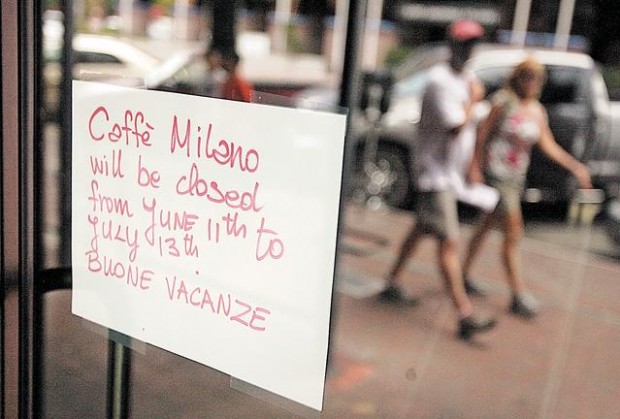
It's not exactly Paris in July, but closing for a few days or a couple of weeks in the summer is a long-standing tradition for some Tucson businesses, particularly restaurants.
Historically, it's a slow time for many — a good time for vacation, or to do some painting, remodeling or deep cleaning.
But now, in this down economy, it's becoming a cost-saving necessity for some business owners — while others are thinking they can't afford the luxury of shutting the doors for even a few days.
Sales tax revenues show the problem: In the most recent data available, restaurants and bars were down 5.7 percent this past April, compared with April 2008, and retail dropped 12.3 percent this past April, compared with April 2008, the Arizona Department of Revenue says. To shut down, or not to shut down
People are also reading…
Inside the tall, cool, plastered walls of El Torero on East 26th Street, it seems a shame to think of shutting down the 53-year-old restaurant in summer. This secluded eatery, set way back on a side street off the north end of the Fourth Avenue Mexican restaurant strip, has always been an insider's place. "You go down South Fourth, turn west when you see the 'Pawn' sign; it's next to the old ballroom."
Speaking from behind the bar, owner Brad Hultquist said the restaurant has typically closed down in summer, usually for a couple of weeks starting in late July.
The tradition didn't start out of a lack of summer business, he said. "We used to make good money in the Mexican restaurants in the summer. Everyone wants to go for vacation; it's good for morale, too.
"I had a cook here. He said, 'Can we move it over a little bit?' "
Hultquist asked why and learned the cook had friends and relatives who were going on a trip together another week.
"It would be a mass exodus; they would go to California or Hermosillo. Whoever had the best car, they'd all pile in and go visit the relatives."
Hultquist tries not to close the same time as some of the other South Fourth restaurants, especially after one incident a few years ago. "I closed down the same time as Mi Nidito. I caught hell," he said. "We talked amongst each other, so we don't leave our customers without a place to go."
But this year, when some other businesses are joining the Tucson tradition, Hultquist said he's not sure he can afford to shut down at all.
It's just been in the last few months, he said, that business has been picking up after being gut-shot by the worst of the Interstate 10 construction project. He said the road closings almost killed his lunch business.
That's eased somewhat, said Hultquist, but not enough that he feels good about closing. Nor, he said, can some of his staff. They need the hours.
"I think the trend of closing in the summer has changed. In the old days we used to look forward to that . . . time to relax, maybe do some repair work. Now, you don't have the funds to do the repairs.
"I haven't decided," Hultquist said, adding he might do what he's done the last couple of years and just stay open for lunch and close at night.
But if he does go back to the tradition and close for a couple of weeks, he said he has two things to be thankful for: His family owns the property and doesn't have to pay rent, and it has loyal customers he thanks for coming to El Torero for 20, 30, even 40 years. "It really helps in the summertime." Not just restaurants
Restaurants dominate the summer closings, but some other businesses also take a break — or consider it.
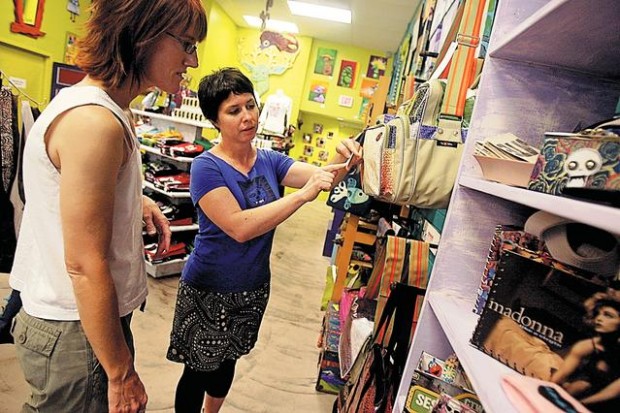
Tana Kelch, owner of the Bohemia art shop at 2920 E. Broadway, said she was tempted to close on Sundays during the summer.
But she's sticking with seven days a week, even if there's no one to speak with other than the art on the walls on Sundays. The store is open Tuesdays through Saturdays 10 a.m. to 6 p.m., and Sundays and Mondays 11 a.m.-4 p.m.
"The whole year leading up to the summer was slow," said Kelch, who sells handmade art, from refrigerator magnets to paintings and metal sculpture, nearly all by local artists. She moved the store from the Lost Barrio before the economy tanked, relocating to more expensive space where Austin's restaurant used to be.
"We had a slower Christmas than anticipated, and we had the expense from the move, and the economy wasn't doing what it is now when I signed the lease," said Kelch. "Summers are always slow . . . students leaving, the snowbirds leaving and people going on vacation."
Still, she said, there is one upside of the bummer economy.
"On the other hand, more people are doing stay-at-home vacation, or staycations, and come in here and buy something."
She said the down economy — or something — has more people asking if the things they buy are local. "We're finding that people are paying more attention to where things are made.
"About 90 percent of my stock comes from regional artists," said Kelch, who is on the board of Local First Arizona, a nonprofit organization that promotes locally owned business throughout the state.
"At a chain, 13 cents of every purchase dollar stays in your town," Kelch said. "If you're shopping at a locally owned small business, 45 cents of every dollar stays in town." "We are staying open"
Caruso's Italian Restaurant at 434 N. Fourth Ave. followed the Old Pueblo tradition and closed for two weeks each summer for nine years, 1997 through 2006.
It was a welcome vacation for some, but there was a problem: "Many employees would find other jobs and not come back" because they couldn't afford the time off, said Ande Allen, Caruso's manager.
This summer will be the restaurant's third in a row staying open through the summer.
"That has to do with the economy," Allen said. "We are staying open because we don't really feel we can afford to lose that business or let it slide that much."
She said it's expensive to shut everything off and start again, to prevent food spoilage, for instance. "So we stay open and make a few dollars." Scaling back a bit
At Baggins, the sandwich shop with nine locations around Tucson, co-owner and co-founder Cheree Garrett said the 25-year-old locally owned company has scaled back evening hours for many years because of Tucson's slow summer pace.
But Baggins has also decided to close all day Saturdays at its shop at East Valencia and South Country Club roads, near Tucson International Airport, which — except for the slow Saturdays — is its busiest location.
"Our Valencia store is closed on Saturdays and probably always will be, but the other stores' shortened hours at night will probably end in October," Garrett said.
She said the recession is "definitely affecting all of our stores and HiFalutin," the Garretts' steakhouse at 6780 N. Oracle Road. Time for a spruce-up
After recently closing — permanently — two of his restaurants, Gaetano "Gavi" Colaleo is taking advantage of the summer to spruce up his namesake restaurant, Gavi, 7865 E. Broadway, probably late in July.
He closed down Gavi la Taverna, at 6960 E. Sunrise Drive, and Gavi at Foothills Mall.
"At Broadway, I wanted to clean it up and give it a fresh look. No, no, no, no, nothing to do with the economy," Colaleo said. "It's been 20 years that we've had the same look," he said of the soccer memorabilia that covers the walls and even the ceilings at Gavi Broadway.
He's leaning toward closing the last week in July.
"I'm hoping I'll be able to do it from Monday or Sunday night to Thursday and be open on the weekend. For those coming in those days, I'm offering a gift certificate to come up to Piazza (Piazza Gavi, 5415 N. Kolb Road). For those who come over to Broadway on those days that I'm closed, there will be somebody handing out $10 gift certificates." Going along in a tough time
"I probably would (close) if I were smarter," said Coralie Satta, owner of Ghini's French Café, 1803 E. Prince Road. "We did a really horrible day today," she added, speaking in late June. "This is probably the worst day we've had for 10 years."
Satta said summer is usually slower anyway, but this year she's also dealing with a shopping center repaving project that is driving off customers and could drag on two weeks into July.
"When we first opened and it was all me, I was the only chef. I was working about 18 or 19 hours a day. I did close," said Satta.
Now, with three cooks, a much larger space and more fixed costs, she said she can't close.
"It would be nice to have a vacation and not sweat it while I'm gone. I can't." photos by greg Bryan / Arizona Daily Star Dave Hostetler dines at El Torero, where he is a regular customer. The restaurant has typically closed down in summer, but this summer it may have to stay open.
Summer breaks harder now
closing costly
Business holidays aren't free, notes Mike Hultquist, manager of Lerua's Fine Mexican Food, 2005 E. Broadway, and co-owner of that eatery and his family's other restaurant, El Torero, 231 E. 26th St., which is managed by his brother Brad.
It costs $1,300 a day to keep South Tucson's El Torero open, said Mike Hultquist. That figure falls somewhat, but not completely, on days they're closed.
He said the daily outlay is closer to $1,600 for Lerua's on pricier East Broadway and includes basic labor, minimum food costs, property taxes, various insurance premiums, telephone, Internet, electric, gas and water services, garbage collection, pest control, permits and licenses.
When they're closed, some — though not all — labor costs go away. Utility consumption goes down, but doesn't stop. Food costs decrease dramatically, but Hultquist said it can cost hundreds of dollars, and up to three days' work, to restock and cook in preparation for an opening after closing for more than a couple of days.
"It costs me about $400 a day to be closed at Lerua's, and El Torero basics run about $300 a day."
He also said most restaurateurs, unlike his family, don't own their own property and are paying rent whether or not they're open. At some of Tucson's most exclusive Foothills dining spots, that cost can be $1,000 or more a day, open or not, he said.
Many restaurants also lease dishwashing machines and ice machines and other equipment, which has to be paid for whether or not it's working.