Let’s state the obvious right out of the gate: This all depends on the inglorious trifecta of Congress, Tony Petitti and Greg Sankey agreeing on groundbreaking legislation.
And they’re not exactly the most simpatico group on the planet.
But since the latest iteration of the Protect College Sports Act leaked late Tuesday afternoon, we can at least daydream about the most intriguing piece within the legislation — one that's lost amid the inside baseball that nearly every fan couldn’t care two nickels about.
The bill — which still technically needs a blessing from commissioners of the SEC (Sankey) and Big Ten (Petitti) — will cap conference membership at 19 schools, and requires schools moving from one power conference to another to play five years as an independent before moving.

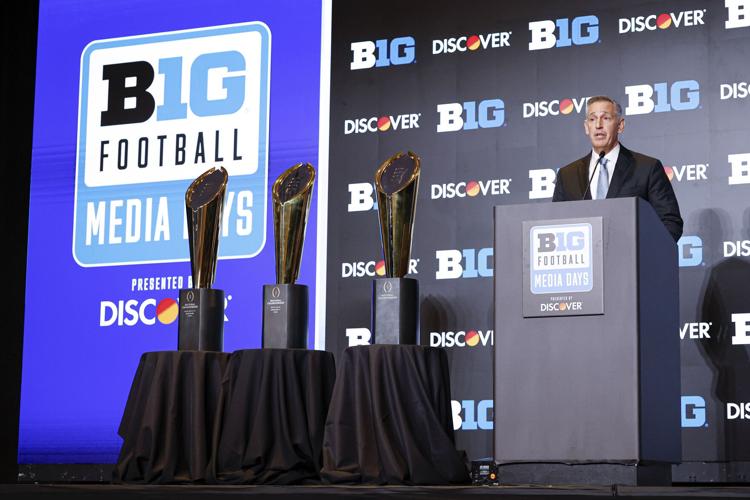
Jul 28, 2026; Chicago, IL, USA; Big Ten Conference Commissioner Tony Petitti speaks during Media Days at Hilton Chicago. Mandatory Credit: Kamil Krzaczynski-Imagn Images
On its face, that looks like a dealbreaker for most schools looking to move. But look a little deeper, everyone.
People are also reading…
Live sports is the one guaranteed money-printing entity for network television and streaming sites. They can’t get enough of it, especially if it’s the NFL or college football.
Which leads us to this intriguing fork in the road: which current power conference teams could go into the five-year exile of independent status and survive? Which has the brand power to earn an independent network or streaming media rights deal to financially hold them over until joining the Big Ten or SEC?
The Big Ten currently has 18 schools, and can expand by one under the bill's proposal. The SEC has 16, and can expand by three.
A five-year exile would mean potential conference realignment would begin with the 2032 season, assuming specific provisions of the bill won’t be challenged in court — which could lead to a much quicker realignment.
But that doesn’t mean we can’t dream.
Which college would be able to go independent?
The brands that can survive as independents (and have a legitimate shot at landing a survivable network or streaming independent media rights deal): North Carolina, Duke, Miami and Florida State.
The brands that have enough money to go independent, and try to convince the Big Ten or SEC of their value while playing without a significant media rights deal: Texas Tech, SMU, Stanford, California.
The brand that isn’t joining a conference (so stop asking): Notre Dame.
The Big Ten
It’s one and done. But where does the Big Ten look? At the best brand (North Carolina), or best fit (Stanford or California)?
North Carolina is the smart choice, but Southern California, UCLA, Washington and Oregon likely would push for another West Coast team to relieve travel expenditures. The Big Ten presidents — who will make the decision — could’ve had both Stanford and Cal in the last expansion, and passed.
But where does North Carolina feel it fits best?
The Big Ten move: Stanford. After UNC declares intentions to stay in the south, the best conference in college sports takes the best all sports program in the country. And gives a little travel relief to all involved.

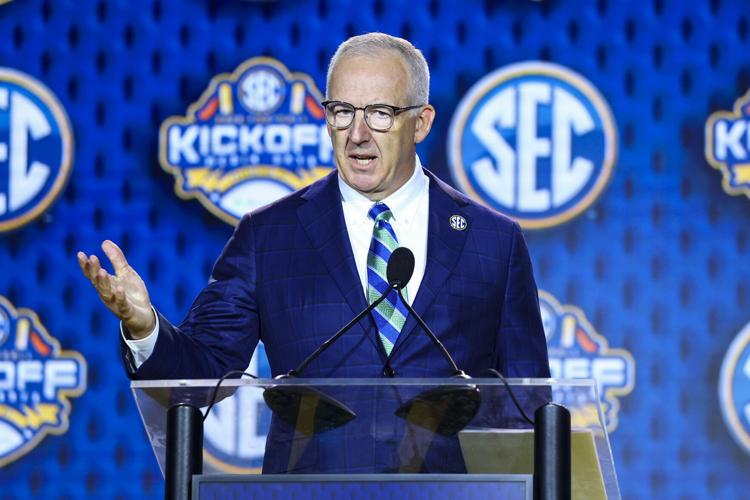
SEC Commissioner Greg Sankey speaks to the press during SEC Kickoff media days on Monday in Tampa Fla.
The SEC
The league’s presidents have said over and over they won’t expand just to expand. But if North Carolina is sitting out there, and they’ve made it clear they want the SEC over the Big Ten, it’s a no-brainer.
Now here’s where it gets tricky. The last thing the SEC wants to do is add Florida State and Miami, and damage its relationship with Florida.
Because Florida could survive on its own for five years with an individual media rights deal. And if the bluest of blue bloods Florida is on the market, guess where the Big Ten is headed?
So the guess here is the SEC adds Duke in addition to North Carolina, and caps it at 18 teams. North Carolina and Duke were two schools former SEC commissioner Mike Slive had eyes on in 2012 after the conference added Texas A&M and Missouri — but it never unfolded.
The ACC
In this scenario, the ACC is the big loser. Gone are linchpins North Carolina and Duke, and newbie Stanford. That leaves the conference with 14 teams, and the idea of adding another mouth to feed doesn’t happen unless it’s a guaranteed hammer in future media rights negotiations.
The conference would first have to transition Miami, FSU, SMU and Cal back into the fold after five years in exile (or less, if the courts get involved). Adding another school(s) — Connecticut, Memphis, South Florida, Houston? — may not be high priority.
The Big 12
No subtractions (no surprise), and no additions. Other than welcoming Texas Tech back into the fold, before the ACC gets smart and adds another Texas school.
Can’t blame the Red Raiders. The other 15 teams would’ve tried it, too, if they had the financial wherewithal.