

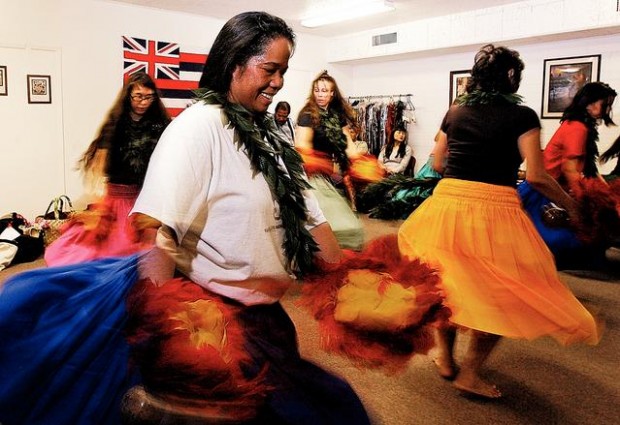
You can learn all about hula by joining a hula halau, or school.
At Leiola Hula Halau, discipline, respect and appreciation for Hawaiian culture come with each hula lesson.
"One needs to know before she dances why she is dancing," says kumu (instructor) Louise Leiola Aquino Galla. "It hurts me, as a Hawaiian, when people don't understand."
After the closure of the Kau sugar plantation on the Big Island of Hawaii, Galla lived briefly in Oregon before coming to Tucson and teaching hula.
"I would go to Japan, Africa, anywhere in this world and teach hula the way it's supposed to be taught," says Galla.
"In order for us to perpetuate, or back up our king and queen and the words they give us, the model, each Hawaiian should be able to follow (the traditions) and keep it going."
People are also reading…
Although it may look simple, ancient hula, or kahiko, is steeped in history, stemming back to the days when some viewed it as paganist.
These days, hula is often centered on Christianity, with many dances done in praise.
"There are mixed reactions to Christian hula," Galla says. "Some think we shouldn't dance about God, sing about him. If we are performing and someone requests that we not do Christian hula, we won't."
Galla teaches both private and group classes in ancient hula many days a week, and her halau is available for performances upon request.
"When we come here, we pretend we are dancing on the sand, listening to the ocean," says Sandi Rosso, a member of the halau originally from Oahu. "When you're from Hawaii, hula is just a part of the essence in who you are."
Prices vary at Leiola Hula Halau but are around $50 a month. Classes are held at 2030 E. Broadway. For more information, call 881-0147 or go to www.leiolahulahalau.com.
At the Pan Asian Community Alliance, on South Craycroft Road near East 22nd Street, dancers chant to leave their worries behind before entering the studio to study hula.
Here, dancers come to learn both ancient and modern hula. Modern hula is more free-form than the ancient style.
"We are preserving our culture and passing it down," says instructor Lisa Leina `Ala Ibarra. "If there aren't people to share, the culture will die."
Dancing together for the past eight years, members of this halau have taken their love of hula beyond Tucson by traveling to the World Conference on Hula.
The group also has been involved in the opening ceremonies of the Arizona Aloha Festival in Phoenix, and plans to attend this year.
"Before, you had to come to one class, learn one chant and try out to be in a hula school. It wasn't open for everybody," Ibarra says. "Now, it's in every race, every creed."
Lourees O'Heir, a member of the halau, says she fell in love with ancient hula when she traveled to Hawaii for her honeymoon.
"When I went to Hawaii I saw kahiko and it touched my soul," O'Heir says. "I fell in love with it. It was like a painting; I had never seen something so beautiful."
Now, years later, hula has become a dance passed down to her children and grandchildren, who all are in various stages of dance.
There are misperceptions about hula that the dancers constantly struggle with.
"They think all we do is shake our hips and wear coconut bras," O'Heir says. Tahitian dance, which includes heavy emphasis on hip-shaking, is very often misrepresented as Hawaiian hula, adds Ibarra.
"For me, it's ancient, it's my ancestors," Ibarra says. "We educate our audience when we perform. (Hula) is an evolution, a history. It's not just a dance."
Halau Hula O Leina `Ala holds practices on Sundays at the Pan Asian Community Alliance, 940 S. Craycroft Road. The cost is $40 a month. For more info, call the alliance at 512-0144 or Lisa Ibarra at 682-6539.
— Kelly Lewis


