

Like a desert flower whose beauty is sandwiched between the harsh arid landscape and unrelenting sun overhead, so too is Leanne C. Miller’s latest artwork in the MFA Thesis Exhibition at the University of Arizona Museum of Art. The exhibit of works by 12 students shows a view of the world that is alarmingly dark with a hint of subtle beauty. It closes Friday.
It is Miller’s honest and vibrant view of the southwestern landscape that first catches the eye. Alongside the works of her peers, she adds a blend of color and mysticism to the show.
To the left of Miller’s three paintings is Thomas Saffle’s nearly 10-foot long oil, “Plane of Existence,” which depicts a desolate landscape marred by a sandstorm. To the right, a photograph by Chris Newberg shows a series of seemingly apocalyptic images with wild dogs gnawing on bone in downtown Tucson alongside mutated creatures and robots.
People are also reading…
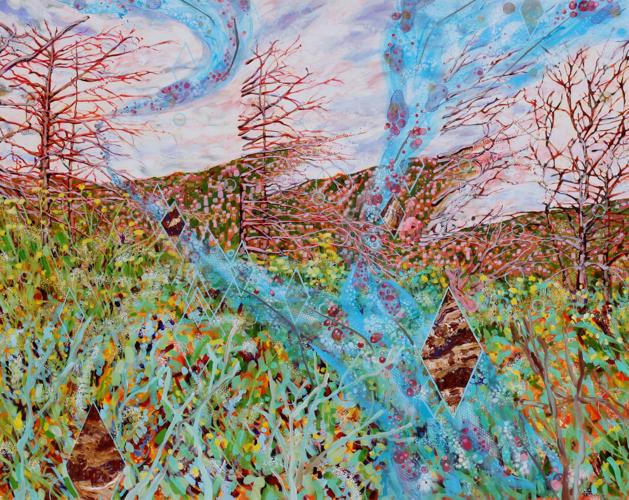
In between is where you’ll find Miller’s oversized works, her attempt to rejoin her past self with her present self. With more than 200 collective hours of labor spent on the three, she uses them as a narrative of her life’s journey, as well as a personal statement.
“These paintings for me are about being a native of the Sonoran Desert, and in coming back to it, being reinvigorated by it,” says Miller.
The 2005 graduate of the San Francisco Art Institute is set to graduate this month from the UA. Her three paintings on display at the UAMA are a few in her latest series “Time Shifts/Fleeting Remains.” Those in the exhibit are a poignant reminder of the hidden beauty of the desert landscape.
Each acrylic and spray paint piece is a combination of the outward expression of her revolt against her religious upbringing, which shunned both science and art, as well as her view of herself as the prodigal daughter — she grew up in Phoenix but had fled the Southwest. Three years ago, after a dozen years away, she returned to paint its subtle majesty.
Her paintbrush has captured the swiftly changing colors of the desert she once again calls home, evoking a sense of rise and fall akin to the topography of the land she has embraced. The lush areas are bright green and vibrant, a contrast to the melancholy bleakness of the desert’s natural tint of tan.
Each piece is marked by cuts, marks or dots mixed into the landscape. These are her representations of subatomic particles, found in everything from mountains to a tree, she explains.
“The beautiful thing is that everything is made up of the same thing,” she says. “I think it is a really grand statement that nature and science make. That is my religion.”
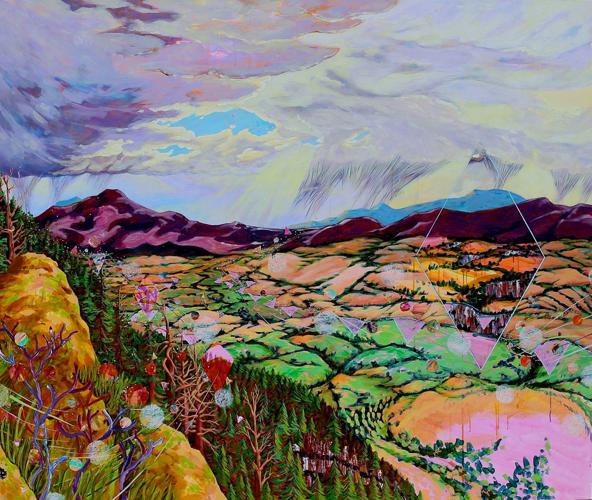
This contrast jumps out in 5- by 6-feet “Lush Line and Desert.” In it, she paints a vantage point looking down in a valley where water collects along one side of a divide, leaving one-half noticeably green and the other barren. The viewer’s eyes are drawn to that distinction immediately, as the natural curvature of the geography surrounding it only adds to the emotional hue of the piece.
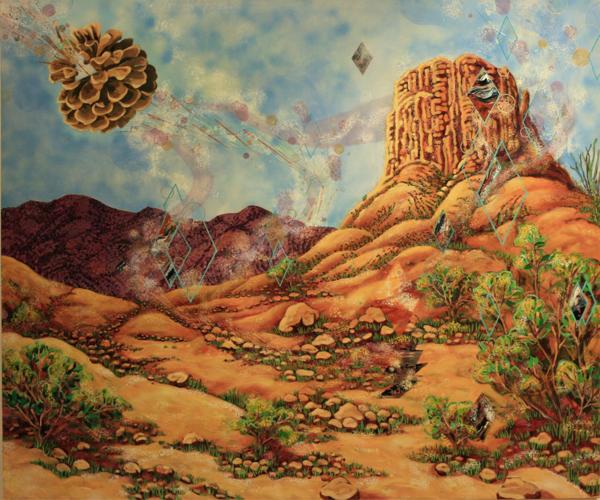
“Pineal Enlightenment,” also 5- by 6-feet, features exquisitely drawn rock indentations, a flying pinecone, and diamond-shaped windows of varying sizes spread throughout.
These windows, she explains, are her playful representations of theoretical physics, primarily parallel universes in the landscape. These different aspects layered on top of each other make a visually stunning depiction of the Southwestern landscape.
“What other people relate to when they look at (my work), I can’t control that, and I actually enjoy that,” she says. “But hopefully they come to it and that it would inspire them to go outdoors and see beauty in that way.”
Daniel Burkart is a University of Arizona journalism student apprenticing at the Star.


