
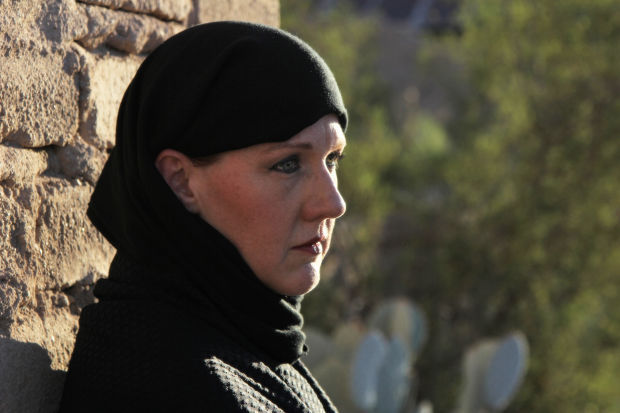
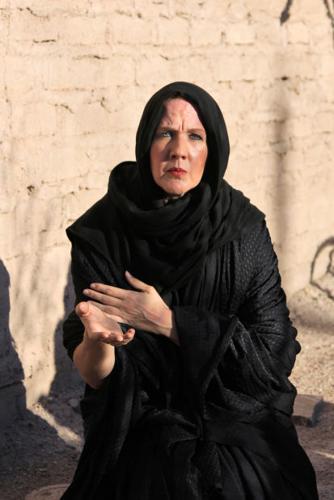
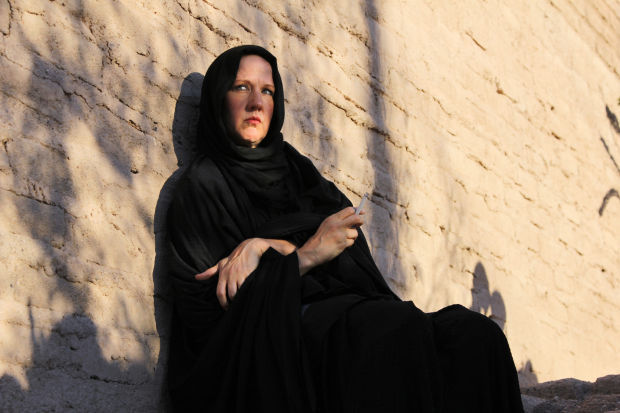
Next week, blue-eye, blond Tucson actress Lori Hunt will stand alone on the stage at Live Theatre Workshop and, in 80 minutes, play nine Iraqi women.
It’s a big challenge.
Hunt, one of Tucson’s strongest actors, admits to a bit of trepidation about the play, “9 Parts of Desire.” But more than that, she can’t wait to bring the women and this story to life.
It’s got punch: “When I first read the script, I had to put it down and walk away for a bit,” says Hunt. “It’s very powerful.”
The play tells the story of nine women between the two Gulf wars, told through a series of monologues. They range from a 9-year old girl to a 70 year-old-women and live in places such as London, New York, and Iraq. There is a doctor, a student, an artist — their lifestyles vary. What they have in common is their culture and their passions.
People are also reading…
The title: It draws from a saying of Ali ibn Abu Taleb , the founder of the Shiite sect and fourth leader of the Muslim world: “God created sexual desire in 10 parts; then he gave nine parts to women and one to men.”
No preaching here: The play was an off-Broadway hit, and reviewers frequently pointed out that “9 Parts …” is not a didactic piece, but rather one that resonates because it tells powerful stories.
Who are the characters? They are a compilation of Iraqi women the playwright, Heather Raffo, interviewed over a 10-year period. Raffo is an American of Iraqi heritage, which she has said made the women feel more comfortable when they told her their stories. The play’s main speaker is Layal, who is based on the Baghdad artist Layla Al-Attar. When the playwright came across one of Al-Attar’s paintings, she was inspired to write the play.
What critics have said: The New York Times said of the 2004 off-Broadway hit: “The voices are a study in contrasts: vivid and subdued, sophisticated and naïve, seductive and standoffish. But they cohere to form a powerful collective portrait of suffering and endurance. …” And this from the Wall Street Journal: The play “…is an example of how art can remake the world and eloquently name pain.”
What Hunt says: The script has been an eye-opener for Hunt when it comes to women and the Iraqi culture. Her hope is the audience has the same experience. “I want to broaden the audiences’ understanding,” she said. “I want to humanize the Iraqi women so that people see that they are more than what is shown on TV or what they read in in the papers. There are so many stories we never hear about and it’s really fascinating.”