

History seems to be divided when it comes to Bach's B Minor Mass.
One school subscribes to "less is more" - small chamber orchestra with a handful of players and a coterie of vocalists.
The other looks for "big and bold" - 80 or more instruments and a complement of 200 voices.
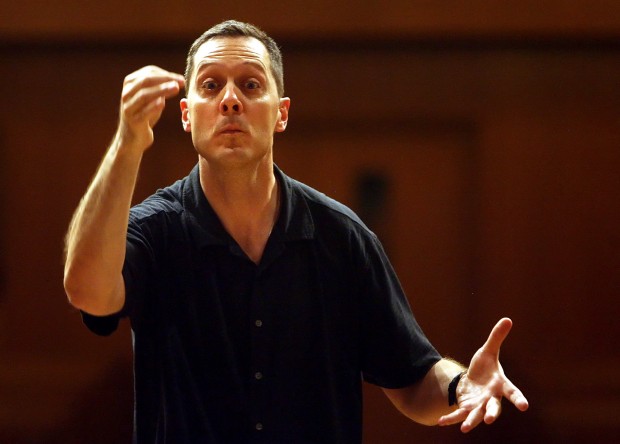
Then there's Eric Holtan's Tucson Chamber Artists, which this weekend will find a middle ground for the B Minor Mass: 26 singers and 24 instrumentalists.
"For portions of the piece we are using that chamber approach, and for other portions we're using the full-on" in his group's three performances of the Mass this weekend, Holtan explained. "We are attempting to balance modern and historical."
The venerable St. Andrew's Bach Society took the smaller-is-better route when it performed the work with eight vocalists and 17 musicians in 2007 and found that the instruments sometimes overpowered the voices. Holtan thinks his balance of voices to instruments will resolve that.
People are also reading…
For Holtan and his professional choir, the B Minor Mass marks the biggest undertaking in their seven-year history.
"This piece is the most sophisticated and complex piece we have ever mounted," he said. "Mozart's Requiem (which the TCA performed in 2006) is a sophisticated work, but there's a level of sophistication" with the Bach that the group has not yet experienced.
For those compiling Tucson's top 2010-11 classical music events, here's a few arguments for considering the B Minor Mass near the top of the list:
• It's Bach: The B Minor Mass is the sum and whole, in many ways, of Bach's genius. Although the work was completed in 1748, Bach wrote it in pieces, never intending initially that it would be a complete work. He composed the Sanctus first in 1724, then the Kyrie and the Gloria in 1733, followed by the Credo in 1732, according to most historical references. "It's like Bach at the end of his life pulled together a portfolio of the best of the best looking back and looking forward," Holtan said.
"It's a compendium of everything that worked well and he built his career on, and it looked forward to Mozart and other composers. In that sense I think it's a brilliant compilation of styles and techniques that really are a monument to that point in history."
• It's rarely performed here: Before St. Andrew's Bach Society took it on in 2007, the B Minor Mass hadn't seen a Tucson stage since 1994 when the University of Arizona performed it.
• It's beautiful: "It's full of compelling and beautiful music. Whether you're talking about the Credo or the awe-inspiring grand and sweeping statement of dona nobis pacem, it's very powerful," Holtan said. "It has so many aspects that engage different emotions."
• There's something for everyone: "I think the hard-core musical afficionados will appreciate the genius and brilliance of Bach. For people who just love good music, it's that aesthetic part," he said. "It's a smorgasbord of musical delicacies from fugues to love duets to grand, sweeping statements. Glory to God in the highest with the trumpets and drums."
If you go
Tucson Chamber Artists present Bach's B Minor Mass
• When and where: 7 p.m. today at St. Francis in the Valley Episcopal Church, 600 S. La Cañada Drive, Green Valley; 7:30 p.m. Saturday at Catalina Foothills High School Auditorium, 4300 E. Sunrise Drive; and 2 p.m. Sunday at Grace St. Paul's Episcopal Church, 2331 E. Adams St.
• Tickets: $20 to $30 through tucsonchamberartists.org or by calling 401-2651. Also available at the door.
• Review: See a review of tonight's performance online at www.azstarnet.com Saturday and in Sunday's ¡Vamos! section.
• Dedication: The concerts are dedicated to the memory of the victims of the Jan. 8 Tucson shooting.
Contact reporter Cathalena E. Burch at cburch@azstarnet.com or 573-4642.


