

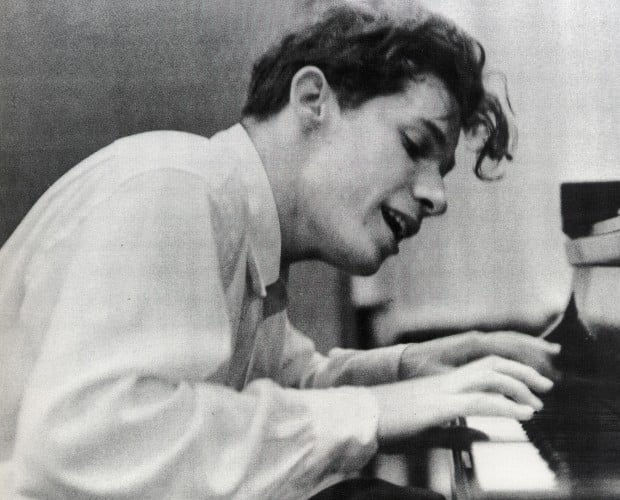
Geniuses can be terribly boring, and compelling individuals can be devoid of any gifts save charm. Glenn Gould, however, who lived his life on the balance point between genius and madness, was a virtuoso who couldn't have been more fascinating.
One of the most significant pianists ever, the Canadian-born Gould, who died in 1982 at age 50, has already been the subject of a sublime fictional treatment, Francois Girard's "Thirty-Two Short Films About Glenn Gould."
Now filmmakers Michele Hozer and Peter Raymont, who made the excellent "Shake Hands With the Devil: The Journey of Romeo Dallaire," have joined forces again for "Genius Within: The Inner Life of Glenn Gould," an engrossing documentary about a cultural figure every bit as iconic as Jim Morrison or James Dean.
Working with a formidable amount of archival footage, including interviews with the pianist as well as conversations with all the still-living significant figures in his life, including many who have never spoken publicly before, Hozer and Raymont succeed in giving us Gould whole.
People are also reading…
So we meet the perfectionist who had a weakness for being silly, the solitary man who yearned for companionship, the formidable eccentric who traveled with his own chair and soaked his hands in hot water yet quite enjoyed being conventional. In a sense, Gould's entire life was a performance people couldn't get enough of, then or now.
It was, of course, musical performance that was the heart of Gould's appeal, his ability to deliver the kind of piano playing that led conductor George Szell to comment in awe and exasperation, "That nut is a genius."
Gould's musical inclinations were discovered early; he could read music before he could read words and began on the piano around age 3 or 4. He made his American debut in New York in 1955 at age 22 and was signed by Columbia Records the next day.
The pianist's first recording was Bach's Goldberg Variations. After the disc came out, cellist Fred Sherry spoke for many when he asked, "Who is this guy? He's playing Bach in a way no one else has."
Gould's next triumph was a 1957 concert tour to the Soviet Union, where Bach had been dropped from the repertory because of the composer's ecclesiastical connections. Gould's playing astonished everyone.
The pianist grew to hate hotel living, thought touring was an inhuman way to live and clashed with people like conductor Leonard Bernstein, who publicly objected to his musical choices. In 1964, after announcing "I detest audiences, they are a force for evil," Gould quit live performance at age 31.
Though Gould was articulate and could be quite charming, his personal relationships were also problematic. Painter Cornelia Foss, the wife of musician Lukas Foss, and her two children here speak for the first time about the intense relationship she had with Gould, including the years they lived together in Toronto intending to marry.
Gould's eccentricities and his controlling tendencies proved too much for Foss, as they were for many of the people who knew him. He was a serious hypochondriac and abuser of pills whose increasing fear of hospitals was a factor in his death by stroke. Summed up John P.L. Roberts, who knew Gould for decades, "It was a whole career being Glenn's friend."
Finally, however, what is most involving about Gould is the extraordinary way he played. To see his fingers hovering above the keys in his characteristic way, to hear the transcendent music that resulted, is to be taken to a place that only the greatest artists have access to.
And that is all that really matters.
Review
Genius Within: The Inner Life of Glenn Gould
*** 1/2
This film is not rated.
• Directors: Michele Hozer and Peter Raymont.
• Featuring: Archival footage of the pianist and interviews with those who knew him best.
• Running time: 109 minutes.


