

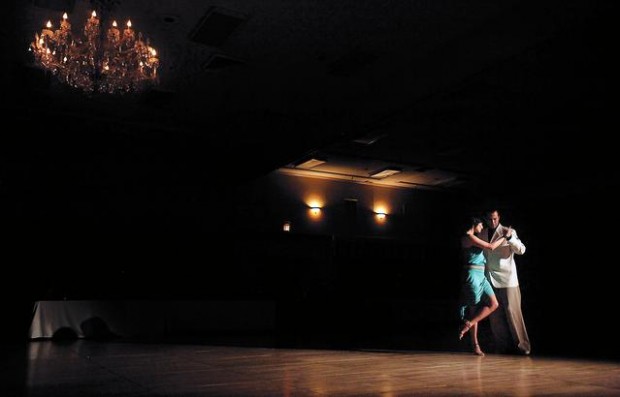
They came from as far away as Denver; Anchorage, Alaska; and Halifax, Nova Scotia, to dance at the first Tucson Tango Festival.
Nearly 300 participants signed on for the five-day event, held last month. It included a little bit of everything: workshops on posture and embrace, lessons on tango's illustrious history and a mix of milongas, or dance parties — one of which ended only after the sun came up.
Donning pressed suits and form-fitting dresses of brilliant reds, blues and purples, couples moved gracefully around the Inn Suites' main ballroom amid hundreds of other enthusiasts during the festivities' all-night Saturday soiree.
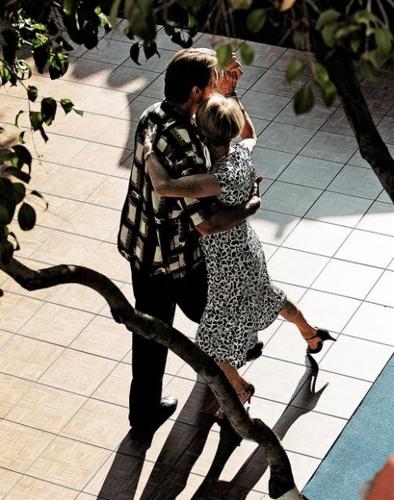
Many had only just met but looked perfectly comfortable with each other on the dance floor, hands clenched, bodies close and legs intertwined, moving in intricate, improvised steps.
People are also reading…
The festival was a declaration to the rest of the world that tango is on the rise in the Old Pueblo.
"Tucson is a little ways off the tango trail," said Rusty Cline, the man behind the event who fronted more than $30,000 of his own money to make it happen. "We were worried last fall that we might get hit with a major financial loss. We ended up making enough that we want to do it again."
The festival put Tucson in the running with more established scenes in cities like Portland, Ore., San Francisco and Washington, D.C., and complemented the growing number of milongas, teachers and training sessions that we have access to any day of the week.
The history
It is widely believed that tango started in the brothels of Buenos Aires, Argentina.
Young, male, European immigrants, looking for fame and fortune in the New World, danced with each other while waiting for their favorite prostitutes.
We can trace Tucson's tango roots back to John Dahlstrand, the lighting designer, stage manager and technical director for the University of Arizona's School of Dance.
Dahlstrand was an astronomy-turned-dance major in college and had received his undergraduate degree in 1985 when he took a job at the Studio West dance school to increase his movement vocabulary.
The studio offered tango, but ballroom tango, often choreographed and found in competitions and on shows such as the hit ABC series "Dancing With the Stars."
"Whenever I did it the way they wanted me to do it, it was so exaggerated, I always laughed," he said. "It wasn't really making any sense to me."
It wasn't until a year later, on a trip to Washington, D.C., to visit a friend, that Dahlstrand truly fell in love with the art form. It was there that he saw Tango Argentina, a touring act made up of Argentine dancers and musicians who performed a more improvised style known as Argentine tango.
"It was one of the most amazing and compelling things I had seen," he said. "The majority of the performers were middle-aged, who had spent their lives dancing tango. To see these people burning up the stage at the age I'm getting to be now was wonderful."
When Dahlstrand, now 52, got back to Tucson, he and fellow UA grad Mara Carlson sought out research materials to learn this form that wasn't around in Southern Arizona.
Since this was before the Internet boom, information was scarce. They bought the only two videos they could find, which in retrospect were "pretty terrible," Dahlstrand said. And they made frequent trips to Phoenix to see dancers coming through.
"We would practice in my mom's garage in Phoenix, which was either extremely hot or freezing, depending on what time of year it was," he said.
Eventually, they started teaching others in Tucson and formed their own performance group, Sueños Tangos.
As interest grew, Dahlstrand became more ambitious. In 1998, he held Tango Week on the UA campus. The event included a series of workshops taught by professionals from both Argentina and the United States.
"For me, tango was just different," he said. "Compared to my education at the university, with tango I am responsible for someone else as well as myself. I have to listen to the music and figure out when they respond so I can respond to them. Then you have to respond to all the other couples on the dance floor and somehow make all this work together without crashing and falling down."
These days, Dahlstrand can be seen on a regular basis at the milongas held around town, depending on his schedule with the School of Dance.
Many in the community call him the "Godfather of Tucson tango." His students' students are now teachers, and he is a well-known face on the local scene.
"People have taken it and really run with it," he said. "They've really done a lot and expanded it so much more. I'm very pleased."
Members of this passionate community born from Dahlstrand and Carlson include Judy Miller, who ran her own communications company, J.A.M. Consulting, until retiring a couple of years ago.
Miller discovered Tucson tango about four years ago through a friend who wanted her to be his dance partner. Miller stuck with it. He didn't.
Since that time, Miller has poured herself into tango. She never misses a chance to dance and has traveled to Buenos Aires three times to learn from the masters.
"They have some really generous, warm people down there," she said. "It is all about just being there and experiencing the culture, understanding and getting to know them."
As the former head of her own business, Miller said, the most difficult thing about learning tango was putting a man in charge.
"A lot of women who dance tango are fairly high-powered professionals, and they have to give the power over to their dance partner," she said. "That took some getting used to.
"You don't learn everything all at once," she added. "The more you dance, the better you get."
Cline didn't grow up with a dance background. He was a bricklayer for many years, more interested in creating with his hands than with his feet.
After coming up with a series of lucrative "how-to" construction tutorials for the computer, teaching methods on building everything from stone patios to block walls, he found himself with a little extra time for new artistic ventures.
Like Dahlstrand, Cline, 51, started with ballroom tango but wasn't into the competition aspect.
"Ballroom is always about choreography," he said. "Getting ready for the next event. That's fine. I just wanted to dance with my peers. I didn't want people to watch and judge."
Cline moved on to Argentine tango. Today he teaches the method alongside his dance partner and significant other, Joanne Canalli.
They wanted to hold a festival, not only to put Tucson on the map, but also to expose the Old Pueblo's dancers to other members of the national tango community.
"I see tango changing and evolving a lot," Cline said. "When tango left Argentina, it was brought to the world on the stage with a lot of dramatic moves. As people on the streets began to learn, they wanted to do it in the clubs, but the clubs couldn't accommodate all the fancy dance moves. It began to morph a little bit, becoming softer and more user-friendly.
"The tango communities in places like San Diego and Denver are much larger, and they dance this softer kind of tango. I wanted to present an exposition of people, dancing tangos, being friendly and not having it be just about flashy stage antics."
The future
While tango isn't strictly for mature audiences, Tucson's tango community tends to lean more toward the 35-and-up crowd.
One of the exceptions is Erik Fleming, 28, who runs one of the most popular milongas in the city.
Every Wednesday night, Fleming emcees the festivities at Casa Vicente, a tapas restaurant Downtown on South Stone Avenue. As organizer, you can find him buzzing around the bar area where the dancing takes place, spreading flour on the floor for gliding, sorting through the playlist for the evening on his laptop and occasionally passing around his hat for donations.
Fleming, a professional competitive dancer and instructor, represents a younger generation of tango dancers in Tucson, but he still has more than a decade of experience behind him.
Fleming started taking ballet and modern dance lessons at 13 years old as cross-training for martial arts. It wasn't long, he said, before he was dancing instead of martial arts.
"There was a gradual segue from sweaty guys punching me in the face to dancing," he said.
Fleming's biggest influence was Homer Ladas, a popular tango dancer best known for his own tango nuevo style, who ran a studio called the Shoebox Tango Club on East Congress Street.
Having always lived near Downtown, Fleming saw learning to tango with Ladas as an opportunity to do something other than roam around, looking for trouble.
"I didn't have any money at the time," he said. "I came in and swept the floors and brought in flowers and fruits from my garden to help pay for lessons."
The lessons eventually led to a fruitful career. Fleming has performed with dance groups across the country, in Mexico and in Southeast Asia.
Fleming has run the Wednesday night milongas for seven of the event's nine years.
They've been held at Casa Vicente since shortly after the restaurant opened in 2005.
Before that, they were at Irene's, a Downtown spot where Sports on Congress is today.
"Even if you are really bad, you still have a valid artistic statement to make," he said. "The more you do it, the better you get. It is wonderful watching people grow through time with it. It is great seeing the positive, transformative power of things."
Also:


