

It's possible to see all of the mountain ranges that surround Tucson from the big ramada at Pima County's newest park.
Over the next decade, the scenic 9.4-acre parcel of rolling desert will also showcase an increasing number of native trees and an extensive variety of cactus and succulents - including what organizers hope will one day be the most complete collection of prickly pear and cholla in the nation.
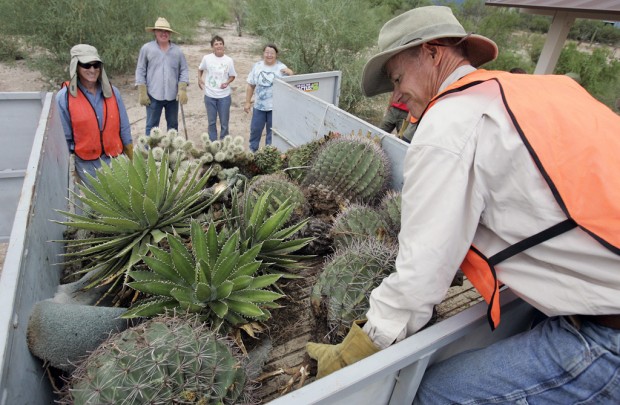
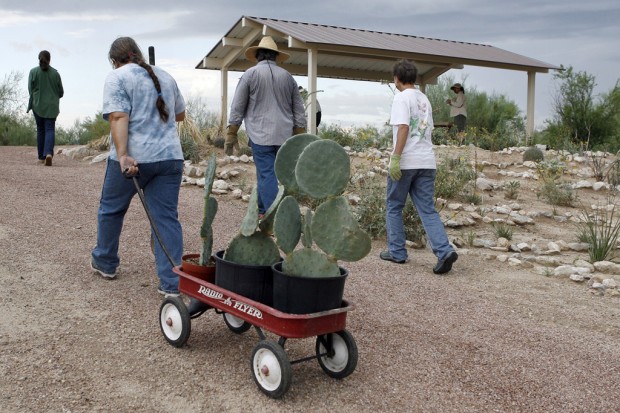
Pima Prickly Park is an effort by the Tucson Cactus and Succulent Society and Pima County to transform a former sand and gravel pit into a community asset using plants rescued from construction.
"It's here for everyone to come and see the best the desert has to offer," said Jessie Byrd, a landscape designer and society member who facilitated the park's design.
Thanks to the volunteers, the park already is home to a fledgling hummingbird garden, a striking "bee tree" made from the trunk of an ironwood, and an impressive collection of cristates - crested plants.
People are also reading…
While the park will take years to complete, its grand opening party is planned for Saturday.
"It's all about education," said Joe Frannea, the event's coordinator.
The event features a range of exhibits, tours and hands-on activities that will introduce people to a wide range of native plants, and in particular show people that even the most prickly are important.
"That's why we named it Pima Prickly Park," he said. "We want to introduce people to a lot of these plants and show them how unique they are."
Pima Prickly Park could be a national model in several ways, starting with its transformation from an industrial gravel pit to a public space that contributes to the health and education of the community, said Rafael Payan, the county's Natural Resources Parks and Recreation director. It also creates habitat for native animals and serves as a model for sustainable landscaping.
The land, which the county bought after the 1983 floods, is unsuitable for athletic fields because of the settling soil - fill material is as much as 60 feet deep in some spots- and it's located in a flood zone.
A small part is used for the administration offices of the Pima County Natural Resources, Parks and Recreation, which opened in 2002.
County park employees started trying to restore the property about nine years ago, fostering the growth of native trees and vegetation - in some cases by bringing in seedling trees from their own yards and scattering seed. Today, Payan said, some of those trees are 12 feet tall.
The nonprofit Tucson Cactus and Succulent Society had been looking for a demonstration project when Pima County Administrator Chuck Huckelberry approached it two years ago. The project is the biggest the 51-year-old all-volunteer organization has undertaken. "We have a 15 year operating agreement," Frannea said.
Payan estimated the value of the plants the society has already donated, installed and nurtured at more than $100,000.
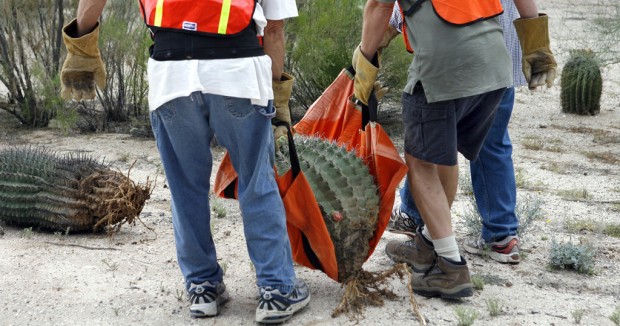
The 22 volunteers who showed up a couple of weekends ago to help prepare the park for Saturday's grand opening planted five saguaros and 30 barrel cactus (including some moved to make way for a school in Sahuarita) among a number of other plants.
"This is such a long-term project. It's a work in progress," volunteer Linda Heisley said during a brief break. "But compared to where we were, we've come a long way."
The Tucson Audubon Society helped to install the hummingbird garden, which is on a slope next to the big ramada. A boy scout working on his Eagle Scout rank built the central trail.
There are also plans for a demonstration garden area and a cholla garden to be modeled after an English rose garden that showcases the native blooms.
Frannea said he'd like to see teachers use the park to teach about the surrounding desert. Eventually, he said he'd like to have volunteers speak to student groups, and to develop lesson plans to help students identify and understand native plants.
The society started with just a handful of people in 1961 and today has more than 1,000 paid members.
"We've been doing what we call cactus rescue for 12 years," said Frannea, who oversees the rescue crews.
The society's website has an odometer-type feature that shows nearly 60,000 plants had been saved as of Tuesday.
One of them is a majestic crested barrel cactus relocated from south of Los Reales Landfill that has a new home near the park's entrance. "It was just this big beautiful plant," said Byrd, who loves taking part in the rescues. "It is the most perfect big crest," he said, describing it as the best of its type that anyone in the society has seen.
If you go
Pima Prickly Park Grand Opening
• What: Celebration includes tours, music, exhibits, hands on activities and rescued cactus sale.
• When: 9 a.m.-2 p.m. Saturday.
• Where: 3500 W. River Road. (Turn in at the Pima County Natural Resources sign and then take the first right into the parking lot.)
• Admission: Free.
• Park hours: The park is open from sunrise to sunset.
• More information: www.tucsoncactus.org
Exhibit highlights
• The Arizona Poison & Drug Information Center's display will include live bark scorpions and various educational materials including magnets and stickers.
• An entomology exhibit that includes live critters by the Bug Man (aka Carl Olson, curator of the University of Arizona entomology department's research insect collection).
• Tucson Audubon Society with information about the hummingbird garden.
• Organic products and gifts by Cheri's Desert Harvest.
• Information about the Flowing Wells Neighborhood Association and Community Coalition.
• Bee houses by Gardening Insights.
• Prickly Pear truffles by Monkey Flower Fine Chocolates.
• Pima County will exhibit its Living with Wildlife trailer, and provide information about its parks and recreational areas.
• Learn about butterfly habitat from the Southeast Arizona Butterfly Association.
• A display by the Southern Arizona Buffelgrass Coordination Center.
• Tucson Cactus & Succulent Society exhibits include a desert educational display and a display of Florilegium Project botanical art that includes a hands-on sketching lesson. Children will be able to plant a small cactus to take home. There will also be books, T-shirts, hats and more for sale.
• Pamphlets on water saving using natural landscapes courtesy of the Tucson Water Department.
• Wells Groen Publishing Co., will have items including desert jellies, syrups, and books on using native fruits.
Did you know?
The eight saguaros that form a circle on a knoll in Pima Prickly Park that's visible from River Road were planted in the early 2000s by Robie Pardee, a county project manager, as a tribute to his mother.
Responsible for landscaping the parks department's new headquarters, Pardee transplanted the saguaros from an area near Crooked Tree Golf Course at Arthur Pack Park, where they had been stored after being moved to make way for the golf course.
Pardee died last year, but organizers plan to honor what he started with the addition of a blue palo verde that will help raise other saguaros. "We're using that nurturing relationship between the baby saguaros and their palo verde nurse trees to demonstrate that maternal relationship," Jessie Byrd said.


