

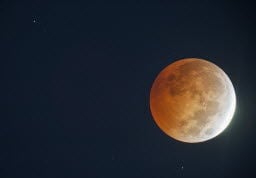
Total lunar eclipses always occur at full moon when the moon is behind the Earth from the sun and the Earth’s long shadow falls on the moon. Not every full moon produces an eclipse as the Earth’s shadow misses the moon most of the time.
The eclipse Saturday morning will be the first of two lunar eclipses this year with the second occurring on Sept. 28. That will complete a tetrad — a somewhat close grouping of four lunar eclipses — the first two took place April 15 and Oct. 8, 2014.
Tetrads are relatively uncommon. According to NASA (http://eclipse.gsfc.nasa.gov/OH/OH2014.html#tetrads), about 16.3 percent of all total eclipses of the moon belong to a tetrad. The next tetrad will be in 2032-2033.
During the penumbral phase of a lunar eclipse, the moon enters a region of partial shadowing and is darkened somewhat. This begins at 2:02 a.m. on Saturday morning. At 3:16 a.m. the moon enters the Earth’s umbra where there is complete shadowing. The moon gets progressively darker as it moves deeper into the umbra. Totality when the moon is completely in the umbra only lasts 5 minutes beginning at 4:58 a.m. and ending at 5:03 a.m.
People are also reading…
Theoretically, the moon should disappear from sight during totality, but that rarely happens. Instead the moon becomes a gorgeous copper color due to sunlight being scattered by the Earth’s atmosphere and somewhat focused on the moon. Sunrise is at 6:08 a.m, and the moon sets at 6:15 a.m. when it is still in the umbra. We will not see the entire eclipse, but we will see the best part.


 Tucson's newest Shake Shack gets neighbors

