

When one spouse dies, control of an Arizona living trust usually stays with the surviving spouse, assuming that spouse is named as the remaining trustee. That might sound straightforward, but the specific details can affect how the process unfolds.
According to a recent report, 56% of U.S. adults have no estate planning documents at all. With that many people flying blind, it’s no surprise that confusion runs deep about how trusts actually work after a death. Many people assume that a complex legal transition kicks in overnight, but the exact outcome depends on the terms of the written trust, the couple’s property ownership structure, and whether certain assets were left outside the trust entirely. Depending on the trust’s terms and circumstances, the successor trustee may not take over immediately.
People are also reading…
What Happens to a Trust When a Spouse Dies in Arizona?
The Surviving Trustee Usually Stays in Control
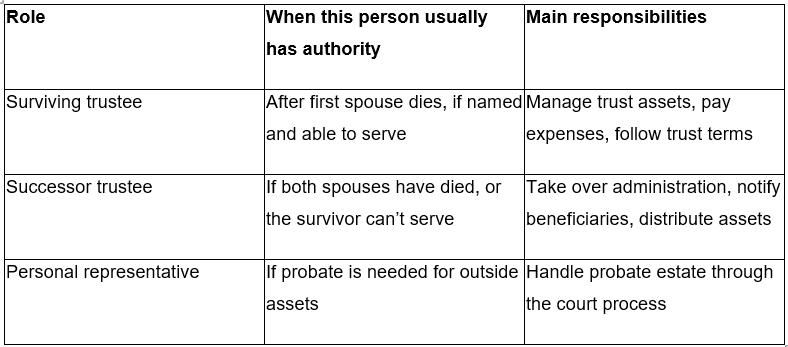
Many married couples in Arizona choose to set up a joint revocable trust where both spouses serve as co-trustees while they’re alive and capable. After the first death, the surviving spouse typically continues to manage trust property without interruption. If you’re the surviving trustee, you generally keep your common administrative powers: paying household bills, managing investment portfolios, and handling distributions allowed by the trust terms.
If the documentation permits it, you can also sell or refinance real estate held within the trust. This kind of continuity is what may help maintain access to accounts and allow the surviving spouse to manage financial matters without immediately seeking court involvement. Think of it less like a changing of the guard and more like one co-pilot taking the controls while the plane stays on course.
When the Successor Trustee Takes Over Instead
A successor trustee is more of a backup decision-maker than an immediate replacement. This person (or institution) typically steps in only when both spouses have died, or if the surviving spouse resigns or becomes incapacitated. Sound familiar if you’ve ever named a backup on a bank account? It’s a similar concept, just with broader authority.
In some complex estate plans, the trust language specifically calls for a split administration at the first death, potentially appointing another trustee for a decoupled portion of the trust. Even then, the surviving spouse often retains primary authority over their share of the assets. If you want a more detailed, Arizona-specific breakdown, this guide on what happens to a trust when a spouse dies covers trustee duties, probate avoidance, and assets that might fall outside the trust.
Why the Trust Document Matters More Than Assumptions
Joint Trust, Revocable Trust, and Subtrust Language
People throw around the phrase “joint trust” casually, but actual legal control depends on the written instrument itself. Some trusts stay mostly revocable for the survivor, giving them broad flexibility. Others automatically split into distinct entities at the first death, creating something like a survivor’s trust and a decedent’s trust.
A bypass trust or family trust might also be created at this stage to preserve specific assets for the next generation. Once a spouse passes away, certain provisions tied to that spouse’s share of the property can become irrevocable. The takeaway? Rely on the written terms, not on family assumptions. Guessing wrong here can lead to unauthorized asset transfers and legal headaches nobody needs during an already difficult time.
What “Irrevocable at the First Death” Usually Means
When a trust document states that certain sections become “irrevocable at the first death,” it draws specific legal lines the surviving spouse can’t cross. You may still control and manage the assets within that subtrust, but you can’t rewrite the final beneficiaries of that portion. Picture it like being the property manager of an apartment building you don’t own; you run the day-to-day, but you can’t sell the building to your cousin.
This arrangement frequently appears in advanced tax-planning strategies and blended-family situations. Typically, the objective is to secure the inheritance designated for children from a prior marriage. So the surviving spouse keeps management authority and financial support, just without unlimited power to change who ultimately inherits. Understanding this limitation early helps families avoid disputes over changes that look unauthorized after the fact.
How Arizona Community Property Affects Trust Control
Arizona Is a Community Property State
Arizona is one of the community property states in the U.S., and that classification directly shapes how assets get categorized when a spouse dies. Under this system, property acquired during the marriage is generally community property, meaning both spouses share an equal ownership interest unless a specific legal exception applies. This typically covers wages earned, real estate purchased, and retirement accounts funded during the marriage.
State law spells out specific rules governing how community property is managed and transferred. Before a surviving spouse takes any action (selling a house, closing an account, or making a large distribution), they need to determine whether a particular asset belongs entirely to the community or qualifies as separate property. Getting this wrong can create problems down the line that are expensive to fix.
Why That Matters After the First Death
The characterization of ownership determines what belongs to the deceased spouse’s estate and what already belongs to the survivor. Some portions of the community property may already be held in the trust, while other portions may pass directly to the survivor through beneficiary designations or survivorship rights.
Trust administration after a death is largely an ownership-and-titling exercise, not a simple reading of a will. Not where most people expected this process to go, right? Accurately sorting these assets helps ensure that the designated share of the deceased spouse transfers correctly according to the trust instructions. Failing to respect community property rules can lead to incorrect distributions and potential legal claims from other beneficiaries.
What If Some Assets Were Never Put into the Trust?
Assets in the Trust Versus Assets Outside the Trust
A living trust only controls assets that were properly titled in the name of the trust before the death occurred. That detail can sometimes be overlooked. Research shows that household income for widows drops by 37% after a spouse dies, making fast access to financial resources a real priority for the surviving spouse.
Unfortunately, it’s common for families to discover that major financial accounts, vehicles, or parcels of real estate were never retitled into the trust. Estate attorneys encounter this issue when helping families administer a trust. Common outside assets include retirement accounts, life insurance policies, payable-on-death bank accounts, and jointly owned property with survivorship rights. Identifying these overlooked bank or brokerage accounts is an important early step a surviving spouse may consider when reviewing their financial position.
Some Assets May Still Avoid Probate, but Not Through the Trust
Financial institutions routinely warn that outdated account titling creates avoidable problems for surviving partners following a death. Some assets automatically skip probate through contractual beneficiary designations or direct rights of survivorship, entirely bypassing the trust document. Payable-on-death designations and transfer-on-death deeds legally control where those specific assets go, regardless of what the trust says.
And yes, there’s a catch: Any asset lacking a trust title, a direct beneficiary, or a survivorship provision will likely require formal probate proceedings. Surviving spouses should systematically review every account to determine exactly how the property will be transferred.
Here are the most common assets that tend to pass outside a living trust:
- Retirement accounts such as IRAs and 401(k)s
- Life insurance proceeds (which go to the named beneficiary, not the trust, unless the trust is named)
- Payable-on-death or transfer-on-death accounts
- Real estate held with survivorship rights
- Property that was simply never retitled into the trust
Probate, Trustee Duties, and What Families Often Overlook
A Trust Can Reduce Probate, but It Doesn’t Eliminate Post-Death Work
A properly funded trust may reduce the likelihood that court intervention will be necessary, but it doesn’t completely eliminate the administrative work that follows a death. Legal professionals estimate that an uncontested probate in Arizona typically takes 6 to 9 months to complete, underscoring that even straightforward court processes can take considerable time. Contested probate matters in Arizona can stretch to 12 to 24 months or longer, placing a heavy burden on grieving families.
Depending on the circumstances, using a trust to limit court involvement may offer financial and practical benefits. But the surviving spouse still has duties to carry out promptly; dragging your feet can invite unnecessary delays or legal challenges from beneficiaries who feel left in the dark.
The Surviving Trustee Still Has Fiduciary Responsibilities
The surviving trustee carries strict fiduciary responsibilities defined by state law, and these demand a high level of financial prudence and transparency. You’re required to gather and safeguard all trust assets and, where necessary, obtain accurate date-of-death values. You also need to pay valid debts and administrative expenses before making distributions to secondary beneficiaries.
Keeping careful records and communicating with beneficiaries when required helps prevent misunderstandings and potential legal conflicts. So what does this actually mean for you in practical terms? It means that following the exact terms of the trust isn’t a suggestion; it’s a legal obligation, and courts take it seriously if a beneficiary raises concerns.
Do Taxes Change Who Controls the Trust?
Arizona Has No State Estate Tax
The financial side of trust administration often prompts immediate worries about tax liabilities after a death. Here’s the good news for Arizona residents: The state doesn’t impose a separate estate tax on property passing to heirs or beneficiaries. That considerably simplifies the administrative burden for most local families settling an estate.
Surviving spouses can generally manage the transfer of property without filing a state-level estate tax return, which is great news if you’re already juggling a mountain of paperwork. Keep in mind, though, that this doesn’t automatically wipe out other possible tax considerations.
Federal Rules May Still Matter for Larger Estates
Despite the absence of a state tax, federal tax rules may still affect the administration of larger estates. Because estate-tax thresholds can change, couples should review their ownership structures and beneficiary designations to help avoid unexpected federal liabilities. Federal estate taxes only apply once an estate exceeds a very high financial threshold, though these exemption limits are always subject to change by lawmakers.
On top of that, issues with the income tax basis and capital gains rules often matter significantly even when the estate itself falls below the taxable threshold. If you’re dealing with a larger estate, complex business assets, or a blended-family plan, individualized legal and tax advice can help families understand their options and make informed decisions during the process.
The Practical Takeaway for Arizona Families
In most situations, the surviving spouse stays in control of the trust as the designated surviving trustee. The successor trustee generally serves as a backup, stepping in only when the surviving spouse dies or becomes unable to serve.
But here’s where it gets nuanced: The survivor’s legal control may be limited by specific subtrusts, irrevocable provisions, or the rules governing Arizona community property. Issues involving beneficiary-designated accounts and unfunded assets outside the trust may affect the expected outcome. So before you sell property, change accounts, or promise distributions to family members, check both the trust language and how each asset is titled. That one step alone can save you from months of legal cleanup.