New books by Southern Arizona authors:

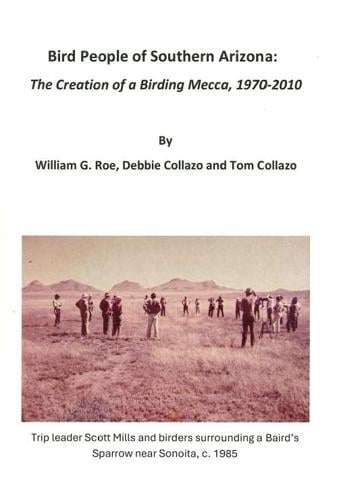
“Bird People of Southern Arizona: The Creation of a Birding Mecca, 1970-2010” by William G. Roe, Debbie Collazo and Tom Collazo (Barrio Hollywood Press). 51 pp. $15 at Tucson Bird Alliance Nature Shop and the Ramsey Canyon Bookstore.
“Bird People of Southern Arizona” is a fond compilation of a hundred-plus short biographies of folks instrumental in establishing, promoting and maintaining the culture of birding in Southern Arizona. Living and departed writers, scientists, naturalists — even an Arizona governor, a University of Arizona president, and one English rock star — make appearances.
William G. Roe, a co-author of the book, introduced collaborators Debbie and Tom Collazo to birdwatching back in 1980. The Collazos were managers of the Mile Hi Cabins and Ramsey Canyon Preserve for the Nature Conservancy. Debbie helped establish Friends of the San Pedro River and the San Pedro House Bookstore. Tom oversaw the remodeling of the preserve’s visitor center and managed the Aravaipa Canyon Preserve.
People are also reading…
Those they feature have participated in an impressive number of environmentally significant organizations — not least, Audubon Societies by cities, the Nature Conservancy, Arizona State Museum, the Condor Recovery Program and Cornell Lab.

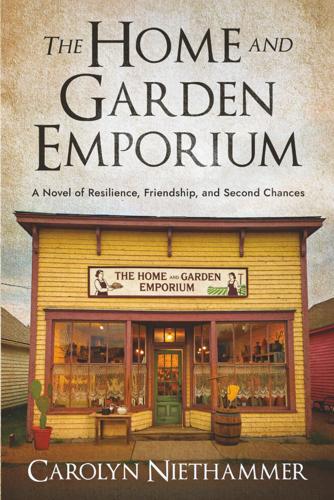
“The Home and Garden Emporium: A Novel of Resilience, Friendship, and Second Chances” by Carolyn Niethammer (Sweet Lime Press). 263 pp. $14.99 paperback; $4.99 e-book.
Wild-food expert, master cook and prolific Southwest food writer Carolyn Niethammer has woven her expertise and interests into this charming period novel set in World War I Tucson.
It opens with 26-year-old Mary Ellen (“Ellie”) Smithfield despairing of the dusty mess of a Tucson hardware store she is expected to run to support herself and her new husband’s widowed aunt. It’s 1917. She, a red-haired, clever New York tenement-dwelling Irish girl, had worked her way up from laundress to haberdashery shopgirl, where she caught the eye of Edward, a worldly banker in need of a wife. Ellie, unworldly, was in need of escape from the tenements. He promised her Paris.
She got Tucson.
She also got Edward’s disdainful aunt, this derelict hardware store, and a husband only too eager to head off to war in Europe.
When Ellie protests that she knows nothing about hardware, Edward waves it off. “You know how to sell, my dear. Gloves, hardware, it can’t be that different.”
Easier said than done. And Ellie can use all the help she can get, as Edward ships off without even visiting the store.
Ellie is both flummoxed by the functions of the piles of unsorted items in the shop and stymied about how to acquire inventory. Fortunately, Anton, a neighbor’s son, unable to enlist because of childhood polio, steps in to help.
When Ellie realizes that she might be able to attract women customers to the shop by offering kitchen and gardening supplies, and when the government opens a campaign to support the war by planting “victory” gardens, eccentric Hattie Carter steps up to give gardening classes. And when Ellie discovers that Edward’s uncle died and left his wife — and thus, her — mired in debt and beset with creditors, Jiu Li, the greengrocer, gives Ellie a break.
Niethammer created a World War I Tucson so realistic you feel you’re living there. Its rich early 20th-century neighborhoods and businesses, cultural biases, war and disease challenges, and domestic details (ever considered the significance of the invention of Pyrex?) … plus a central character you'd like for a friend.
This is a heartwarming “novel of resilience, friendship, and second chances.”

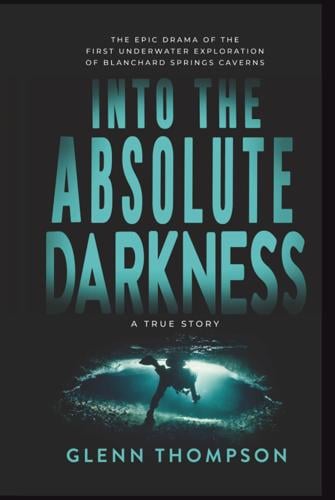
“Into the Absolute Darkness” by Glenn Thompson (independently published). 166 pp. $26.95 hardcover; $24.95 paperback; $9.99 Kindle.
When hydrogeologist Glenn Thompson was a 13-year-old snorkeler, he was spooked by encountering a horseshoe crab the size of a trash can lid. When he was 17, he donned a 35-pound, pre-WWII diving helmet and was dropped 30 feet into murky Narragansett Bay, only to have the helmet fill with water. Under-ice scuba-diving as a college student, he lost sight of the hole and narrowly escaped drowning. Later, on a dark, foggy January night, driving over the dunes for a night-time jaunt, Thompson’s VW plunged over a dune into a tidal river and was swept into the Atlantic Ocean. With him aboard.
Yet, at 24, he couldn’t wait to be the first to explore Arkansas’s underwater Blanchard Springs Caverns.
“Into the Absolute Darkness” is a gripping adventure memoir of Thompson, a former UA assistant professor of hydrogeology turned groundwater toxins researcher and entrepreneur.
In breath-stifling detail (particularly for the claustrophobic or dark-phobic among us), with striking photos, Thompson relates how he and spelunker friend Bob Langford set about exploring the large Blanchard Springs cavern system whose completely water-filled tunnel had prevented previous exploration.
One harrowing event after another makes this a fact-better-than-fiction work. Squeezing through 10-inch air spaces. Getting trapped beneath low ceilings under water. A cave ceiling collapsing in front of them. Worst, losing their lights deep in the system, and having to feel their way out, through water and open caves, in utter darkness.
But their discoveries of hundred-thousand-year-old stalactites in grand, multi-colored spaces inspire awe.
Thompson describes its rewards: “Being the first person to swim several hundred feet through a water-filled cave and surface into a vast new air-filled room decorated with dripstone formations, waterfalls and rimstone dams … is a totally mind-blowing experience.”
It’s a memoir not to be missed.

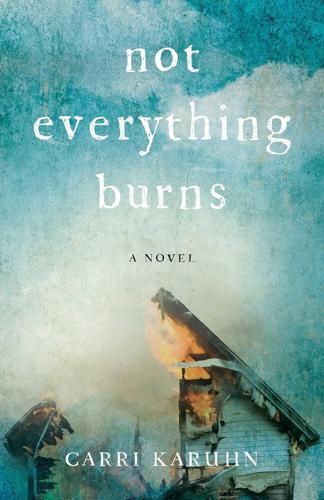
“Not Everything Burns” by Carri Karuhn (She Writes Press). 305 pp. $17.
We know what will happen in this new novel by Carri Karuhn from its opening pages. The prologue tells us that. In the course of a few months, the narrator has just lost everything in her life: her job, her marriage, and her house, burned to the ground in a wildfire, her cherished dogs and cat inside. Even the three small monuments to her pets have been looted from the ashes.
This gives the tale a prescient poignancy.
Chicago-raised journalist Amber Mettle has attained her dream job — front-page reporter for the Chicago Tribune. She and her reporter-turned-PR-guy husband Drew are living in a small, fourth-story walk-up hammered 24/7 by traffic noise.
They’d like to be able to buy a house with a yard, especially as Amber has begun taking in needy animals — a tabby dropped by the side of a highway, a terrier-mix chained outside in the Chicago cold, an abandoned Lab —but they lack the funds. Unexpectedly, Amber’s grandmother presents them with cash for a house down payment.
More unexpectedly, Drew announces that he’s been offered a promotion requiring a move to Los Angeles. No problem leaving the Tribune, Drew assures Amber; with your résumé, you’ll quickly land a job. No problem leaving your comfortable city, family and lifelong friends, he continues; you’ll adapt and make new ones.
Most of Amber’s “no problems” don’t work out. She finds no job, no comfortable L.A. vibe, no friends, but they do find a home with a yard. It’s a fixer-upper high in treed, vegetated Malibu, with gorgeous views and a yard. Amber begins to garden, and finally feels they’re putting down roots.
Until they aren’t.
Karuhn has created a sympathetic 38-year-old Amber, who’s an accomplished writer willing to forego her ambitions to support her husband’s. Karuhn has also given real life and personality to Amber’s pets, Ponce de Leon, Maggie and Esther, which quickens readers’ involvement with and tightens anxiety for them.
This is a novel of loss, agency, and grace that will linger after you’ve closed the book.
Carri Karuhn will give a book talk and signing on Saturday, Nov. 14, 1-3 p.m., at Mostly Books, 6208 E. Speedway.

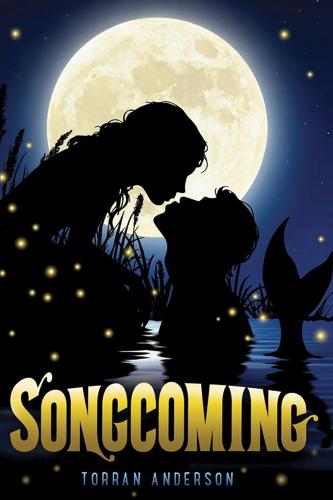
“Songcoming” by Torran Anderson (Enslow Publishing, LLC). 187 pp. $16.35 paperback.
Don’t let anyone tell you you can’t get young people to read poetry. Just give them poetry that tells a story that includes injustice, danger, romance, and a touch of the supernatural.
Like “Songcoming.”
“Songcoming” is Torran Anderson’s second Young Adult HI/LO (High-Interest/Low-Readability) novel-in-verse. Anderson, the director of the Center for Storytelling Innovation, writes that, as a struggling reader himself, he writes to connect with teen/adult readers who struggle.
You don’t, however, have to have reading issues to be enchanted by this tale.
The first poem (“Bad News”) introduces the problem: “Father hasn’t smiled/ since Mother died…./” it reads, "He looks at me / for the first time/ in a week. ‘Eve,/ I found you/ a husband.’”
Eve does not want a husband. She does not want to marry. She dreams of living alone by the sea. Her chosen husband is the blacksmith’s son. He’s stupid and smells. Eve will be given to him in exchange for wine and an old cow. The blacksmith comes to their hut, measures her hips, and pronounces her ready to breed “strong blacksmiths.” Eve has no options.
The tale is set in a foggy, indistinct past, on a farm near a creek that flows to the sea. Eve’s father, always drunk, has failed at farming. To earn the pittance he’ll drink away, Eve takes in village laundry to wash in the creek. Which might provide her with some options.
It’s on that creek that Eve senses a presence.
First she sees nothing. Then she glimpses a face under the water. It disappears. Finally, it materializes into a handsome, muscular man with sky-blue eyes and a powerful tail.
Her father had told her there were no sprites in the waters nearby, but to beware of merfolk.
Eve will find nothing to be wary of when she leans into the lake to sip a drink of water, and Merman Oorin rises to the spot to gently kiss her. Her father and coarse husband-to-be can be counted on to create trouble.
Anderson’s decision to narrate the HI/LO tale in poetry can serve both reluctant and eager readers. Most poems, each relating a single scene, are no more than a page long, and drive the action in short, visualizable, concise stanzas.
The title, “Songcoming,” refers to the rite of passage that Oorin is on — to travel the seas until he finds his song. How suitable that is for discovering the joys of literacy.
Former high school and college English instructor Christine Wald-Hopkins is an essayist and longtime regional and local book critic.
If you are a Southern Arizona author and would like your book to be considered for this column, send a copy to: Elaine Encinas, AZ Daily Star, P.O. Box 26887, Tucson, AZ, 85726-6887. Give the price and contact name. Books must have been published within a year. Authors may submit no more than one book per calendar year.