With six seconds to play in the women’s basketball national championship game between Arizona and Stanford in 2021, Wildcat basketball coach Adia Barnes called a timeout to design one last play … one final shot … one shining moment to make history and dreams come true.
All her preparations, all her experiences, all her instincts went into that one decision …
… which ultimately failed when Ari McDonald’s last-second shot bounced off the rim.
The Cats lost that day, 54-53, but in his new book — “The Five Tool Team” — Tucsonan Ricardo Valerdi suggests that Barnes made the right call.
“It was the only call,” he says, simply. “It’s just that good decisions don’t always lead to successful outcomes,” which is precisely why those six seconds are part of a book released Sept. 29 by Regalo Press.
People are also reading…
“The Five Tool Team” is a business, management and leadership guide to better decision-making, but it is as accessible as a business book can be — and readers here will feel very much at home in its 210 pages.

Tucsonan Ricardo Valerdi explains the inspiration for his new book: “In baseball, scouts are always looking for a five-tool player. ... So for the book, I decided to present five things someone should master to be a good decision-maker.” Local sports celebrities play roles in the stories.
Among the people we meet is Father George Coyne of the Vatican Observatory on Arizona's Mount Graham.
We learn of a partnership that evolved between Dr. Andrew Weil, then the director of the University of Arizona’s Center for Integrative Medicine, and local restaurateur Sam Fox.
Like Barnes, local sports celebrities Tommy Lloyd, Mike Candrea and Nick Foles also have roles to play.
The result is a nimble, page-turning study that will no doubt catch the attention of workshop planners and seminar leaders for years to come.
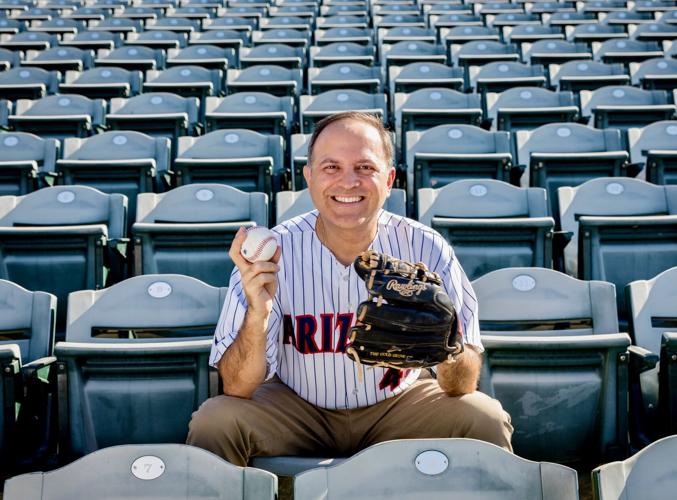
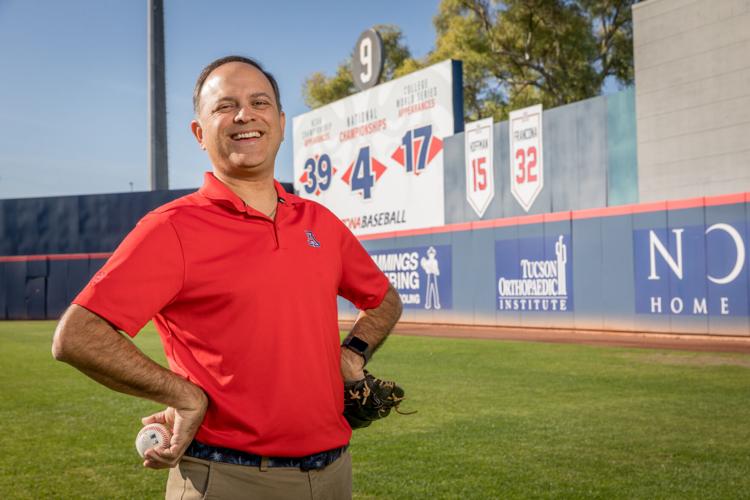
A Tucsonan since 2011, Valerdi heads the Department of Systems and Industrial Engineering at the university. He is also the faculty representative to the athletic department. Both sides of his brain speak up in this, his first book.
“Other authors told me to write the book only you can write,” Valerdi said, “and I’m pretty sure I did that.”
Raised in San Diego’s South Bay, Valerdi starred in tennis at Bonita Vista High, and for a time — a short time — entertained thoughts of playing in college.
“I tried to walk on at the University of San Diego, but a couple of 6-4 Swedish guys with big serves made me realize I should probably get back to the library,” he said, laughing.

Ricardo Valerdi is the faculty representative to the UA athletic department, in addition to heading the university's Department of Systems and Industrial Engineering. Both sides of his brain speak up in his first book.
Valerdi would later earn a Ph.D. in industrial and systems engineering at USC. From 2005-11, he taught at MIT, but even in the heart of academia he sometimes explained his work by using the language of sports.
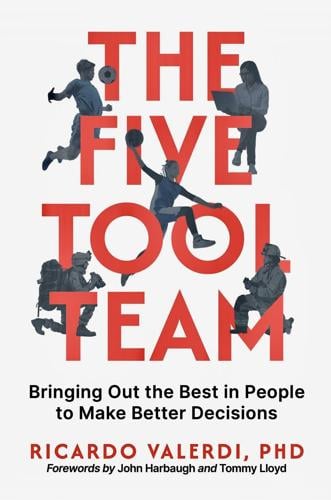
He still does, as evidenced by the new business book that has a soccer ball on the cover.
Valerdi’s journey from computer scientist to published author began eight years ago, and 2,500 miles away.
“When I was on sabbatical in 2018, I went to West Point to teach a course called decision analysis,” Valerdi recalled. “The Army being the Army, they handed me a three-ring binder and said, ‘Here are the 40 lessons you will deliver.’ I couldn’t deviate because there were other sections of the course. We needed to have the same cadence leading to a common exam … and the exam had already been written.”
Valerdi stayed in step, of course, but he began seeing real-life problems that couldn’t be addressed with a simple decision tree.
“I remember thinking, in the real world decisions can be much messier than this,” he said. “I could think of some examples where the answer that looked most correct was actually the worst thing you could do.”
Not knowing why, exactly, Valerdi began filing examples of problems whose solutions seemed counterintuitive.
“In the back of my mind, I thought it might become a book someday, but that’s as far as I went with it. Then, two years later, COVID happened. Like everyone else, I began looking for things to do. That’s when I started to get serious about the whole book thing.”
In time, and after several false starts, Valerdi settled on five distinct talking points and borrowed a term from the sports world to connect them.

“In baseball, scouts are always looking for a five-tool player,” Valerdi explained. “That’s a player who hits for average, hits with power, runs well, throws well and fields well. So for the book, I decided to present five things someone should master to be a good decision-maker.”
A real-life protagonist appears in each chapter, and each section is seasoned with stories.
“The fun part was thinking of stories that were special to me, stories that fit with what I was trying to say,” Valerdi said. “Luckily, I know a lot of stories.”
Some came from the world of sports. UCLA Coach John Wooden, for example, began the first day of practice every year on Square One: by showing his players how to pull on their socks and tie their shoes.
But we also learn about the Coast Salish, a loosely-knit group of 40 Indigenous tribes in the Pacific Northwest. Governed by matriarchy instead of patriarchy, the Coast Salish believed that decisions made today would be felt for seven generations to come.
Then there is the annual Pumps and Pipes Conference in Houston. Each December, cardiac surgeons huddle with oil and gas engineers to discuss recent advances in imaging, tubing and flow management. This unlikely alliance has proved invaluable. Over the years, both sides have adopted processes they learned from the other.
Last December, during Christmas break, Valerdi enlisted a creative writing student at the university to edit his final draft.
He sent it along to Regalo in January, and then … one last story.
“We were almost done and things were growing great when Regalo sent me a preliminary design for the cover,” Valerdi recalled. “It was maroon and yellow. ASU colors. We had a talk about that. I like the new cover a lot better.”
Footnotes
Tucson journalist Carri Karuhn will celebrate the release of her new novel, “Not Everything Burns,” with a book talk and signing next Saturday, Nov. 14, at Mostly Books. The event will begin at 1 p.m. To learn more, visit mostlybooksaz.com.
Author Christina Lauren will celebrate the re-release of “In a Holidaze” Nov. 16 at the Savoy Opera House in Trail Dust Town. The evening is being hosted by Stacks Book Club. For tickets and more information, visit stacksbookclub.org/events.
The next “Poets in the Park” program, hosted by Tucson Poet Laureate Logan Phillips, will be Nov. 22 from 3:30 to 5 p.m. at Udall Park on East Tanque Verde Road.