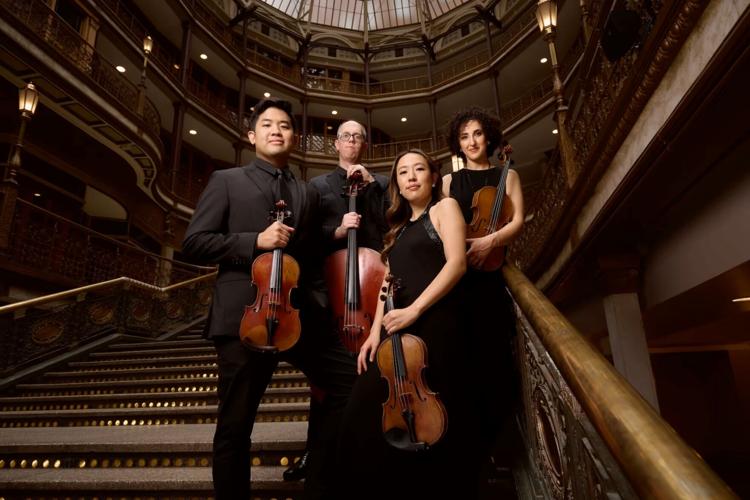
Shakespeare apparently loved, loved, loved Verona.
He set his most famous story, “Romeo and Juliet,” in the Italian city and then circled back for a couple of other famous tales, including “Taming of the Shrew.”
The Bard never visited Verona; he famously stuck close to his native England and let his imagination fill in the blanks.
So what do Shakespeare, a city he never visited, and his famous writings have to do with an Ohio-based American string quartet?
Everything, says Verona Quartet founding violinist Jonathan Ong.
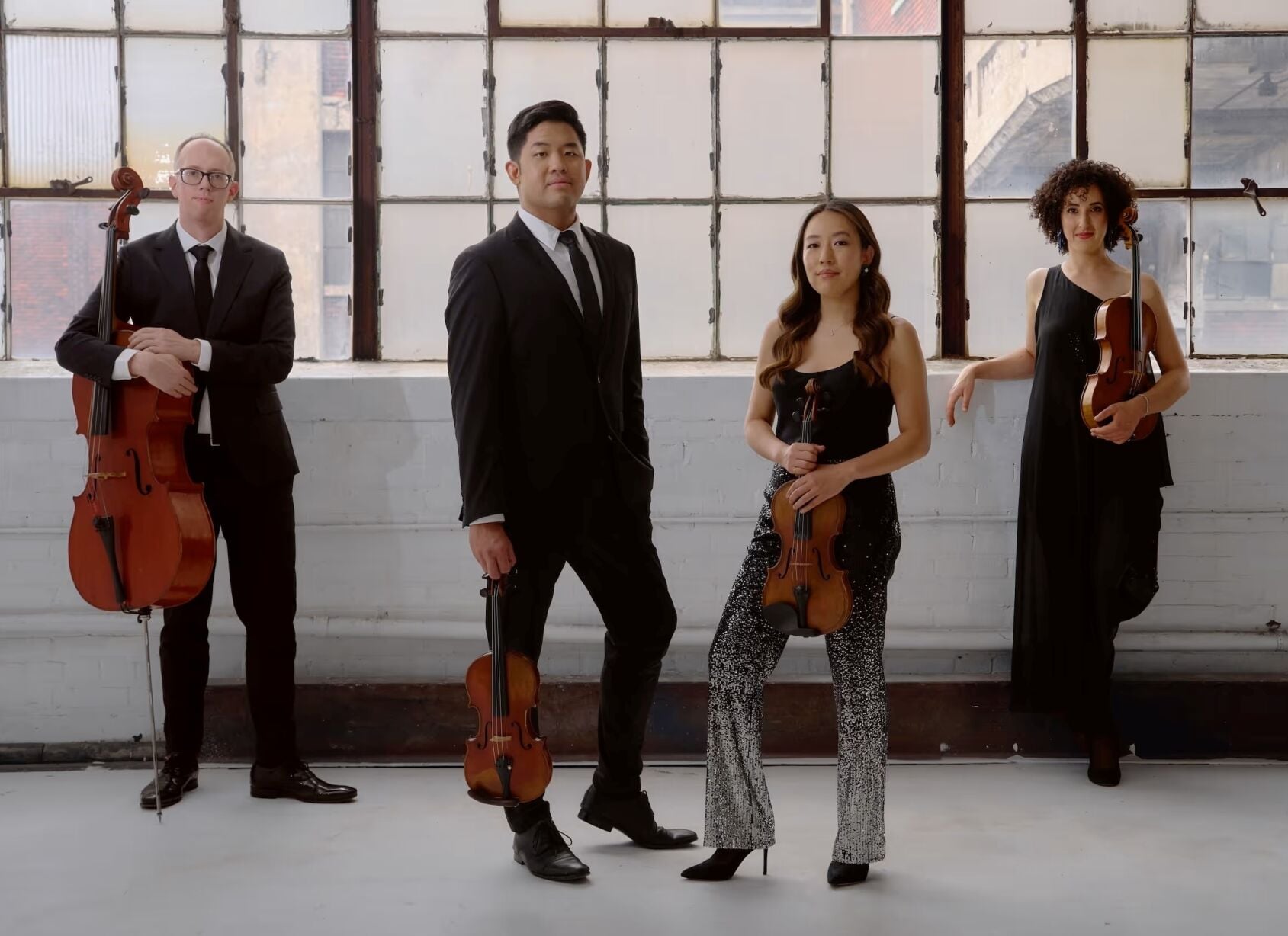
Verona Quartet — from left, Jonathan Dormand, Jonathan Ong, Dorothy Ro and Abigail Rojansky — will play a recital with St. Andrew's Bach Society on Sunday, Aug. 2.
From its start in 2013 when Ong and founding violist Abigail Rojansky were students at Indiana University, telling stories was central to their music-making ethos.
People are also reading…
“We believe that music is storytelling,” said Ong, whose ensemble, in residence at Ohio’s Oberlin College and Conservatory, will make its Tucson debut on Sunday, Aug. 2, with St. Andrew’s Bach Society. “We always try to find what the narrative is, what the story is. I think it came out of a bit of a natural search for who we are as a quartet.”
If the musicians were unified by a common bond — say they came from the same place, for example — their story would be obvious, Ong said.
“We're four musicians from four different places,” he explained; he’s from Singapore, Rojansky is from the U.S., second violinist Dorothy Ro is from Canada, and cellist Jonathan Dormand is from the U.K.
“We felt like rather than trying to unify four very different backgrounds and different cultures, why not try and tell stories, tell the story of our own origin,” he said.
And if they can tell their story through chamber music, they can tell so many others, they surmised.

Verona Quartet — from left, Jonathan Ong, Jonathan Dormand, Dorothy Ro and Abigail Rojansky — will make their Tucson debut with St. Andrew's Bach Society on Sunday, Aug. 2.
Like how the string quartet form evolved from Alessandro Scarlatti’s groundbreaking 1725 Sonata a Quattro No. 4 in D minor.
“We always think of the origin of the string quartet as being Joseph Haydn, but Scarlatti actually wrote what we can consider to be the first string quartets,” Ong said.
Verona Quartet’s Tucson program starts with Scarlatti, then follows the form’s evolution through the centuries.
“It actually is a snapshot of the quartet across the generations, so all the pieces are separated by about 100 years,” Ong said.
The Verona contrasts Scarlatti’s 18th-century work with Chicago composer Augusta Reed Thomas’s “Clara’s Ascent,” a 2019 homage to 19th-century composer and pianist Clara Schumann, wife of early Romantic-era German composer Robert Schumann.
Reed Thomas casts the cello as the protagonist scaling the instrument’s register from low to high to emulate the human voice.
“It starts on the lower end of the cello, and as the piece goes on, the cello goes higher and higher and higher and higher until it reaches the very top of the instrument,” Ong said.
Sunday’s program skips back to the early 20th century with Janáček’s String Quartet No. 1 "Kreutzer Sonata," inspired by Leo Tolstoy's incredibly emotional and raw 1889 novella “The Kreutzer Sonata.” The novella was also the inspiration for Beethoven’s Sonata No. 9, the “Kreutzer.”
Sunday’s program closes with Beethoven’s String Quartet No. 12 in E-flat Major.
“It doesn't feel right to tell the story of the string quartet without putting Beethoven in there,” Ong said.
Sunday’s concert at Grace St. Paul's Episcopal Church, 2331 E. Adams St., will be only the second time the Verona Quartet has performed in Arizona. The concert begins at 2 p.m., and tickets are $16 through standrewsbach.org.
Contact reporter Cathalena E. Burch at cburch@tucson.com. On Bluesky @Starburch

Cathalena E. Burch
Reporter