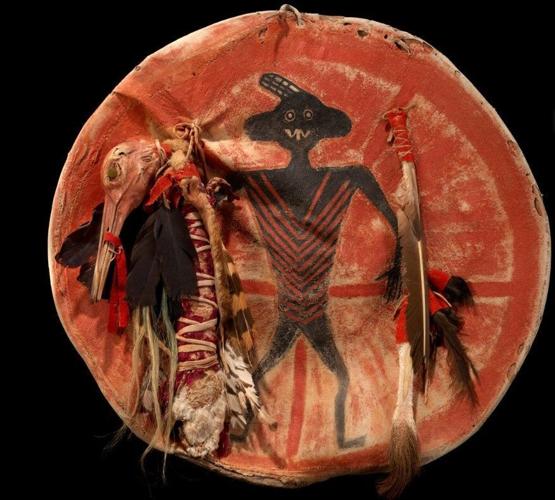
While collecting artifacts for the Museum of the American Indian in 1923, anthropologist William Wildschut became intrigued by a buffalo rawhide war shield owned by an Apsáalooke Tribe member identified only as Mrs. Bull Tongue.
The intricately decorated item featured a painting of a black figure at its center around which had been attached raven, eagle and hawk feathers, the skull of a crane and a deer tail partially wrapped in flannel.
The shield was owned by Arapoosh, also known as Sore Belly and Rotten Belly. Made in the early 1800s, the decorated shield was passed down through several generations of the River Crow chief’s family in Montana.
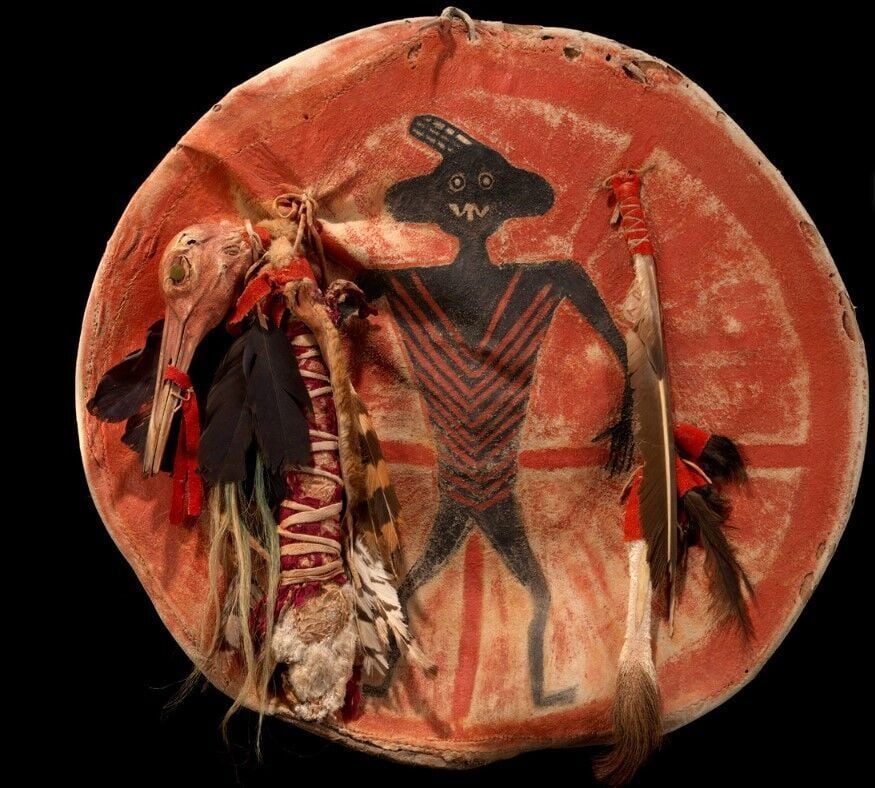
The Crow Indian shield of Arapoosh (Rotten Belly), circa 1815. The figure represents Spring Boy, one of the Crow twin heroes. The raven, hawk, and golden eagle feathers along with the crane head represent the mythical birds encountered by the twins in their adventures in the sky. Museum of the American Indian, Heye Foundation, New York. Cat. No. 11/7680.
Moon shield
As a young man, according to the National Museum of the American Indian’s website, Arapoosh received the shield after fasting. The shield “gave him spiritual protection and the power of prophecy.” Arapoosh died in a battle with the Blackfeet in 1834.
People are also reading…

Larry Loendorf
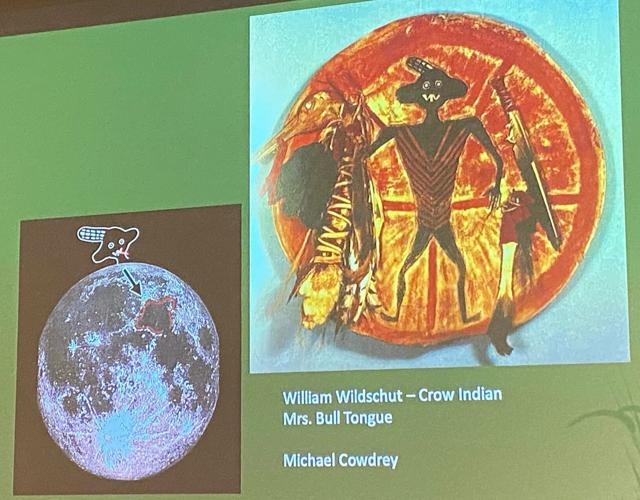
When Wildschut, the anthropologist, asked Mrs. Bull Tongue what the painting on the shield depicted, she told him it was the moon.
“The figure with large staring eyes, big bulbous ears, sharp teeth, and a thin body with ribs showing through is recognized as a most unusual shield design,” wrote Larry Loendorf, Calvin Grinnell and Aaron Brien in a 2019 research paper.
Mrs. Bull Tail’s description of the figure as the moon confused museum staff and other academics for years. Then in 1995, Mike Cowdrey, a student of Plains Indian art, recognized the figure as Baháa Awúuasshiituua, or Thrown into the Spring.

The Arapoosh shield, at right, has a depiction of Spring Boy on it. The oddly shaped head of the figure resembles a crater on the moon, shown at bottom left.
Mythic twins
Thrown into the Spring is the twin of Bitáalasshiaalitchiasshiituua, or Thrown Behind the Tepee Lining, according to Apsáalooke legend. But the twins — also called Spring Boy and Lodge Boy — similarly appear in the stories of 23 other tribes, including the Hidatsa and Kiowa. One researcher traced the tale’s origins back to the northeastern Woodland tribes.
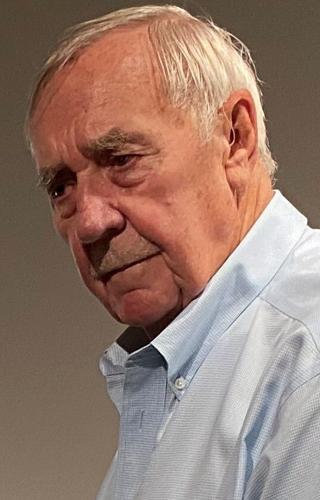
In Indian folklore, the twins get their names after their pregnant mother is killed by a stranger who cuts out the babies and throws one into a spring and the other behind the tepee lining, archaeologist Larry Loendorf recounted at an August talk in Lewistown, Montana.
When found by the father, the boy living in the spring has grown sharp teeth to eat fish. After being reunited, the twins “set out to save the world,” Loendorf said, killing various monsters, not unlike mythical figures found in other cultures’ folklore.
“They kill the sucking monster. They kill the giant beaver with a flint tail,” Loendorf said.
Sky tale
In one story, Thrown into the Spring is captured by Long Arm and taken captive in the sky. He is rescued by his brother, who cuts off Long Arm’s hand after being guided to his brother by cranes.
“Lodge Boy discovers his brother lashed to the top of the Crow Sun Dance lodge or Hidatsa Naxpike Hide-Beating lodge,” Loendorf and his colleagues wrote in their 2019 research paper. “Long-arm and his companions, the Black Eagles, are preparing to eat Spring Boy.

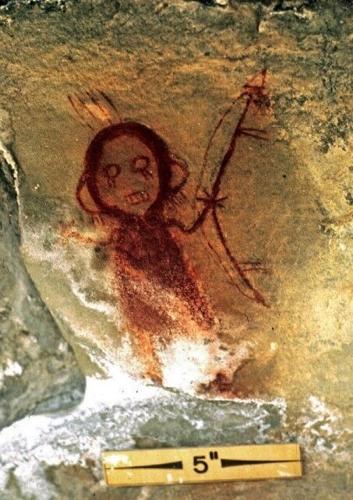
Spring Boy or Lodge Boy at the Harlowton site. The figure has the characteristic staring eyes, bulbous ears, sharp teeth, head feathers, and magical bow.
“The Crow version explains that Lodge Boy hid on the back of the Moon until he could reach Spring Boy to set him free, which explains why Mrs. Bull Tongue told William Wildschut that the shield was the Moon,” the researchers concluded.
“Apsáalooke (Crow) shields almost always derive from powers of what could be referred to as the Above World,” the National Museum of the American Indian noted on its website. “In Apsáalooke belief, the beings of the sky — the sun, moon, various stars, clouds, and also birds — are very potent.
“When a warrior had a vision that communicated to him the particular powers of his shield, he would depict those powers, often from the Above World, on the shield. Sometimes they would be represented by the attachment of feathers and bird heads.”
The museum’s interpretation is that Arapoosh’s shield depicts the hero twin Thrown into the Spring, evidenced by his sharp teeth.
In his Lewistown talk, Loendorf also said the oddly shaped head of Thrown into the Spring is the earthbound depiction of craters that can be seen on the moon.
“So, in effect, it is the moon,” he said.
Hiding in plain sight
A Hidatsa ledger book discovered about 30 years ago has similar depictions of the twin boys with oddly shaped heads and sharp teeth. One twin is entirely black with red lines on his body. The other is red with black lines. Depicted in the book are scenes of the twins running away with the beaver’s flint tail. Another shows a long arm severed with the twins appearing to fall from the open hand’s grasp as arrows fly through the air.
The hand remains in the sky as the Apsáalooke constellation known as Ihkawaléische, or the Hand star. The same constellation, named Orion by ancient Greeks in honor of a mythical hunter, is one of the most recognizable in the night sky.
Although the provenance of the ledger art has been questioned, some tribal members have confided the depictions show incidents only a native would know, Loendorf said.
More important to Loendorf is that once recognized, depictions of the twins were recognized in numerous pictographs in Montana and Wyoming. At Hole in the Wall in Wyoming there is a depiction of a stenciled arm with a severed hand associated with a human head with “bulbuous ears and large round eyes.”
“That's what's fascinating about the whole thing is, we had not recognized that figure at all until we got these ledger books and until Cowdrey put together the fact that Rotten Belly’s shield had one of these figures on it,” Loendorf said. “Well, then what happens is we start finding them all over the place.”
South of Lewistown and near Ryegate, Montana, other Lodge Boy images have been found.
“They always have these big ears and sometimes they have that breastwork coming down the front, and then we find just the heads too,” Loendorf said.