

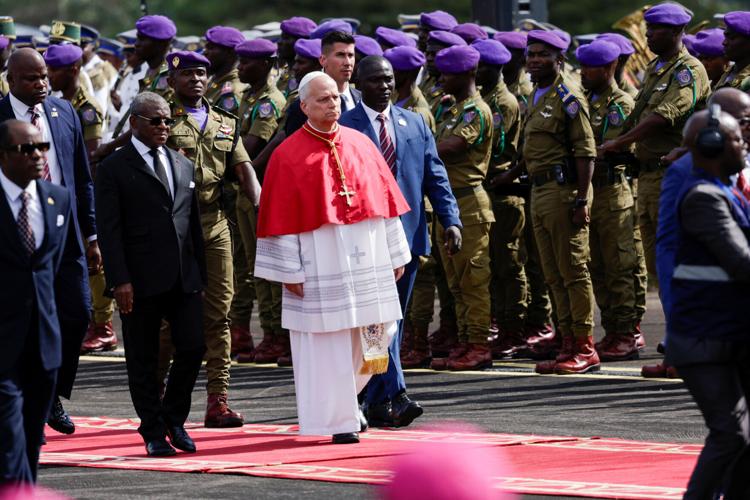
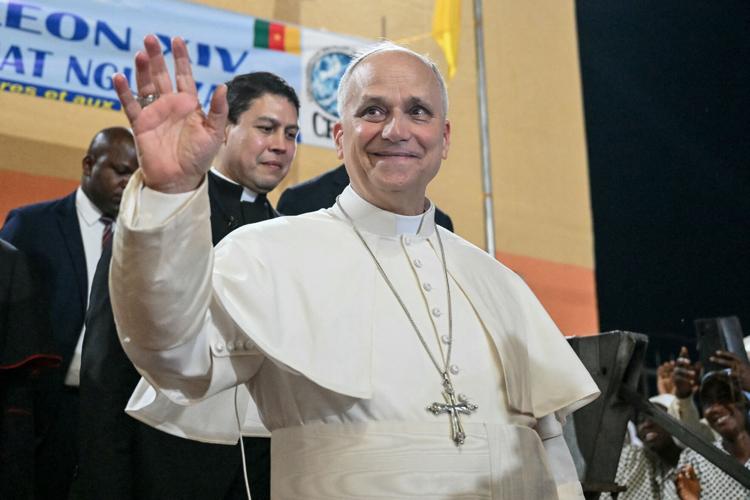
President Donald Trump's attacks on Pope Leo XIV have infuriated Catholics worldwide, a rift with the Vatican that could exacerbate an already challenging 2026 election season for congressional Republicans as Trump risks alienating a key constituency.
The president castigated the world's first American pontiff as "weak on crime and terrible for foreign policy" in an April 12 social media post, then told reporters he was "not a big fan" of the religious leader.
Several conservative-leaning Catholic leaders called on Trump to apologize — which the president rebuffed — saying they shouldn't have to choose between their faith and their country.
"There is no doubt that President Trump's post insulting Pope Leo crossed, again, a line of decorum that plays an important part in diplomacy," Kelsey Reinhardt, president and CEO of CatholicVote, a political advocacy group, said April 13 on social media.
People are also reading…
Catholics are the largest religious denomination in the United States, accounting for one-fifth of the population, according to the Pew Research Center. Catholics are 10 percentage points more likely to lean toward Republicans than Democrats, Pew found last year.
Trump lost the Catholic vote to Joe Biden, a Catholic, 52% to 47% in 2020, CNN exit polls showed. Trump won over Catholics 59% to 39% against Kamala Harris in 2024.
This is expected to be a tough year for the GOP as forecasters shift more races in Democrats' favor.
Republican pollster Brent Buchanan said his polling firm Cygnal has tracked Catholic voters since the 2022 midterms. He said if Trump persists in squabbling with the pope, it could spell trouble for the GOP this fall.
"Catholics tend to be one of the swingier groups in the country, and pretty much whatever direction Catholics go politically, the country goes politically," he said. "They're almost like a bellwether of sorts. So it's unnecessary noise for an important swing group."
Leo, who leads about 1.4 billion Catholics, said he had "no fear" and would continue to speak out against the U.S.-Israeli war with Iran and defend migrants against the Trump administration's deportation campaign.
Political scientists note Washington and the Vatican were at odds over policy before.
However, "There's never been anything this public, this personal or this partisan," said David Campbell, a political science professor at the University of Notre Dame, a Catholic institution.
The White House did not immediately respond to a request for comment.
Vice President JD Vance, a convert to Catholicism, indicated April 14 that the Trump administration won't back off and takes issue with Leo's antiwar comments.
"I think it's very, very important for the pope to be careful when he talks about matters of theology," Vance said at an event hosted by the conservative advocacy group Turning Point USA.
U.S. presidents for decades courted a relationship with the papacy because of the growing influence of Catholic voters since 1959, when Dwight D. Eisenhower had an audience with John XXIII.
Still, it was often difficult political terrain to navigate for presidents in both parties. Republicans such as Trump are often at odds with the Catholic Church's teachings on war, social justice, immigration and the death penalty, and Democrats struggled with Catholic opposition to their support for abortion rights and gay rights.
An NBC poll in March found Leo is more popular than Trump, which made his explicit denunciations of the war against Iran harder to ignore. It became particularly relevant as administration officials evoked Jesus and other references when asking for the country's support of the U.S. mission.
Even conservative Catholics who support Trump's policies are wary of his tone.
Kevin Roberts, president of the Heritage Foundation, a group closely aligned with the White House, said the two men "ultimately want the same thing" for the U.S. and Iran: peace.
Reinhardt said too many people are trying to turn a "public disagreement into a grand showdown" between Trump and Leo. "That is false, and Catholics should reject it," she said.
Bishop Robert Barron, who serves on the president's Religious Liberty Commission, said in an April 13 social media post that "serious Catholics" in the administration, such as Vance and Secretary of State Marco Rubio, should meet with Vatican officials to start a dialogue.
Campbell said those comments indicate "there really is no benefit" for Trump and the Republicans in "picking a fight with" a popular religious figure such as Leo, who has been calm and measured in his criticism.
He said Republican candidates vying to hold on to their congressional seats this fall, "particularly in swing districts that have large Catholic populations, will not want to be portrayed as in any way hostile to the church or to church leadership."
Trump's polling problem among Catholics
Some conservative leaders are confident Trump's tie to his religious base will overpower any reservations about his disrespect for the pontiff.
Ralph Reed, a prominent Christian conservative activist who sits on the president’s faith advisory board, said Trump holds a "deep reservoir of appreciation" among faith-based voters that can withstand disagreement over a social media post.
That is particularly important on the political right given the resurgence of faith among younger voters, particularly Gen Z men, born from 1997 to 2012, who take a greater interest in religion.
"As young people seek out the Catholic faith today in droves, it is important for the church and American voters alike to recognize that the Trump administration' policies are a great benefit for people of faith in America, and we are on the cusp of America's Golden Age because of them," Roberts said.
Trump showed no signs of heeding conservative activists' calls for an offline summit with the pope.
"Will someone please tell Pope Leo that Iran has killed at least 42,000 innocent, completely unarmed, protesters in the last two months, and that for Iran to have a nuclear bomb is absolutely unacceptable," Trump wrote in an April 14 social media post.
A survey in March conducted jointly by Republican pollster Shaw & Co. Research and Democratic pollster Beacon Research before Trump's squabble with Leo erupted showed 52% of Catholics disapproved of Trump's performance as president and 60% of Catholics disapproved of the war.


