FLORISSANT, Mo. — Two weeks ago, Ashley and Kwasi Oyirifi got an email.
The Florissant, Missouri, couple, after years of struggling to start a family, were finally on their way. The surrogate they had found to carry their baby was pregnant. And they had deposited tens of thousands of dollars with a Houston firm to safeguard the money that would be paid to her.
Then came the note from the firm: “All operations have been placed on hold,” it read.
The Oyirifis called, but the phones were off. Social media was shut down. And payments, the couple realized, weren't being made.
They quickly discovered there could be hundreds of other families in the same position.

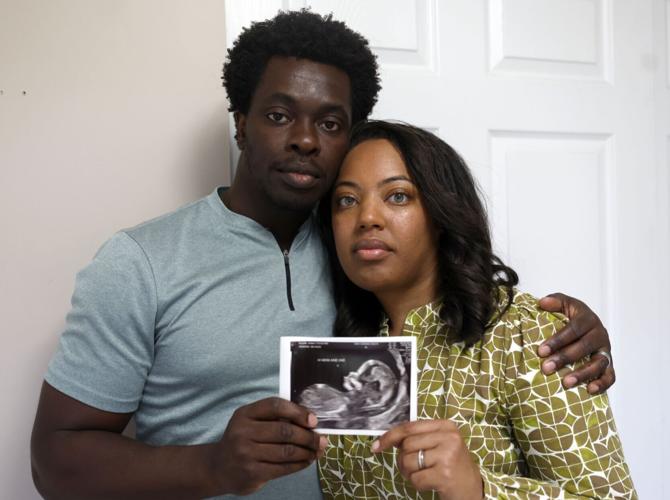
Kwasi and Ashley Oyirifi hold a sonogram of their daughter, who is being carried by a surrogate in Wisconsin, at their home in Florissant on Tuesday, June 25, 2024.
Authorities in Houston have confirmed they are investigating Surrogacy Escrow Account Management, known as SEAM, after dozens of complaints.
People are also reading…
"My phone hasn't stopped ringing," said Houston police Officer William Wright, who got his first call from a SEAM client June 16.
Houston police Sgt. Chad Long, the supervisor of the department's financial crimes unit, said in an email Monday that more than 30 people had contacted them, and the FBI would be leading the investigation "due to the size and wide territory in which the victims are coming from."
Madeline Sieren, a spokesperson for Missouri Attorney General Andrew Bailey’s office, said that it had received three complaints about SEAM, which were under review. The Texas Attorney General’s Office did not respond to questions about how many complaints it had or whether it is investigating.
Dominique Side, the owner of SEAM, could not be reached for comment.
SEAM's clients, however, are mobilizing: A Facebook group called SEAM Breach formed this month and has more than 750 members. They are sharing ideas on how to file complaints, rewrite contracts and fundraise to replace their money.
For families like the Oyirifis, who were finally emerging from the physical and emotional turmoil of infertility, it feels like the ground is giving way, again.
“Our journey is quite a saga,” said Ashley Oyirifi. “This was supposed to be our happy ending.”
Their baby, due in November, will come home from the hospital with them. That, they know.
Everything else is a question mark — including how much more they're now going to have to pay.
Millions could be held up
Gestational surrogacy, when a woman carries a baby that she has no biological link to, is a rare but growing path to parenthood. In 1999, according to the Centers for Disease Control and Prevention, U.S. fertility clinics reported 727 embryo transfers to gestational carriers. Twenty years later, that number was almost 10,000.
The global surrogacy market was valued at just under $15 billion last year and is expected to climb to almost $100 billion by 2033, according to Spherical Insights, a market research firm.
The surrogacy process is a maze of legal and medical hurdles, with regulations varying by state. The intended parents find a surrogate match, either through an agency or on their own. Lawyers are hired. Contracts are drawn up. Rounds of medical and psychological tests follow.
The costs can easily climb past $100,000. Almost always, the money that will be paid to the surrogate flows through an escrow firm.
SEAM is one of only about a half-dozen such “third-party reproduction” escrow firms in the United States. It draws clients from across the country and overseas.
Escrow ensures that before an embryo is implanted, the intended parents have their funding in place. The firm interprets the contract, paying out an agreed-upon monthly fee, plus reimbursements for medical expenses and other incidentals, like maternity clothing.
“It’s meant to protect both parties,” said Joanna Beck Wilkinson, a St. Louis lawyer who specializes in family building.
Beck Wilkinson has multiple clients around the country with money tied up in SEAM. The burden falls to them to come up with the payments if SEAM is insolvent, she said.
No one knows how many people are affected or when a resolution will come. Posts in the Facebook group suggest the total amount the escrow firm held could be in the millions, said Beck Wilkinson.
“We have very little verifiable information,” she said.
'Ready to give up'
Surrogacy is almost never a Plan A. The decision to turn to a gestational carrier often comes after years of heartache: failed fertility treatments, miscarriages, stillbirths.
Arielle Mitton of Bellingham, Washington, had been through nearly every type of medical intervention. Her uterus is filled with scar tissue.
She and her husband decided to try surrogacy, but that had its own difficulties. Finding the right connection is a little like online dating.
At one point, “I was sort of ready to give up,” Mitton said.
In November, though, the couple Zoomed with a woman in Rosedale, Indiana. Right away, they knew it would work. They signed a contract in March, and the Mittons deposited about $50,000 into their SEAM account.
Their surrogate, Tena Doan, has four children of her own but had always thought of carrying a baby for someone else. On April 8, the embryo from the Mittons was implanted.
The first trimester was rough on Doan, whose morning sickness stretched into the night. Every day, she had to give herself multiple shots of estrogen and progesterone.
“You are giving up a lot to do this,” said Doan, who is a server at Outback Steakhouse. She had earmarked her fees for renovation work on her home.
Still, she didn’t think much of it when SEAM missed a payment on June 1. But when the emails went out, and word spread among other account-holders, the gravity of the situation became apparent.
Doan and the Mittons will likely need to hammer out a new contract, perhaps for smaller payments over a longer period. The Mittons took out a loan to pay SEAM; they, like others, have set up a GoFundMe to help.
Doan will need to take off work after she delivers the baby, due on Christmas Eve, and now she is unsure of whether she will have a financial cushion to cover that. She’s picking up extra shifts at the restaurant when she can.
Mitton doesn’t want Doan to stress. Doan doesn’t want Mitton to worry. They are in this together.
“It is heartbreaking,” said Doan. “Someone has basically robbed us.”
‘Just middle-class people’
Ashley and Kwasi Oyirifi, the couple from Missouri, met as students at the University of Missouri-Columbia. They knew they wanted a family with biological and adopted children.
After trying to get pregnant for a year and a half, the couple underwent in vitro fertilization. The first embryo transfer was successful, and they decided to relocate to St. Louis from central Illinois to be closer to their parents.
Just before the move, at 19 weeks' pregnant, Ashley Oyirifi gave birth to a daughter, Averi. She did not survive.
Four more embryo transfers didn’t take. So, in late 2022, the Oyirifis looked into surrogacy.
“I spent hours and hours learning about it,” Ashley Oyirifi said.
They found their first potential surrogate through a Facebook group called Surrogates and IPs Match, but she ended up backing out.

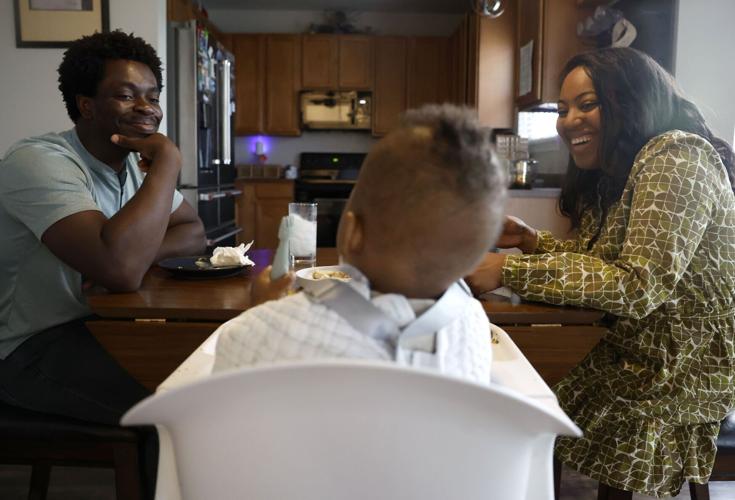
Ashley and Kwasi Oyirifi eat dinner with their foster son at their home in Florissant on Tuesday, June 25, 2024.
Late last summer, around the same time they were welcoming a 5-month-old foster child into their home, they met a woman from Wisconsin who said she would carry their baby. The surrogate planned to use the money she would make to pay off student loans.
Finally, the pieces were falling into place, the Oyirifis thought.
They scraped together $65,000 and sent it to SEAM in January.
“We’re just middle-class people,” said Ashley Oyirifi. “It was a major sacrifice for us.”
In February, an embryo was successfully transferred into their surrogate.
The Oyirifis exhaled. Their foster baby, too, was on his way to becoming a permanent member of the family. His adoption is set to be finalized in early fall.
Then, a couple weeks ago, the sledgehammer fell. They had close to $50,000 left in the SEAM account when they got the email.
They were able to scrounge up their surrogate’s payment for this month, but they have six yet to come.
“We’ll feel this for a few years,” said Ashley Oyirifi.
She wants things to go back to normal, to concentrate on their to-do list, the same as any soon-to-be parents: whittling down a list of names, decorating the nursery, stocking up on diapers.
“I love the feeling of being a mom,” she said. “I don’t want this to be the storyline when we think of our son or daughter getting here.”