

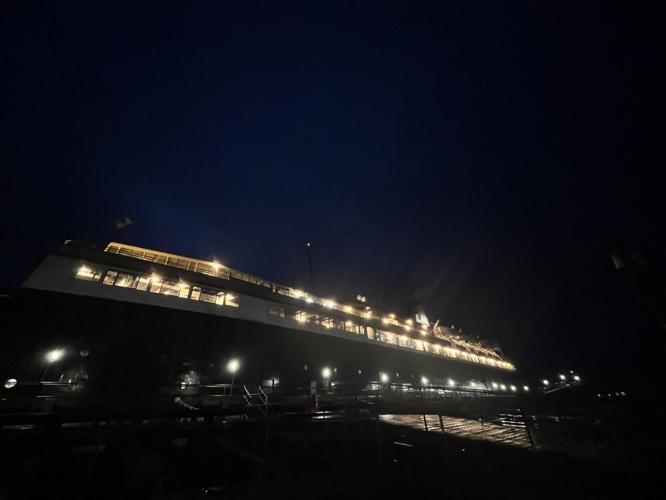
Summer ends on Labor Day. You can be annoying and say, no, it ends with the calendar, the rotation of the Earth, the coming of autumn on Sept. 23, but please, Labor Day, it’s always Labor Day. Which also happens to be the last day this year when the SS Badger, pride of Lake Michigan since 1953, the last steam-powered passenger ferry on the Great Lakes, takes overnight travelers across the lake, in the dead of night.
No, there is nothing typical about this.
Passenger ferries don’t tend to keep overnight schedules, and so about two hours into a four-hour trip, in the middle of Lake Michigan, on an overcast night, if you stand at the bow, you can see almost nothing at all. A few phantom clouds. The running lights of a tanker in the distance. Otherwise, nothing. A void. An absolute black. No land, and other than fleeting crests of white caps, no water. The effect is so disorienting it’s easy to fantasize you’re passing through a wormhole, and as the sun rises, you’ll arrive in prehistoric Michigan or post-apocalyptic Michigan.
People are also reading…
Instead, you land in Ludington, Michigan, winter home of the Badger, pop. 7,634.
If you’re looking for one last summer adventure, it’s a poignant and exhausting one, the chill of approaching autumn and the smell of the summer lake together at last. The Badger ends its season Oct. 11 — until then, you can still ride at a more sane hour — but come Labor Day, these overnight passages, which started in the 1990s, go away until May.
Personally, I’d go.
There’s no better way of pregaming Halloween than driving from Chicago to Manitowoc, Wisconsin, about two and a half hours north, to board a ferry at, yes, 1:30 in the morning. Here, outside Sheboygan, the Badger leaves for Michigan, playing its role as the official marine portion of U.S. 10, which runs from Seattle to Detroit, separated only by the lake.
Manitowoc, at the witching hour, is dead, still, silent, no cars, dark homes, downtown traffic lights winking yellow. There’s the smell of barley from a malting plant, and finally, waiting at the dock, the Badger, its own lights gauzy and gold at this hour. Smoke — it’s powered with coal — drifts out of its stack. I took the 1:30 a.m. boat recently, and I was told it tends to be lightly attended; people just don’t know there is an overnight cruise, so I was one of only 30 passengers on this 400-foot-long, seven-story-tall ship built for 600.
You’ve seen “The Shining”?
Picture it at sea, minus the bar (and, of course, the blood, murder and madness). It’s an opulent beast of a relic, constructed in 1952 and launched in Sturgeon Bay the following year to transport rail cars across Lake Michigan. It’s so large that it occasionally moves wind turbines across the lake. But its origins date to the early 20th century, when the expanding Chicago area had turned into a spaghetti of rail traffic, taking commercial freight cars from all over the country, and therefore, often so gridlocked and slow-moving at times, freight would sometimes be abandoned. One answer: ferries. Initially, the Badger was built with train tracks inside of its belly to allow train cars to be loaded on one side of the lake and unloaded on the other. It provided this service year-round. But by the early 1970s, rail congestion had eased and ships like the Badger went into steady decline. In 1990, the Michigan-Wisconsin Transportation Company, the Badger’s owner, was bankrupt. But a couple of years later, a Ludington businessman, Charles Conrad, purchased the boat and refashioned it as a passenger and commercial ferry. In 2016, the S.S. Badger was named a National Historic Landmark, one of the few that moves. (The streetcars of San Francisco were given landmark status decades earlier.)
These days, who wants a ferry at 1:30 in the morning?
On clear nights, meteorite hunters and admirers of any moon-related phenomena. The middle of the lake, alas, is one of the savviest spots in the Midwest to catch a perfectly starry sky. But also, there’s truck drivers hauling freight, and day trippers who don’t want to pay for a hotel room. There’s a sizable number of Amish and Mennonite passengers. Acacia Fletcher of Wisconsin was heading to Michigan to pick up a car. (“And besides, I don’t sleep much anyway.”) I met a guy going to Michigan to sell his own deer repellent.
I found no one in its video-game arcade. I saw no one in its two cafes, or in the playroom for children, or in the screening room, which was nevertheless showing a documentary about the Badger’s Dickensian furnace room, where coal gets shifted onto a conveyor belt and ultimately churns the engine. (In 2008, the Environmental Protection Agency decided Badger crew were dumping toxic coal ash into the lake; it’s since reached an agreement with the EPA and been retrofitted to offload the daily coal remains of the furnace.) Its small museum of Badger-related history — outfitted with some of the same Eames chairs that have been here since the 1950s — was empty.
The only person in the gift shop at 3 a.m. worked there — Timothy Merrick, hunched over a copy of Anne Frank’s diary: “Me, personally, I’m less of a people person, so the job is perfect. I just prefer the quiet of the overnights; I’m basically suited to this so well. In fact, I think this may be the only job that I have ever had that I actually liked.” On Merrick’s first day on the Badger, two seasons ago, Lake Michigan had 10-foot waves.
We moved, this time, with a gentle, constant rock.
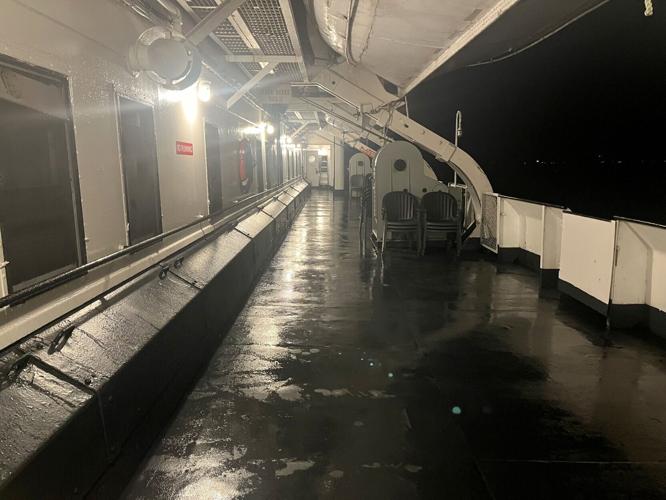
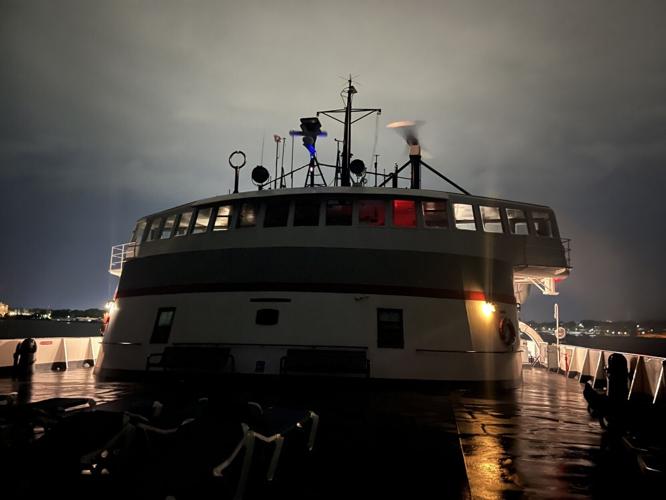
There are 40 private staterooms for sleeping (which cost extra), so on the deck, a few passengers were stretched out on lounges, bundled beneath sleeping bags and hoodies. The air was damp, and every once in a while, a searchlight scanned the water. The boat was quiet, a symphony of creaks and taps. A traveler paced the ship all night, passing me every 10 minutes, seemingly walking for four hours. A smell of bacon wafted out of the crew quarters, and between the curtains there was the glow of a TV showing “King of the Hill.”
Spooky, I said to Kaia Kenyon, who stood in the cruise director’s office.
Her eyes lit up.
There is a rumor among crew, in fact, she said, that supposedly one of the rooms is haunted, the ghost of the 84-year old woman who died here in 1997, suffocated in her collapsible folding bed.
That death is true; the ghost, I don’t know.
An hour later, she was rapping on the steel doors of the private quarters, waking the dead: “Twenty minutes before docking!” The ghost ship was suddenly populated, relatively, its travelers adjusting their eyes and yawning. In the Ludington harbor, in front of the Badger, Coast Guard boats ran here and there, scattering a handful of pre-dawn fishermen, ordering them out of the ship’s path. It was a Sunday morning, and pouring, so I disembarked and ran to the only diner in Ludington open before sunrise. Then I raced back and caught the 9 a.m. boat back to Wisconsin, and this time, slept.


