

SAN SEBASTIÁN, Spain — His sculptures adorn public spaces around the world from the UNESCO headquarters in Paris to the German Chancellor's Office in Berlin, Plaça del Rei in Barcelona and the World Bank in Washington, D.C.
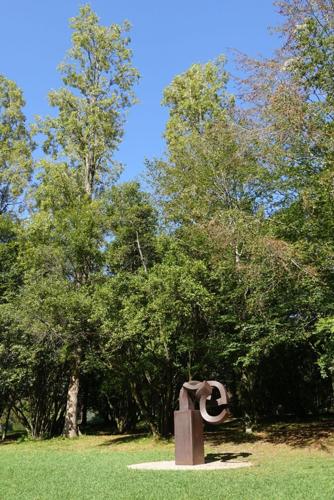
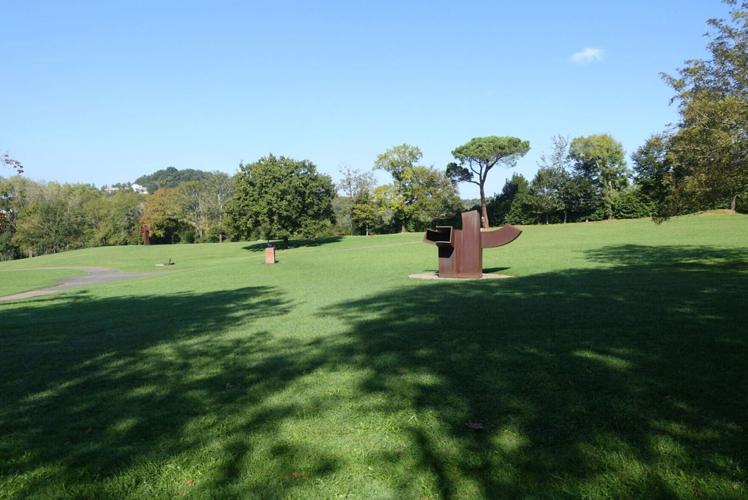
But for the very best selection of work created by Eduardo Chillida (1924-2002), head to Spain's northeastern Basque region and an entire park designed by Chillida that presents his towering sculptures in a quiet setting.
The Chillida Leku Museum ("leku" is the Basque word for "place") is located in Hernani, some 6 miles south of the artist's birthplace of San Sebastian. The sculptor acquired the erstwhile country retreat in order to create his own vision of an open-air sculpture garden on the 27-acre grounds.
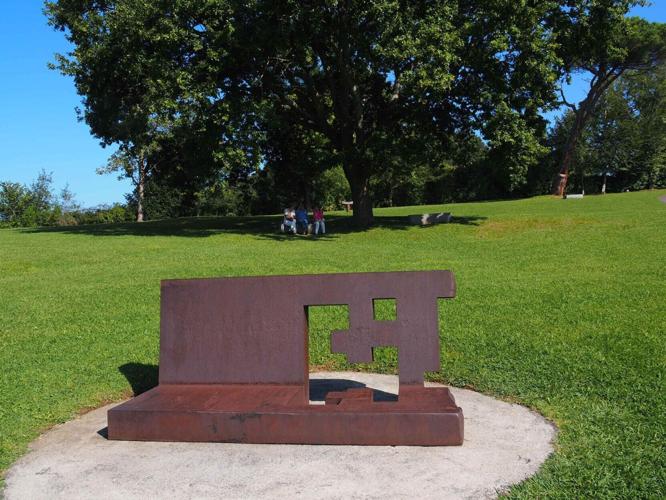
It is arguably Spain's most beautiful sculpture park, but there is no arguing that Chillida was one of the giants of sculpture in the 20th century. The park features 40 of his works made from different materials and of different sizes.
People are also reading…
Art in a public space
"My father always said: 'That which is only from one person is almost from no one.' That's why he wanted to share his works in the public space," said Luis Chillida, one of the artist's sons and chairman of the Chillida Foundation, trying to explain his father's fame. "That was now decades ago." The massive, expansive sculptures made of concrete and metal were also innovative.
Chillida created his own unique language of form — with sculptures that seemed to grow up out of the ground, would let light flood in, open up heavenwards, interlock with the landscape and appear to defy gravity.
Mexican Nobel literature laureate Octavio Paz said that every sculpture by Chillida was, despite its size, "like a bird, like a sign of space." Spanish cultural historian Kosme de Barañano views the works as something unique in their own right.
International breakthrough
Mikel Chillida, development manager of Chillida Leku and one of 27 grandchildren of the artist, says his grandfather balanced his talents. Early on, he had been a soccer player who played goal for San Sebastián's second division team, but he suffered a serious injury that put an end to his playing days.
Next came architectural studies in Madrid that he did not finish. Then it was off to Paris to become a sculptor. But it was only after returning to his Basque homeland at the outset of the 1950s that — inspired by a nearby blacksmith — he discovered metal as his favorite material to work with.
His international breakthrough came in 1958 with the Grand Prize at the Biennale in Venice. From then on Chillida exhibited his works at international art shows, including several times at Germany's prestigious Documenta in Kassel, creating literal heavyweights that weighed many tons.
Through it all, he remained true to his homeland. "He compared himself to a tree," grandson Mikel says. "The roots in their place in Basque country and the branches open to the rest of the world."
Unique items instead of mass-produced products
There was something else that made Chillida different from other artists: Each of his works was unique. He did not want any reproductions, much less mass goods.
Just once, his son Luis reports, did he let a gallerist talk him into producing copies of some of his works. When he saw the results, the artist told his wife Pilar — who was his closest adviser — "this looks like a shoe shop."
Luis says his father was a "slow artist." While the sum total of Chillida's works comes to 1,350 sculptures, this was the production from 52 years and includes smaller works.
"To him, every work was an adventure, an experiment never tried before," said Luis Chillida. Nor did his father have a favorite sculpture: "It was always the one which he was currently working on." For large-scale sculptures, the artist designed models which he called "aromas." Some of these are on exhibit at the Chillida Leku country estate. One aroma is for A House for Goethe, a sculpture in Frankfurt, the 18th-century German classical poet's birthplace.
A life-long dream
Chillida Leku is the fulfillment of a life-long ambition of the sculptor, who once said he had a dream about "a space where my sculptures rest and people can stroll through them as if in a forest."
And so it is that art and nature celebrate an exceptional symbiosis. In this natural space the sculptures — be they giants of steel or smaller works made from granite — are spread out among trees and meadows.
One of them is Advice to Space IV, Corten Steel — a bit of a wink by the master, who attached the "IV" to the title of the sculpture even though he didn't produce any series of his works. Curved lines make the work seem downright alive as it spreads its stylized arms out to the sides as if to welcome viewers while stretching its neck towards the firmament. Or is the viewer's imagination running wild?
Visitors who want to get up close to the works here often get their feet wet when walking through the grass. This is because the Basque region, located in the Atlantic climate zone, is also known for its abundant rainfall, with rain simply dripping off the sculptures.
_____


