
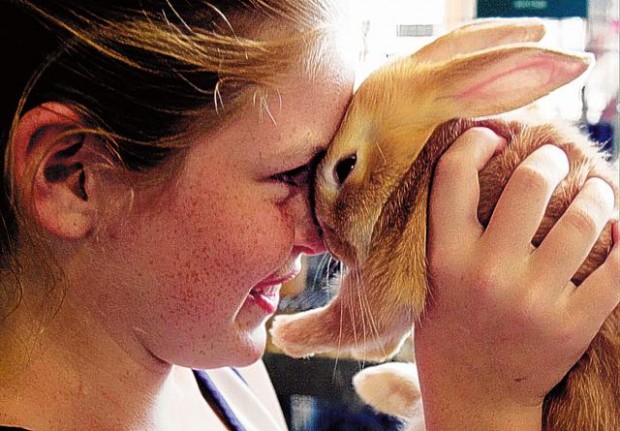
Q I don't know the age of my rabbit; I adopted her from a family member who no longer wanted her. She recently stopped eating alfalfa kibble. We've tried all sorts of ways to get her to eat it, but she just turns up her nose. She gets fresh fruits and veggies daily. Is this OK? — P.M., Miramar, Fla.
A "Your rabbit is darn smart," says Marcia Froelke Coburn, president of the Chicago-based Red Door Animal Shelter, which specializes in rabbit rescue and adoption. "Alfalfa kibble and timothy hay pellets are for baby rabbits only. You do want to feed adult rabbits primarily timothy hay (not to be confused with timothy hay pellets), which should always be available. Also, feed lots of salad with romaine and green and red leaf lettuce, as well as some parsley. Don't use iceberg lettuce or feed spinach or kale to rabbits."
Offer your rabbit tiny bits of fresh (not packaged) carrots only as a treat, not as part of her regular diet. "Don't believe the Bugs Bunny myth," Coburn notes. "Restrict fruits to a very rare special treat. There's just too much sugar in fruit for rabbits."
People are also reading…
Q Out of the blue, my nearly 2-year-old Australian shepherd began having seizures. My vet was quick to diagnose epilepsy and put Taj on phenobarbital. I tried to speak with the vet about other possibilities, such as brain infections, thyroid conditions and toxic pods of the Kentucky Coffee Tree, which could be causing the seizures, but she dismissed these ideas. I also mentioned MDR1 and suggested that my dog ingested an Immodium pill (loperamide). I even gave my vet information from the Web on MDR1, which she knew nothing about and wasn't interesting in learning. Is there anyone out there who can really help my baby so she doesn't have to be on phenobarbital the rest of her life? — G.V., Hermitage, Tenn.
A Veterinary neurologist Dr. Dennis O'Brien explains that a significant percentage of collies and other herding dogs may carry the MDR1 gene (multi-drug-resistant-1 gene), which causes some drugs at certain doses to have a toxic effect. While there are places on the Web that list loperamide or Immodium as among the drugs potentially hypersensitive in dogs with the gene, no expert I spoke with could positively confirm this. Even if Immodium can cause a problem among some collies and herding dogs, it's exceedingly unlikely that a single Immodium pill could cause repeated seizures. Besides, seizures are not indicated as an adverse reaction to Immodium. You are right to consider all possibilities, however.
"The question about what's causing seizures is one we deal with all the time," adds O'Brien, of the University of Missouri College of Veterinary Medicine-Columbia. "And similarly, to consider what diagnostics and medications — if any medications — are appropriate. Does idiopathic epilepsy (unexplained seizures caused by epilepsy that just happen in some dogs based at least partly on genetics) seem most likely, or could there be a specific cause for the seizures, as you suggest? Instead of expensive diagnostics, sometimes we can learn just as much by treating the dog for six months with phenobarbital, then gradually tapering the dosage, watching to see if the dog has additional seizures."
All pet owners should be as committed as you clearly are.
Do keep in mind that not everything on the Web is true. Be cautious about the sites you're considering. I can't comment about your veterinarian, but certainly you know your dog best. Indeed, there is specialized help available for your baby; to find a veterinary neurologist near you, contact the American College of Veterinary Internal Medicine, www.acvim.org or 1-800-245-9081.
Q My cat, Calvin — named for the underrated President Coolidge — is now pooping on my bed. Why? — V.B., Hartford, Conn.
A Your cat might be complimenting you, according to behaviorist Stephen Zawistowski, senior vice president of animal sciences at the American Society for the Prevention of Cruelty to Animals in New York City. He says when Calvin is feeling anxious, he runs to where your scent is strongest, and also to a nice high, safe place. Zawistowski says there may be a pattern to your pet's poops. For example, does he poop on the bed when you're out of town or after a visit from raucous relatives?
You didn't mention other pets. It's common for another cat(s) and/or dog(s) to be intimidating, so Calvin may feel a trip to the litter box is too risky. Instead, he picks a nice place where he feels comfortable and has a good view while he's doing his thing.
Zawistowski suggests draping a plastic shower liner over your bed (cats don't like to relieve themselves on slick surfaces), or keeping the bedroom door closed. Calvin may then choose the sofa or another inappropriate place when he's anxious or threatened. Plugging a diffuser called Feliway into the wall (a sort of aromatherapy for cats) may help relieve general anxiety, but it's best to find the source of Calvin's angst.