
It is March 1967. The battleship-gray Navy bus, with a transmission that must be filled with buckshot, grinds its way north, up the coast road from Naples.
Fresh from boot camp, I take off my Dixie Cup sailor hat and press my nose against the window to gawk at a world so very different from the one I left in Iowa.
We pass a number of two-wheeled ox carts carrying hay, lumber and wine. Many middle-age and older women - widows?-dressed all in black. And swarms of small three-wheeled trucks with whoopee cushion-sounding exhausts.
I catch blurred glimpses of the Mediterranean. A few sugary beaches. Small vineyards festooned with dead vines. Upturned boats painted red and turquoise, blue and yellow. Mountains of tangled nets, turned camouflage colors by rusted rigging.
An old man in sagging clothes and a snap-brim cap leans on a cane. He watches my bus until it is out of sight.
People are also reading…
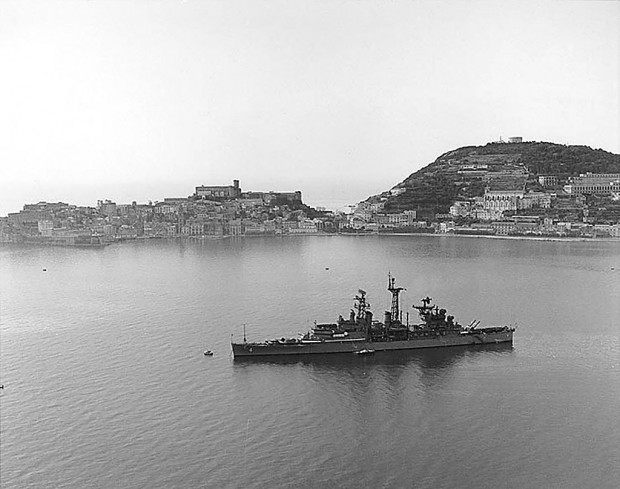
Between Naples to the south and Rome to the north, a picturesque bay comes into view. In the center, a ship rides at buoy anchor. It's the USS Little Rock, CLG-4, flagship of the Mediterranean's Sixth Fleet. I can make out the gun turrets on the foredeck, and a dual missile launcher on the fantail.
Vastly powerful. Intimidating.
Although the WWII fighting ended in Italy before I was born, this war machine in the harbor at Gaeta (ga-AY-ta) will be my duty station for the next two years.
Suddenly it is May 2010. I am pushing my rental car to 140 kph (87 mph) on the A1 Autostrada, and I am being passed like I was standing on a corner in Winslow, Arizona. My wife, Sandy, says her fingerprints are forever embedded in the door handle. We escape on the Cassino exit, head west to Formia, and there, on a narrow promontory jutting into the deep-blue water, is Gaeta. The harbor is a stunner, just as I remembered.
The USS Mount Whitney, the current flagship, is tied to a pier, and the wide-open fleet landing of my memories is now double-barred and guarded. I approach the gate. A sailor in a camo uniform asks me to state my business.
I tell him I was enlisted Navy, stationed here 43 years ago. He says he is 26. I say there was a crew of 1,200 men on the Little Rock. He says there are maybe 500 on the Whitney, half are civilian mariners and a fifth are women.
I ask him where the hottest bars and restaurants are. He says he stays aboard with his Facebook and e-mail, and plays video games. He is from New Jersey. Sadly, I discover no common ground.
I find a parking spot and we stroll Old Gaeta, with its cathedral, narrow cobblestone streets and medieval walls. We turn a corner and I think I have found the apartment I shared with four friends while my ship was in port. The building dates to the 1600s.
I ask store clerks and passers-by in my barely adequate Italian, "Mi scusi, was this place at one time rented to Americans? Was there a locker club? Was the Hideaway Bar in the next building, with a nearby room reserved by working girls from France? Have you heard stories about three sailors who played American rock 'n' roll for drinks and food in Mama's Trattoria across the street? Do you know about the Nazi war criminal who was held in a prison cell in the old fort?"
They try to remember. I think they want to remember. But nobody does. They are too young.
I approach old men on park benches. They wear suit coats or sweaters. Cleanshaven. Many in neckties. They must be in their 80s. Have you lived in Gaeta all your life? Yes? Then do you remember this place 40 years ago? No, no. Not 40, but 60. Sessanta anni, they say.
The war and its aftermath are memories as clear as the ring of a church bell. Southern Italy was slower to rebuild after the war. Times were hard. In 1967, inquisitive sailors like me stumbled upon shell-pocked buildings along the coast and German machine-gun nests in the hills. Even then, many citizens considered us liberators.
I am having little success at reconstructing the more impermanent places I knew so well way back when. But the Turkish Grotto is here, with its 270 precipitous steps to the sea. Near the harbor is a plaque dedicated to Giovanni Caboto, a navigator born in Gaeta, who discovered Canada in 1497.
And Mount Orlando, more a hill than a mountain, is dominated by the round, white mausoleum of Roman Consul Lucius Munatius Plancus. Sandy is staggered when I tell her it was constructed in 15 B.C.
Yet life in this ancient and modern Roman vacation destination, as I once knew it, goes on. Laundry is hung out to dry on balconies. Fishermen mend their nets. The late-spring climate is spectacular. The breakfast cappuccino has never been creamier. Mothers and daughters, friends and lovers walk unpretentiously arm-in-arm. And the gelato is deliriously delicious.
My belated return to Gaeta reinforced the adage that no man can turn back the clock, but the things that really matter - the warmth of the people, the heavenly food, the remarkable history - are unchanged. And if I can find the time, and the resources, we will one day visit this wonderful place again.
Greg Knowles is a semi-retired writer and marketing consultant who moved to Tucson in 1996. From the day they met, he repeatedly told his wife, Sandy Tweedy, about his Italian adventures while in the U.S. Navy. All along, he swore he'd take her there one day. We welcome submissions for this column of personal essays. Submit original pieces up to 1,000 words along with a short biography of the writer and contact information to Maria Parham at mparham@ azstarnet.com Please put Life in Print in the subject line. Selected essays will be published in ¡Vamos!