

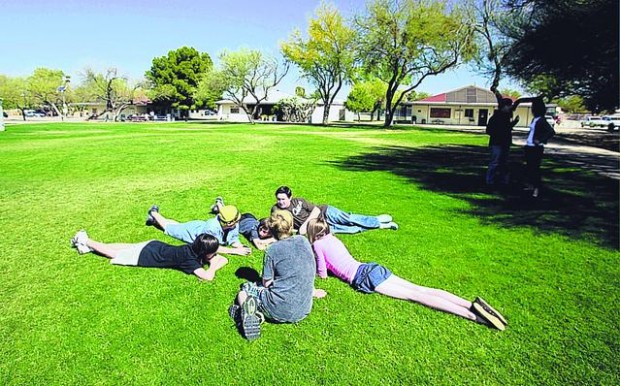
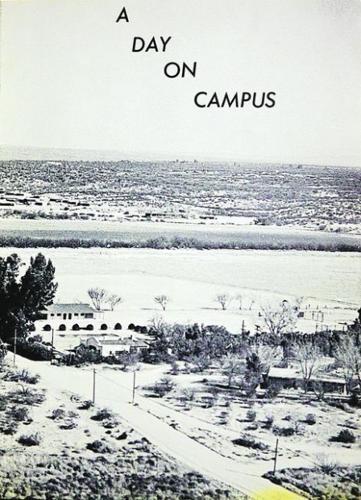
One former student likens it to a time capsule. I couldn't agree more.
Drive down what still looks like a country road, park your car, then amble onto the campus, past classrooms where teachers lecture with the doors wide open.
Been to any schools like that lately? Ones without a guard at the gate and a strict warning to check in first at the office?
Thought not.
"It's amazing. It's absolutely a time machine. The old buildings are still there," says Hayford Peirce, who attended Green Fields Country Day School, as it's now known, in the mid-'50s.
Still standing are the frame and adobe dwellings founder George Atchley started putting up back in 1933, the year he and his wife, Rubie, began what was then known as the Circle Double A, Green Fields Preparatory School for Boys.
People are also reading…
Built in the middle of alfalfa fields at 6000 N. Camino de la Tierra, Green Fields is the oldest K-12 independent school in Arizona, meaning it takes no public money.
"That enables our students and curriculum not to have to teach to the test," says Lori Foster, a former teacher at the school and now its director of development, marketing and alumni.
Her office is inside the home where the Atchleys and some of those initial boarders once lived.
The old bunkhouses have long been converted to classrooms. Meanwhile, today's campus boasts a performance center, gym and library, as well as a geodesic dome built in 1975 by Green Fields faculty and students and University of Arizona students. Today, it's used by art students.
"They raised money to build it with bake sales, horse shows and matching money from the board," says Foster.
Though tuition ranges from $9,500 to $14,200 a year, depending on grade, and many of the school's current crop of 175 students are headed to elite colleges, Green Fields still retains an aura of hands-on learning.
The younger grades at the school maintain a garden and hold a farmers market on the last Friday of the month, says Foster. The older kids have created a solar-powered iPod charger and stereo system.
That's just the sort of inventiveness you'd imagine the Atchleys would have envisioned when as former Tucsonans they returned from Pittsburgh to start up the school.
Aimed at helping boys in middle grades prepare for the nation's top prep schools, such as St. Paul's and Exeter, the school took in five boarders its first year, 24 boarders by 1936.
Among the tiny faculty by then was newly minted English teacher Frederick Baltzell, who would go on to become the school's headmaster, retiring in 1970.
All who learned under him recall how he almost always taught outdoors. "I remember only two or three times we went into the dining room, because it was raining," says Peirce, who attended Green Fields for the eighth and ninth grades before heading off to Exeter.
"Fred Baltzell was one of the best English teachers I ever had, including Exeter and Harvard," says James Pray, who attended Green Fields in 1954-1957 and later came back to chair its English department.
Like Peirce, Pray lived in Tucson but boarded at the school on weekdays. And despite the school's penchant for horseback riding, both detested that activity.
"I went riding until the spring term," says Peirce. "Then I said, 'Hey, I hate this. I want to play baseball.' They let me stop riding."
Adds Pray: "For a few miserable months, I rode. Then I was able to persuade Fred Baltzell I did not want to ride a horse."
He also managed to talk his way out of attending target practice at the school's firing range.
Not so for Don Davidson, who attended Green Fields as a ninth-and 10th-grader in 1953-1955. "I liked it," says Davidson, who took in the rifle range, as well as the riding.
"I'd ride from the school to Westward Look along Orange Grove Road. It was mostly paved. The only trick was crossing Oracle Road."
He, too, sings the praises of Baltzell, as well as the school's academic rigors. "That school just changed my life," says Davidson, who would earn a graduate degree in geosciences from Columbia University.
In 1942, George Atchley died and Rubie named Baltzell as her co-director. In 1947, her sister, Grace Hammarstrom, also a teacher, came to help out. After Rubie Atchley died in 1950, Baltzell and Miss Grace, as everyone called her, carried on.
In 1957, Baltzell bought the school from Miss Grace. In the early '60s, Green Fields became a day school only. And in 1966, girls — wearing mandatory uniforms — were admitted for the first time.
In time, grades were expanded upward and then downward, with Green Fields holding its first high school graduation in 1969.
By the way, Hobo, the school's last horse, died at age 33 in 1999. "He was euthanized on campus, and the students were here," says Foster. "It was a learning experience."
Been to any schools like that lately?
did you know
In 1947, Ted DeGrazia taught art classes and covered the school's corrugated tin hobby shed with murals.